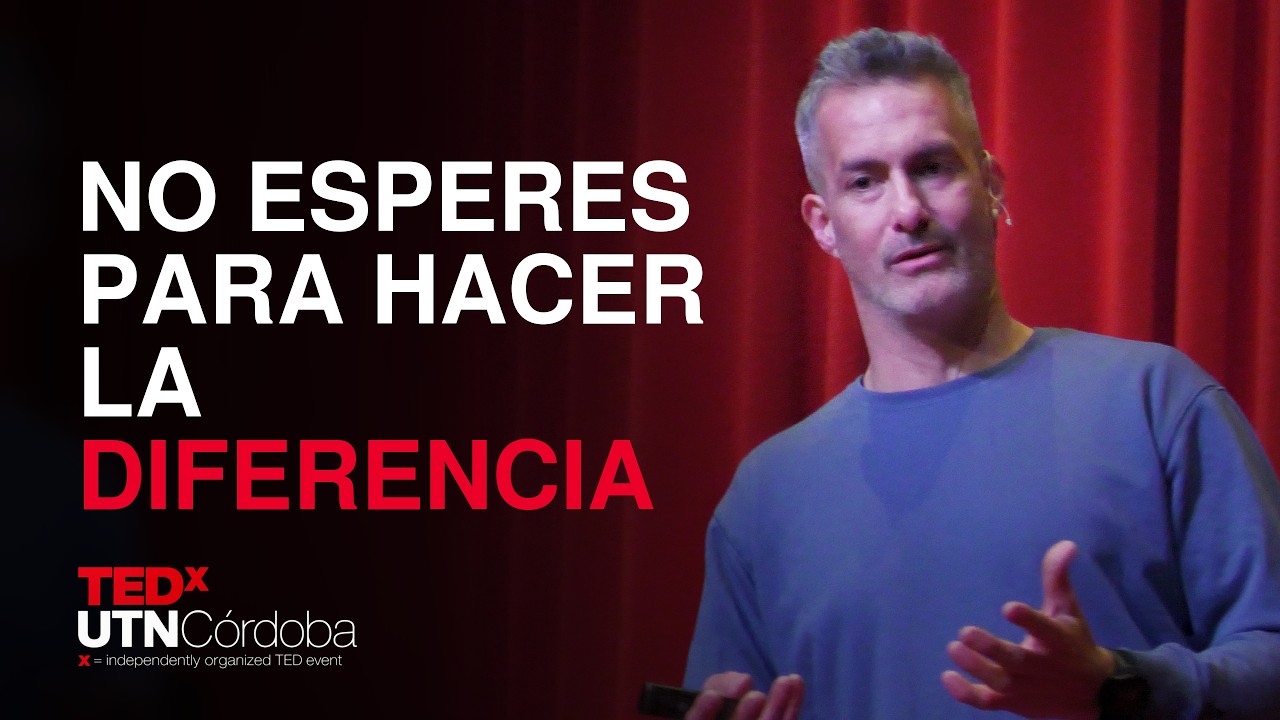
Cuando la tecnología viene al rescate | Claudio Paz | TEDxUTN Córdoba
When Technology Comes to the Rescue | Claudio Paz | TEDxUTN Córdoba
Keywords
Summary
243 words
Critical Evaluation
Value of the Information & Strength of the Argument
The informational value lies less in technical specification than in process: the talk documents a real user-centred design loop between a university lab and professional rescuers, and it is unusually candid about failure. The strongest content is the sequence of concrete constraints and corrections: dust making a capacitive touchscreen inoperable, mud blinding an optical lens and forcing a stop to a joint drill with rescuers, the shift from articulated chassis to tracks and back, and the simple acrylic wiper that solved the fouling problem. Each item is a design lesson that transfers beyond this specific project, and the framing of ’the rescuer brings the problem, the university brings the solution’ is a clear, testable methodology rather than a slogan. The argumentative structure is narrative and inductive: personal history, organisational lineage, then a series of cases, then a moral. That works rhetorically but leaves key claims under-supported. There is no data on how many victims the tools helped locate, no accuracy or detection-rate figures, no comparison with alternative sensing methods such as acoustic or thermal detection, and no discussion of cost, weight, battery endurance or deployment logistics, which are precisely the parameters that decide whether a rescue tool is adopted. The ‘72-hour window’ is presented as an established fact without nuance, although the survival curve is known to vary strongly with injury pattern, climate and access to voids. Physical concepts are handled correctly but at a descriptive level: ’life triangles’ are explained as self-shoring rigid slabs, which is a fair simplification. The closing exhortation to students is motivational rather than evidential, and the implicit claim that learning while doing outperforms preparation is asserted rather than argued. Overall the argumentation is coherent, honest and well-sequenced, but it operates as testimony and persuasion rather than as demonstration.
Scientific Rigor, Source Quality, Title Accuracy
Rigour is moderate. The speaker makes no exaggerated scientific claims and repeatedly marks uncertainty where it exists, explicitly labelling the death-toll figure for the 1985 Mexico City earthquake as non-official; that number is at the high end of the published range and should be treated as an upper estimate rather than a settled count. Beyond that single figure, no statistics, measurements, publications or test reports are cited, and none of the prototypes are characterised by their sensing modality, resolution or field performance, which weakens the engineering value of the account for anyone wanting to assess it. The talk does, however, name real institutional actors and traceable entities: the UTN research centre in informatics for engineering, the React group, and Rescate Internacional Topos with its Argentine cell formed in 2018, all of which are identifiable organisations rather than vague authorities. Dates and events are given precisely enough to be checked, though the internal chronology as spoken is compressed and partly anachronistic in the transcript, so a listener cannot reconstruct a reliable timeline without external verification. The only source supplied in the description is the generic TEDx page, meaning the talk provides no route to primary documentation of the projects themselves. On title fit: the title is accurate and non-sensational, matching a talk genuinely about technology serving rescue work, and it inflates neither the results nor the scope.
535 words
Title / Content Match
The title is a faithful, if generic, description of the content: the whole talk is about university-built robots and cameras placed at the service of search-and-rescue teams. It promises no more than it delivers, though it does not signal the specific engineering angle.
Quality & Reliability
6/10
First-hand account by a named academic researcher about projects he leads, with concrete design details and stated failures, which lends credibility; however the talk contains no quantitative performance data, no peer-reviewed publications, no independently verifiable deployment records, and the only external figure quoted (40,000+ deaths in the 1985 Mexico City earthquake) is explicitly flagged by the speaker as unofficial. The narrative is therefore credible as testimony but weakly documented as evidence.
Key Moments
Markers derived by PSI from the transcript: the creator did not define chapters.
- Opening with footage dated 10 August and an appeal to imagine having family members trapped under rubble without knowing where they are.
- Explanation of the degradation of survival conditions after a collapse and of the informal '72-hour window' of highest survival probability.
- Presentation of the UTN research centre in Córdoba and of React, a group of over 30 students, engineers and researchers building sensors, cameras and robots for emergency response.
- Origin story: the 1985 Mexico City earthquake and the volunteer 'topos' who dug through rubble without training, later professionalised into international rescue teams.
- The 2018 training of Argentine responders by Rescate Internacional Topos and the chance encounter that started the first collaboration with the university lab.
- The problem statement: 'life triangles' formed by self-shoring slabs, the danger of breaching walls blindly, and the need for a camera on a pole to inspect voids safely.
- First borescope prototype tested in an abandoned factory; dust renders the touchscreen useless, and the team learns that laboratory-friendly interfaces fail in the field.
- A joint drill is halted when mud blinds the lens; the fix is a simple acrylic shield the rescuer can wipe with a glove. Introduction of Mustela, a tracked robot for pancake-collapsed buildings.
- Keimber, a vertical inspection camera for looking down deep shafts, is developed as a graduation thesis by former React students.
- Deployment of the borescope and Keimber to a Colombian earthquake response, followed by the closing lesson: listen to rescuers, iterate, and start working before graduating.
Cited Sources
- TEDx — official programme page — The only link provided in the video description; generic reference to the TEDx format and to the independently organised local event at which the talk was given. It is not a reference for the technical content.
- Rescate Internacional Topos (Argentine cell) — Rescue organisation named in the talk, formed in Mexico after the 1985 earthquake and established in Argentina in 2018; it defined the operational requirements for the borescope and requested the equipment for the Colombian deployment. No verifiable URL supplied by the video.
- Centro de Investigación en Informática para la Ingeniería / React (UTN Córdoba) — The speaker's own research centre and the React group, presented as the developer of Borescope, Mustela and Keimber. No project page or publication link is given in the video.
Concurring Sources
- Urban search and rescue — Corroborates the operational context described: overwhelmed local services, international teams requested from neighbouring countries, and prioritisation of the first days after a collapse.
- Rescue robot — Confirms that small tracked and articulated platforms are a recognised class of tool for entering voids in collapsed structures, consistent with the Mustela description.
- Borescope — Confirms the optical principle of the first device described, a camera on a rigid probe used for inspection in confined spaces.
- 1985 Mexico City earthquake — Provides the historical anchor for the origin story and situates the speaker's 'non-official' death toll figure within the published range of estimates.
Contribution & Novelties
The originality of the talk is documentary rather than scientific: it exposes the inside of a humanitarian engineering pipeline, showing how a university group converts an operational complaint from rescuers into hardware, and how many of the decisive design changes come from mundane field conditions (dust on a touchscreen, mud on a lens) rather than from advanced algorithms. The naming of an actual failure loop, plus the detail that one of the deployed tools originated as an undergraduate thesis, gives a concrete, transferable model for problem-based engineering education and for university–civil-society partnerships in disaster response. It also connects contemporary search robotics to a specific and often overlooked lineage, the volunteer ’topos’ of 1985, rather than to a generic narrative of technological progress.
Pour aller plus loin :
- Rescue robot — Overview of the category to which Mustela belongs, including platforms used after structural collapses.
- Borescope — Technical background on the optical instrument the team’s first device was based on.
- Urban search and rescue — Doctrinal context for the ‘72-hour window’ and for the organisation of international rescue teams such as the one described.
- 1985 Mexico City earthquake — Background on the event at the origin of the ’topos’ movement, including the disputed death toll.
- CRASAR (Center for Robot-Assisted Search and Rescue) — reference centre for the deployment of robots in disasters; cited by name only, as no stable URL is asserted here.
- INSARAG guidelines (UN OCHA) — international methodology for urban search and rescue team coordination, useful to situate the rescue-side requirements described in the talk.
256 words
Radar Profile
The profile is that of an experiential engineering talk: information quantity, quality and technical level sit in the middle band, reflecting a narrative built on design anecdotes rather than measurements. Reliability is the strongest axis, driven by first-hand authorship and openly acknowledged failures, while technical depth is capped by the absence of specifications, test results or comparative evaluation.