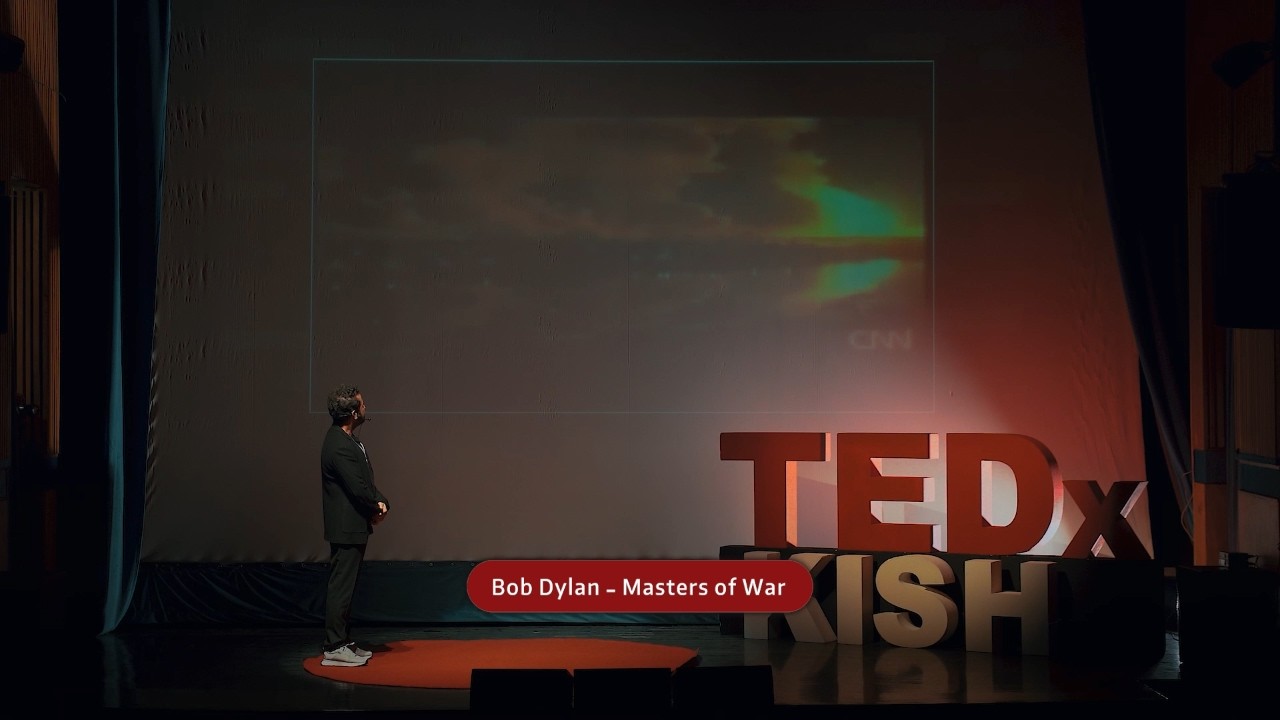
The Role of Art and Artists at Pivotal Moments in Society | Omid Nemati | TEDxKish
Keywords
Summary
318 words
Critical Evaluation
Value of the Information & Strength of the Argument
The informational value lies less in new facts than in the assembly of four well-chosen episodes into a single argumentative line: Shostakovich under siege, the passage from slave songs to the civil-rights movement, Vietnam-era protest music, and the Berlin Wall. Each episode is presented at the level of a vivid anecdote rather than a documented case study — the fire-brigade enrolment, the loudspeakers aimed at the front, the improvised orchestra of retired players, Hendrix on the fourth day, Bowie addressing the East — and these details are what give the talk its argumentative traction. The reasoning is essentially inductive by example: because music played these roles at four critical moments, it should not be silenced in the present crisis. The speaker states the opposing positions fairly (some say music should fall silent out of mourning, others that it should become a slogan) and then answers both with the historical record, which is a reasonable rhetorical structure. The weakest link is causality: the talk demonstrates that music accompanied and expressed social movements, not that it caused them, and the claim that music ‘can create a movement’ is asserted rather than argued. The concluding move is explicitly modest — music will not solve war or poverty, but it prevents people’s whole being from filling with suffering — and this restraint strengthens rather than weakens the case. The personal testimony about concerts held in Tehran under the threat of war gives the abstract argument an evidentiary anchor of a different kind: first-hand experience, clearly signalled as such.
Scientific Rigor, Source Quality, Title Accuracy
No written source, book, archive or study is cited at any point; the historical material is delivered from memory and the only link offered in the video description is the generic TEDx page. Several factual anchors are nonetheless correct and checkable: Shostakovich’s birth in 1906, the four-movement structure of the Seventh Symphony, the 872-day duration of the siege, the 9 August 1942 Leningrad premiere, Hendrix’s solo rendition of the anthem on the fourth day at Woodstock, and Bowie’s 1987 performance at the Wall. Precision drops elsewhere: the symphony is said to have been ‘written in 1941’ without distinguishing composition from premiere, the Soviet state’s reuse of the work is summarized in one sentence with no date, and the American sequence compresses roughly a century of musical history into a few minutes with no intermediate references. The transcript also garbles several proper names and song titles, including the white singer whose rendition of a spiritual-derived song is played as an example, which leaves one illustrative case unidentified. The title is honest about the scope — art and artists at pivotal social moments — and the content matches it; the only gap is that ‘art’ in practice means music almost exclusively, with a brief mention of the speaker’s graphic-design background never developed. The talk is best treated as a well-constructed narrative essay with reliable landmarks and loose sourcing.
495 words
Title / Content Match
The title announces a broad reflection on art and artists at pivotal social moments; the content delivers exactly that, though it is confined almost entirely to music and adds a personal coda on the speaker's own concerts in Tehran.
Quality & Reliability
6/10
Historical landmarks referenced (Shostakovich's Symphony No. 7 and the siege of Leningrad, the blues lineage from work songs and spirituals, the Vietnam-era protest song, Woodstock and Hendrix's anthem, Bowie's 1987 concert at the Berlin Wall) are real and broadly accurate in their outline, but the talk cites no written sources, gives few exact dates, and simplifies several points (the Soviet state's later appropriation of the symphony is mentioned only in passing; names of several songs and one singer are garbled in the transcript). The argument is carried by narrative and personal testimony rather than by documented evidence.
Key Moments
Markers derived by PSI from the transcript: the creator did not define chapters.
- Opening performance excerpt and identification of the work as a movement from Shostakovich's 1941 symphony.
- Shostakovich's youth under Stalin's repression; the anecdote of the packed suitcase kept by artists expecting arrest.
- The siege of Leningrad begins and lasts 872 days; the composer volunteers for the fire brigade.
- Composition of the symphony's movements inside the city, completion after evacuation, and the refusal to premiere it anywhere but Leningrad.
- Recruitment of retired and radio musicians for the 9 August 1942 premiere, with loudspeakers turned toward the front.
- The Soviet state's later appropriation of the work, and Shostakovich's reply that he wrote it for the city, not the regime.
- Transition to the general question: the role of music in social crises, and the current debate over whether music should fall silent or become a slogan.
- American slavery: work songs by day and spirituals by night, gradually absorbing protest and hope, then feeding into the blues and the civil-rights movement.
- The Vietnam era, the rise of rock and pop stardom, Bob Dylan, and John Lennon's peace anthem taken up weeks later at New York demonstrations.
- Woodstock, extended to a fourth day, and Hendrix's solo electric rendition of the national anthem saturated with the sounds of war.
- Divided Berlin, the 1987 concert with speakers aimed east, clashes behind the Wall, and Bowie greeting those on the other side.
- Personal conclusion: Tehran concerts under threat of war, a song written during a night of bombardment, and friends dancing in a small apartment.
Cited Sources
- TEDx — official programme page — The only link in the video description; generic reference to the TEDx format, not a documentary source for any of the historical claims.
Concurring Sources
- Symphony No. 7 (Shostakovich) — Wikipedia — Confirms the four movements, the composition spanning the siege, the 9 August 1942 Leningrad premiere by the Radio Orchestra under Karl Eliasberg, and the loudspeaker broadcast toward the German lines.
- Siege of Leningrad — Wikipedia — Confirms the duration of the siege at roughly 872 days, matching the figure given in the talk.
- Dmitri Shostakovich — Wikipedia — Corroborates the 1906 birth date and the composer's constrained position under Stalin.
- Blues — Wikipedia — Supports the claimed descent of the blues from African-American work songs and spirituals.
- Woodstock — Wikipedia — Confirms the 1969 festival, its unplanned fourth day and Hendrix's solo performance of the American national anthem.
Contribution & Novelties
The talk’s originality is not documentary but compositional: it places a Persian musician’s own wartime experience in continuity with four canonical episodes of Western and Soviet musical history, and it lands on a position that escapes the usual binary — music should neither fall silent out of respect for mourning nor be reduced to slogan, but should do its own work of narration and accompaniment. The Shostakovich segment is the strongest: the detail of the loudspeakers turned toward the front, and the composer’s rejection of the state’s retrospective claim on the symphony, give the argument a concrete case of a work whose meaning was contested by the power that later celebrated it. The closing testimony — a group dance in a small apartment while the city was being hit — is the one genuinely new element the speaker brings, and it functions as a counter-example to the demand that art stop during a crisis.
Further reading (Pour aller plus loin):
- Symphony No. 7 (Shostakovich) — Background on the ‘Leningrad’ Symphony, its composition and its 1942 premiere; directly underpins the opening third of the talk.
- Siege of Leningrad — Chronology and casualty figures for the 872-day blockade invoked by the speaker.
- Blues — Origins of the genre in African-American work songs, field hollers and spirituals, the lineage the talk sketches.
- Woodstock — The 1969 festival, its extension to a fourth day, and Hendrix’s closing set.
- Work song — On the labour songs the speaker describes as the earliest layer of the tradition.
- Shostakovich’s Eighth Quartet and the doctrine of socialist realism — useful context on the pressure exerted on Soviet composers, a theme the talk touches but does not develop.
- The ‘Concert for Berlin’ of June 1987 and the political afterlife of Bowie’s Berlin-period recordings — relevant to the segment on divided Berlin.
302 words
Radar Profile
The profile is markedly asymmetrical: information quantity and quality sit at a solid mid-level, technical density is low as expected for a narrative talk, and overall reliability is held back by the complete absence of cited sources rather than by any demonstrable factual error. The result describes a persuasive, well-structured cultural essay whose strength is synthesis and whose weakness is verifiability.