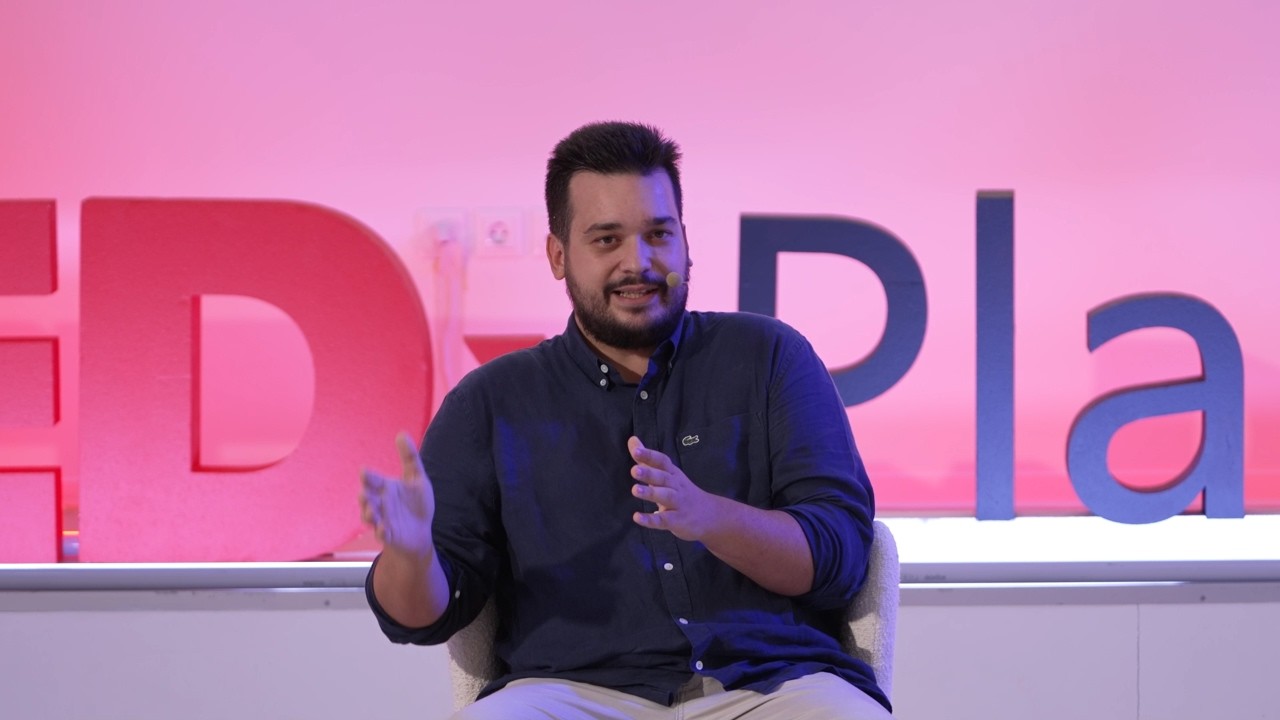
Η αειφορία και το μέλλον είναι υπό διαπραγμάτευση; | Βασίλης Αγγελόπουλος | TEDxPlaka
Is sustainability and the future under negotiation? | Vasilis Angelopoulos | TEDxPlaka
Keywords
Summary
242 words
Critical Evaluation
Value of the Information & Strength of the Argument
The talk provides value by framing sustainability not as a technical or purely environmental issue, but as a social and political negotiation involving multiple stakeholders with divergent interests. The argumentation is built on a logical structure: defining the concept, mapping the negotiation levels, presenting empirical data from a survey, and using personal anecdotes to illustrate systemic challenges. While the survey is not described in detail (sample size, methodology), it serves as a concrete touchpoint. The speaker’s experience in EU-level youth negotiations adds credibility. However, the reasoning sometimes relies on generalities (‘all stakeholders’, ‘different priorities’) without deep analysis, and the call to include ‘all voices’ remains somewhat idealistic without concrete policy proposals. The strength lies in raising important questions about representation and the ‘how’ of sustainability, rather than providing definitive answers.
Scientific Rigor, Source Quality, Title Accuracy
The scientific rigor is moderate. The talk is based on personal experience and a survey, but no specific sources or publications are cited. The only external reference is the general TEDx page. The title is precise: ‘Is sustainability and the future under negotiation?’ directly addresses the talk’s thesis. The content matches the title, exploring the negotiability of sustainability and the future. However, the talk does not engage with academic literature or provide verifiable data, limiting its scientific depth. The absence of citations undermines the ability to verify the claimed survey results. Still, the logical consistency and the speaker’s expertise in sustainability offer some assurance.
249 words
Title / Content Match
The title accurately reflects the central theme of negotiation around sustainability and the future.
Quality & Reliability
7/10
The talk presents a personal perspective on sustainability negotiations, supported by anecdotal experience and one survey. While not a rigorous scientific study, it raises valid points about stakeholder representation and the importance of the 'how' in sustainability. Claims are not extensively sourced, but the reasoning is coherent.
Key Moments
Markers derived by PSI from the transcript: the creator did not define chapters.
- Definition of 'aeiforia' and its temporal dimension.
- Introduction of ESG as the language of sustainability.
- Presentation of survey results on consumer willingness to pay.
- Anecdote about whether youth should be a special stakeholder group.
- Conclusion on time and the importance of inclusive participation.
Cited Sources
- TEDx Talks — General TEDx page providing information about the TEDx format.
Contribution & Novelties
The talk’s original contribution lies in framing sustainability as an ongoing negotiation among stakeholders, emphasizing that while goals are agreed upon, the methods and power dynamics are contentious. It introduces survey data from Greece and personal insights from EU-level processes, offering a practitioner’s perspective on the challenges of representing diverse voices. It also highlights the often-overlooked question of how sustainability is implemented, not just whether it should be pursued.
Pour aller plus loin :
- Environmental, social, and governance (ESG) — Foundational concept in sustainability reporting, relevant to the talk’s discussion of ESG as a language.
- Intergenerational equity — Ethical principle central to the definition of sustainable development as not mortgaging the future.
- Youth participation — The talk’s call for including youth in decision-making aligns with this concept.
127 words
Radar Profile
The profile shows moderate scores across the board, with quality and fiability slightly higher than quantity and technical level. This suggests a talk that is intellectually coherent and credible in its arguments, but with limited depth in terms of data and technical detail. The emphasis on qualitative reasoning and personal experience over quantitative evidence is clearly reflected.