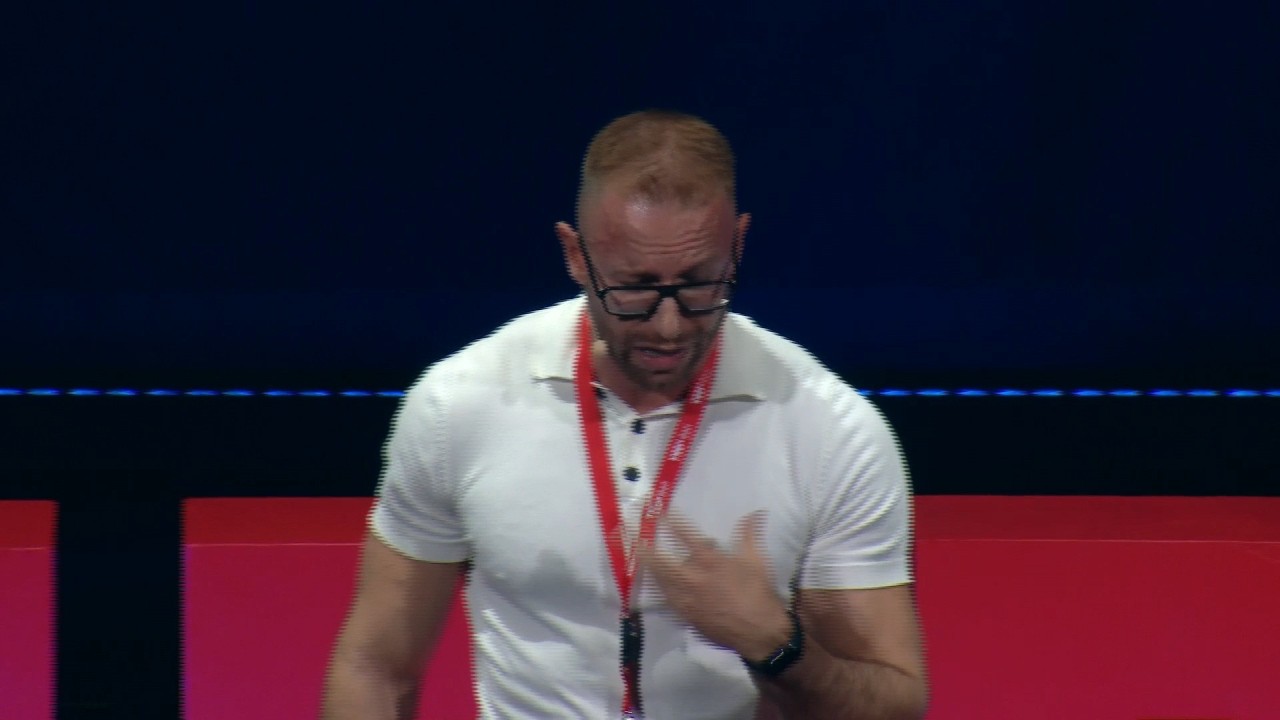
Il paradosso della vulnerabilità. Ammettere le debolezze ci rende forti | Immanuel Casto | TEDxBari
The paradox of vulnerability. Admitting weaknesses makes us strong | Immanuel Casto | TEDxBari
Keywords
Summary
247 words
Critical Evaluation
Value of the Information & Strength of the Argument
The informational value lies less in novelty than in the compression of a coherent set of epistemic and rhetorical virtues into a memorable, operational checklist. Each of the twelve items follows the same template — the fear, the reason the fear is misplaced, and the benefit actually produced — which makes the argument easy to apply and easy to test against one’s own behaviour. The strongest reasoning concerns quantifiers: the claim that universals are far easier to falsify than hedged statements, and that hedging therefore strengthens rather than weakens a position, is a correct and non-trivial point about how claims survive scrutiny; it also implicitly corrects the common confusion between rhetorical force and argumentative robustness. The distinction between self-confidence as the absence of error and self-confidence as a reasonable expected value over a body of work including mistakes is likewise well framed. The weakest points are the ones most asserted rather than argued: the evolutionary claim that being perceived as strong is advantageous is invoked and immediately shelved; the assertion that others are usually wondering the same thing when you ask a ‘stupid’ question is plausible but unexamined; and the psychological mechanism behind ‘slow thinking’ is gestured at through a vague reference to survival biases rather than developed. The closing caveats are what give the talk its intellectual honesty: the speaker concedes that the advice is not an algorithm, that repetition inverts the effect, and that in asymmetric or bad-faith settings the same behaviour can be punished for some and rewarded for others. That qualification is stated rather than resolved — the talk identifies the context-dependence of vulnerability without offering criteria for judging when to reveal it, which remains the central unsolved question. Overall the argumentation is clear, structured and self-aware, but it is persuasive reasoning from experience, not demonstration.
Scientific Rigor, Source Quality, Title Accuracy
No source, study, author or dataset is cited at any point; the only external reference in the accompanying material is the generic TEDx site, and the speaker’s own book is mentioned in the description rather than in the talk. The intellectual tools he uses are named informally — ‘principle of charity’, ‘slow thinking’, ‘falsifiability’ in substance though not by name — without attribution, which is acceptable for a short talk but means the audience has no way to verify or deepen any claim. The general shape of the argument is consistent with established work on charitable interpretation, on the vulnerability of universal claims to counter-examples, and on dual-process accounts of reasoning, but none of this is made explicit, so the reliability of the content rests entirely on the audience’s trust in the speaker’s personal and professional standing. The title is faithful to the content: the paradox announced is exactly the one developed, and the twelve items are delivered as promised, without digression beyond a clearly signposted closing caveat. No advertising sequence was present in the recording.
491 words
Title / Content Match
The title is fully consistent with the content: the entire talk is built around the paradox that admitting weakness, ignorance or error signals strength rather than fragility.
Quality & Reliability
5/10
The talk is internally coherent and its reasoning is often sound (falsifiability, steelmanning, disclosure of interests), but it rests entirely on the speaker's personal and professional experience. No empirical data, no study, no named author or reference is cited; the twelve behaviours are presented as a reasoned heuristic, not as validated findings, and the speaker himself explicitly limits the scope of his advice (measure, context, bad faith, toxic workplace cultures).
Key Moments
Markers derived by PSI from the transcript: the creator did not define chapters.
- Opening caveat about his voice sounding peremptory, followed by the framing question: why we instinctively want to appear strong in a performative, competitive, polarized society.
- Start of the list — item 1: asking a 'stupid' question and saying 'I didn't understand' positions you as someone who values clarity over appearances.
- Item 2: saying 'I don't know' and committing to find out is more credible than improvising a confused answer.
- Item 3: admitting error — intellectual honesty exists, infallibility does not; confidence is an expected value over a body of work, not the absence of mistakes.
- Item 4: cautious quantifiers — absolutes are rhetorically satisfying but trivially falsifiable by a single counter-example, so hedging strengthens the thesis.
- Items 5 and 6: acknowledging the limits of one's discipline, and changing one's mind publicly when new information arrives — valuing truth over vanity.
- Items 7 and 8: asking for help, and taking time before responding to a provocation or a social-media comment, linked to slow versus automatic thinking.
- Shift to polarized debate — items 9 and 10: conceding a valid point to the opponent, and criticizing one's own faction despite the risk of being branded a traitor.
- Items 11 and 12: the principle of charity, i.e. engaging the strongest version of the opposing thesis, and disclosing one's own interests to end speculation.
- Closing caveats: measure matters, the framework presupposes good faith, and in punitive corporate cultures vulnerability is a privilege of those already in power.
- Conclusion: the most authoritative voice in the room is increasingly the one that admits doubt, and these small self-questionings are also opportunities for growth.
Cited Sources
- TEDx — official programme page — Generic TEDx reference given in the description to explain the independently organized TED format; the only external link provided with the video, no specific study or author is cited in the talk itself.
Concurring Sources
- Principle of charity — General philosophical background supporting the talk's eleventh item: interpreting an opponent's claim in its most reasonable form.
- Falsifiability — Supports the reasoning behind the fourth item on cautious quantifiers and the vulnerability of absolute statements.
- Dual process theory — Framework underlying the distinction between automatic, reactive responses and deliberate, slower reasoning invoked in item 8.
Contribution & Novelties
The original contribution is not a new finding but an operational reframing: the talk converts a diffuse intuition (‘showing vulnerability is a strength’) into a checklist of twelve specific, nameable micro-behaviours, each paired with the fear it triggers and the credibility it actually buys. Two elements stand out as more than reformulation. First, the argument that cautious quantifiers are an epistemic rather than a rhetorical device — that ‘many’ is harder to falsify than ‘all’, and that this makes a hedged claim stronger, not weaker. Second, the closing asymmetry: in hierarchical or punitive environments, the person already holding power can afford to admit error and gain reputation, while the subordinate cannot — so the advice is explicitly not universal, which is where most popular treatments of vulnerability stop short.
Further reading:
- Principle of charity — Background on the interpretive norm the speaker recommends for engaging opposing views (item 11).
- Falsifiability — Conceptual basis for the argument that universal claims collapse on a single counter-example, whereas hedged claims survive (item 4).
- Dual process theory — The slow/fast thinking distinction the speaker invokes, without naming it, to justify taking time before responding (item 8).
- Steelmanning — present the adversary’s position in its strongest form; the explicit practice behind the ‘principle of charity’ item, cited by name rather than by URL.
- Mensa Italia — the organization the speaker presided over from 2019 to 2023, mentioned in the description as part of his background rather than as a source.
245 words
Radar Profile
The profile is deliberately balanced: a high density of usable information and coherent reasoning, paired with a low technical level and no verifiable sourcing, since the talk is an essay rather than an exposition of research. Reliability sits mid-scale because the claims are plausible and honestly qualified but never evidenced. The result is a consistent, well-argued piece of applied social reasoning rather than a technical or empirical one.