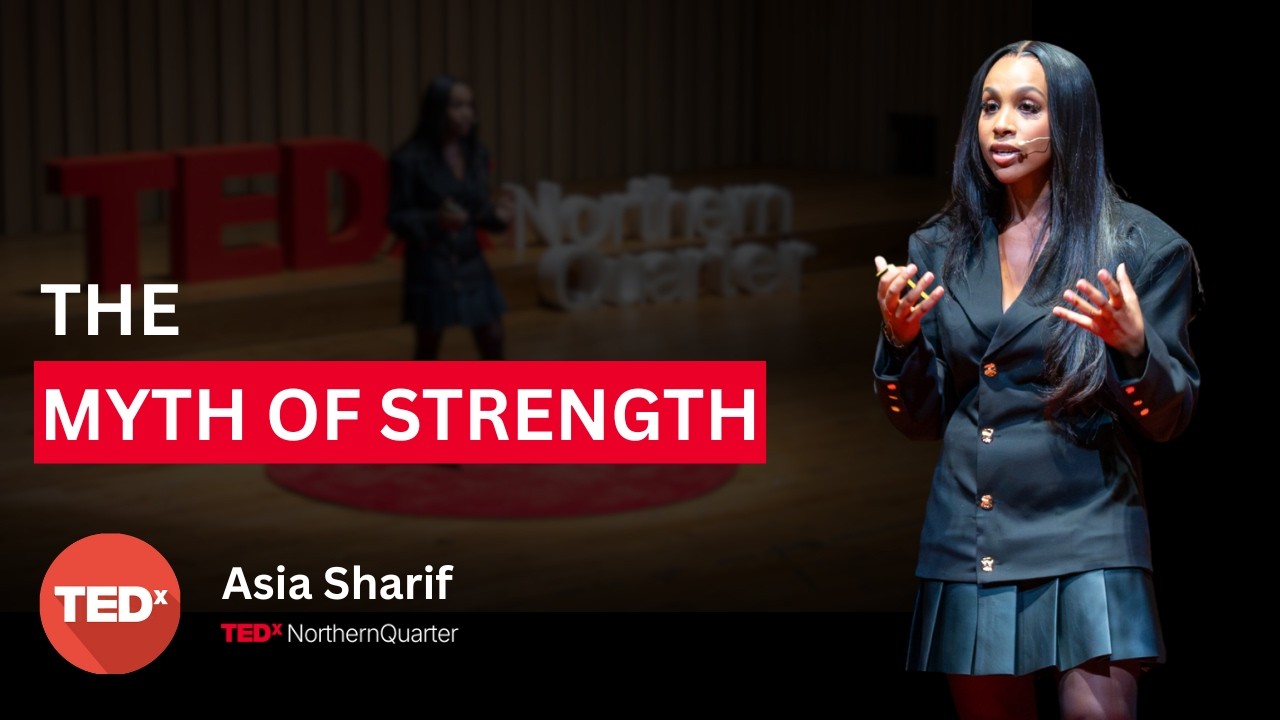
The myth of strength | Asia Sharif | TEDxNorthern Quarter
Keywords
Summary
269 words
Critical Evaluation
Value of the Information & Strength of the Argument
The informational value of this talk lies primarily in its framing rather than in new factual content. Its central proposition — that societies reward the performance of pain and mistake emotional suppression for strength — is a coherent and widely discussed thesis in psychology and mental-health communication, and the speaker gives it force through a concrete, internally consistent personal chronology. The argument is built on a rhetorical structure: an opening question to the audience, a literary quotation, a personal narrative arc from constructed invulnerability to collapse to reconstruction, and a closing analogy drawn from structural engineering. The engineering analogy is the most substantive argumentative move: the claim that structures are deliberately designed to flex and sway under load, and that we do not call a bridge weak for moving, is used to reframe strength as adaptation rather than endurance. This is a metaphor rather than a demonstration — it does not establish that human emotional flexibility operates by the same principles as structural compliance — but it is deployed clearly and does not overreach into false technical claims. The three prescriptive steps (notice the mask, tell one truth, allow support) are practical and internally consistent with the thesis, though they are asserted rather than derived from any therapeutic framework or outcome data. The narrative contains specific, checkable anchors — age at diagnosis, cancer type, hospital, heritage, treatment path — which lend it credibility as testimony. What the talk does not do is quantify, compare, or test its claims: there is no discussion of research on emotional suppression, help-seeking behaviour, or masculinity and distress, and no engagement with counterarguments or boundary conditions. Its value is therefore motivational and conceptual rather than evidential, and it should be read as a persuasive personal essay rather than as a scientific contribution.
Scientific Rigor, Source Quality, Title Accuracy
Scientific rigour is low by design: this is a TEDx personal narrative, not a research presentation. No studies, statistics, or expert sources are cited in the transcript. The only explicit attribution is a quotation from the poet Paul Laurence Dunbar (’the mask that grins and lies’), which is correctly attributed and used appropriately. Named entities — the Christie Cancer Hospital in Manchester, a consultant referred to as Professor Adrien Blur, and the diagnosis of stage 4 classical Hodgkin lymphoma — are specific enough to be verifiable in principle, though no documentation is provided. The description’s only non-promotional link is the generic TEDx programme page (https://www.ted.com/tedx) , which is not a source for any claim made in the talk. The stem cell appeal outcomes (thousands of responses, hundreds of registrations, two donors) are asserted without reference to any register, campaign, or news report. On title/content adequacy: the title ‘The myth of strength’ is an accurate and faithful summary of the talk’s thesis, and the content delivers exactly what the title promises. No viewer comments were supplied for analysis.
489 words
Title / Content Match
The title 'The myth of strength' matches the content precisely: the entire talk deconstructs the conflation of emotional suppression with strength and reframes strength as vulnerability and adaptation.
Quality & Reliability
5/10
The talk is a first-person narrative grounded in verifiable personal experience (stage 4 classical Hodgkin lymphoma, relapses, autologous stem cell transplant, remission), delivered in a TEDx format with named institutions (Christie Cancer Hospital, Manchester) and a named consultant. However, it offers no citations, no data, no peer-reviewed references, and no methodological framing; the claims about 'performing pain', societal reward of suffering, and the engineering analogy of flexible structures are rhetorical and interpretive rather than evidenced. The stem cell register appeal and its outcomes (thousands responding, hundreds joining, two donors) are asserted without documentation. Reliability is therefore moderate: credible as lived testimony, weak as evidence-based science communication.
Key Moments
Markers derived by PSI from the transcript: the creator did not define chapters.
- Opening question: how many have been called strong while falling apart; the claim that society rewards people for how well they perform pain.
- Reference to Paul Laurence Dunbar's 'mask that grins and lies' and the observation that social media now provides better lighting and filters for the same mask.
- Biographical background: entering the UK foster system at 14, instability and chaos, and the turn to structure as a survival strategy.
- Building a 'strong life': self-taught coding during lockdown, award-winning software engineer, mentor, first home at 27.
- Onset of symptoms in 2021 — itching, swollen lymph nodes, weight loss, night sweats — and 18 months of self-reassurance.
- Diagnosis at 24 of stage 4 classical Hodgkin lymphoma at the Christie Cancer Hospital in Manchester.
- The weight of being called strong during treatment: performing strength on social media while breaking internally.
- Relapses and the search for a stem cell donor, complicated by mixed Somali-Moroccan heritage.
- The televised appeal for donors, the decision to ask for help, and the response of thousands worldwide.
- Remission and autologous stem cell transplant; the reframing of the myth as believing one must face it alone.
- Engineering analogy: skyscrapers sway, bridges flex, wings bend — strength as adaptation, not rigidity.
- Three practices: notice the mask, tell one truth, allow support; closing question 'How are you really?'
Cited Sources
- TEDx programme page — The only non-promotional link in the description; it documents the TEDx format and the independently organised local event context, but is not a source for any factual claim made in the talk.
- Paul Laurence Dunbar — 'We Wear the Mask' — Quoted in the talk ('the mask that grins and lies'); the poem is the sole explicit literary attribution in the transcript.
Concurring Sources
- Psychological resilience — Wikipedia — Supports the talk's reframing of resilience as adaptive flexibility rather than rigid endurance.
- Emotional suppression — Wikipedia — Provides the psychological grounding for the critique of rewarding the performance of pain.
- Help-seeking — Wikipedia — Corroborates the claim that asking for help is a functional coping strategy rather than a failure of strength.
Contribution & Novelties
The talk’s original contribution is not scientific but conceptual and rhetorical: it reframes resilience away from endurance and self-sufficiency and toward adaptation, help-seeking, and the capacity to receive support without apology. Its most distinctive move is the transfer of a structural-engineering principle — that load-bearing structures are deliberately designed to flex, sway, and bend rather than remain rigid — onto emotional life, using the speaker’s own professional identity as a software engineer to make the analogy feel native rather than decorative. The narrative also adds a specific and less commonly heard dimension: the difficulty of finding a stem cell donor match for patients of mixed heritage, illustrated by the speaker’s Somali-Moroccan background, and the observation that a public act of vulnerability produced donor registrations benefiting patients other than herself. The three-step framework (notice the mask, tell one truth, allow support) is a compact, actionable distillation rather than a novel therapeutic model.
Pour aller plus loin :
- Emotional suppression — Overview of the psychological construct the talk critiques under the label of ‘performing strength’.
- Psychological resilience — Background on resilience as adaptation rather than endurance, the talk’s central reframing.
- Hodgkin lymphoma — Clinical context for the stage 4 classical Hodgkin lymphoma diagnosis described.
- Hematopoietic stem cell transplantation — Explains autologous versus allogeneic transplants and donor matching constraints.
- Anthony D. Ong et al., ‘Psychological resilience, positive emotions, and successful adaptation to stress’ (JPSP, 2006) — Empirical work on resilience as flexible adaptation to stress.
- Help-seeking behaviour — Concept directly underlying the talk’s call to ’tell one truth’ and ‘allow support’.
- DKMS — International stem cell donor registry relevant to the donor-matching appeal described.
271 words
Radar Profile
The profile is dominated by low technical depth and moderate informational density, reflecting a personal narrative rather than an analytical exposition. Reliability and information quality sit at the midpoint: the testimony is specific and internally coherent, but unsupported by citations or data. The overall shape is that of a persuasive motivational talk with a clear thesis and a memorable framing device, not an evidence-driven briefing.