A World Without Equality | Brandon Tupchong | TEDxPWHS Youth
Keywords
Summary
269 words
Critical Evaluation
Value of the Information & Strength of the Argument
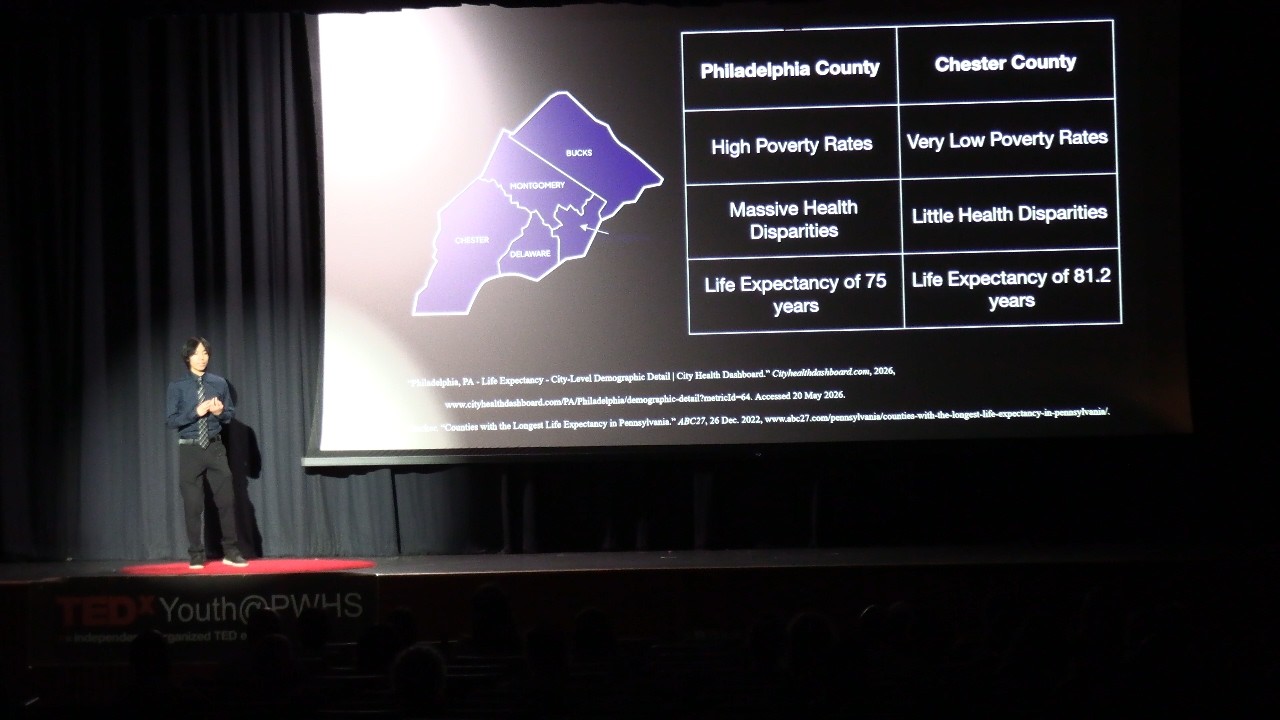
The informational value lies in the pedagogical assembly of a coherent causal chain that is often scattered across specialised literature: birthplace → income and socioeconomic status → housing, neighbourhood environment, food access and public-service spending → chronic stress and allostatic load → cardiovascular and metabolic disease → differential life expectancy. The pairing of a macro-level comparison (countries) with a micro-level comparison (two Pennsylvania counties) is a genuinely useful rhetorical device, because it shows that the gradient is not an artefact of comparing rich and poor nations but reproduces itself inside a single wealthy state. The physiological passage on allostatic load is the most substantive technical contribution: it names a real construct and sketches a plausible mechanism (stress hormones, inflammation, vascular stiffening, reduced coronary oxygen flow) rather than simply asserting that stress is bad. The argument is weakest where it moves from description to prescription. The causal language is consistently stronger than the evidence offered — ‘recent researchers have proven a strong correlation’ is asserted without a study, and correlation is repeatedly spoken of as if it settled causation, notably when income is treated as the lever and health as the effect, with no discussion of reverse causality (poor health depressing income) or of confounders such as education, genetics and health-system design. The counter-case is never engaged: countries with similar income per head but very different health outcomes, or the well-documented limits of income as a predictor once a threshold is crossed. The solutions section is a list rather than an argument — six WHO headings are enumerated but none is costed, sequenced or tested against evidence of effectiveness, and the closing appeal to volunteering, food banks and awareness-raising sits at a different scale from the structural determinants the talk has just identified. The speaker also concedes early that full health equity is ‘unrealistic’, which quietly undercuts the urgency of the prescriptions that follow. Overall: a well-organised explanatory argument with a sound conceptual spine, but an evidential base that is gestured at rather than demonstrated.
Scientific Rigor, Source Quality, Title Accuracy
Sourcing is the talk’s clear weak point. The only institution named is the World Health Organization, quoted for the definition of health equity and for the policy recommendations; everything else — the mortality ratios, the life-expectancy projections, the ‘90%’ attribution, the county income and life-expectancy figures — arrives without a dataset, report or author attached. Several statements are numerically loose or verbally garbled (‘a 1 in 10 chance of passing away before the age of poverty’), which leaves the listener unable to reconstruct the exact indicator being used. The three-country table and the Pennsylvania comparison are presented without units, years or definitions, so the per-capita GDP and income figures cannot be traced or dated. The talk does handle one conceptual trap with real rigour: it explicitly rejects biological-race explanations for health disparities and reframes them as socioeconomic, which is the correct reading of the epidemiological literature and a meaningful guard against a common misreading. It also correctly identifies social determinants as non-medical factors, which shows the framework has been understood rather than merely quoted. But the assertion that non-medical factors contribute ‘up to 90% of all human health outcomes’ is deployed as settled fact; the underlying estimates vary substantially depending on which factors are counted and how, and the talk does not acknowledge that range. Regarding title and content: the title promises a reflection on a world without equality, while the body delivers a survey of health inequality and a policy checklist — related, but the framing oversells what follows by a modest margin.
603 words
Title / Content Match
The title's framing ('a world without equality') is broader and more dramatic than the content, which is a factual overview of global health disparities rather than a thought experiment about a world without equality. The mismatch is modest: the subject matter is genuinely equality in health.
Quality & Reliability
5/10
The talk rests on a legitimate and well-established framework (WHO's social determinants of health and health-equity agenda) and its headline figures are broadly in line with public data (large life-expectancy gap between Japan and Nigeria, ~13x under-5 mortality gap between low- and high-income countries, Pennsylvania county gaps). However, the figures are delivered without naming the underlying datasets, several numeric statements are imprecise or garbled in delivery, one attribution ('up to 90% of health outcomes') is stated as fact without a source, and the proposed remedies are a restatement of WHO recommendations rather than an argued, evidenced programme. Solid orientation material, weak traceability.
Key Moments
Markers derived by PSI from the transcript: the creator did not define chapters.
- Opening thought experiment: the same individual born in suburban America, in Nigeria or in Japan.
- Core mortality figures: roughly 1 in 10 deaths before age five in Nigeria versus 1 in 500 in Japan, and a 13-fold gap between low- and high-income countries.
- The projected ~30-year life-expectancy gap between Japan and Nigeria, and the two questions framing the rest of the talk.
- WHO definition of health equity, and the speaker's own concession that full equity is an unrealistic target.
- Introduction of the social determinants of health as non-medical factors, with the claim that they drive up to 90% of health outcomes.
- Income as the primary determinant: socioeconomic status, housing, neighbourhood safety and spending on public services.
- Food deserts and the neighbourhood-level cycle by which poor residents concentrate in undesirable locations and lose political leverage.
- Comparative tables: South Sudan, Brazil and Switzerland, then Philadelphia County (~$39,000 income, ~75 years) against Chester County (~$110,000, 81.2 years).
- Allostatic load explained: chronic stress, inflammation, calcium deposition, vascular stiffening and cardiovascular risk.
- Explicit rejection of biological race explanations, reframing racial health gaps as socioeconomic.
- The six WHO recommendations: equity-based system redesign, primary care, structural discrimination, women in the workforce, universal coverage, rural health.
- Closing call to individual and community action, and to assistance from wealthy to less wealthy countries.
Cited Sources
- World Health Organization — health equity definition and policy recommendations — The only institution named in the talk; it is the source of the definition of health equity and of the six recommended actions presented in the final third.
- TEDx — independently organised TED-format events — Link provided in the video description, documenting the TEDx format under which the talk was delivered and disclaiming formal TED curation.
Concurring Sources
- World Health Organization — Social determinants of health — Institutional statement of the framework the talk relies on: non-medical factors shaping health outcomes and health inequities.
- Whitehall Study — Supports the talk's central claim that a socioeconomic gradient in health exists within a single wealthy population, independent of absolute poverty.
- Allostatic load — Corroborates the physiological passage on cumulative stress, inflammation and cardiovascular risk.
Contribution & Novelties
The talk’s contribution is not new evidence but accessible synthesis: it assembles a single causal narrative running from birthplace through income, neighbourhood environment and food access to chronic stress physiology and, finally, to life expectancy. Two elements are more distinctive than the rest of the material. First, the pairing of a cross-national comparison with an intra-state comparison of two adjacent Pennsylvania counties, which makes the income-health gradient tangible for an audience that might otherwise treat global disparities as a distant phenomenon. Second, the move from sociology to physiology via allostatic load, which supplies a mechanism rather than a mere correlation and carries the argument beyond the usual ‘poverty is bad for health’ register. The talk’s explicit refusal of biological explanations for racial health gaps is also worth noting as a corrective framing, even though it is not original.
Pour aller plus loin :
- Social determinants of health (Wikipedia) — Background for the framework the talk uses as its spine, including the WHO Commission on Social Determinants of Health.
- Health equity (Wikipedia) — Clarifies the concept the speaker quotes, and why ’equity’ differs from ’equality’ of access.
- Allostatic load (Wikipedia) — The construct behind the talk’s stress-physiology passage; useful to judge how far the presented mechanism is supported.
- Whitehall Study (Wikipedia) — Michael Marmot’s civil-servant cohort studies, the classic evidence for a social gradient in health within a single wealthy population.
- Food desert (Wikipedia) — Background for the neighbourhood food-environment argument, a contested but widely used concept.
246 words
Radar Profile
The profile is lopsided: information quantity and overall reliability sit at a moderate mid-range, while technical depth is markedly lower, reflecting a synthesising talk with little methodological detail. Quality of information tracks reliability closely, so the shape indicates breadth without corresponding depth or traceability.