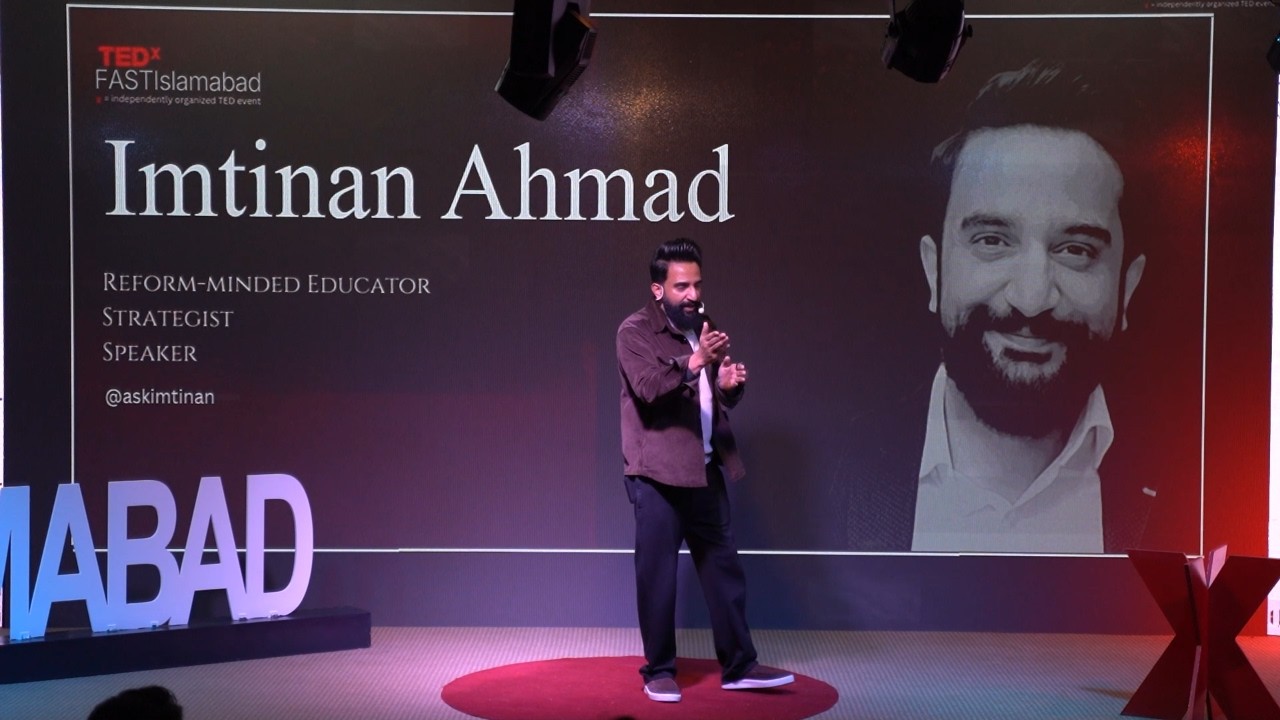
Questioning Education, Work, and Purpose | Imtinan Ahmed | TEDxFASTIslamabad
Keywords
Summary
185 words
Critical Evaluation
Value of the Information & Strength of the Argument
The talk offers valuable insights into the importance of questioning and self-awareness. The argumentation is persuasive through rhetorical devices and religious references, but lacks empirical evidence. The speaker’s claim that ‘you are not your thoughts’ is a philosophical stance rooted in Islamic tradition, presented without scientific backing. The discussion on media and education is critical but general. Overall, the talk is more inspirational than analytical.
Scientific Rigor, Source Quality, Title Accuracy
The talk references several intellectual figures including Allama Iqbal, Bulleh Shah, and Ibn Qayyim, but provides no specific citations or URLs. The only source provided is the general TEDx page. The title accurately reflects the themes of questioning education, work, and purpose. The speaker’s self-identification as a conspiracy theorist might undermine trust. The talk lacks rigorous sourcing and relies heavily on personal anecdotes and poetry.
145 words
Title / Content Match
The title accurately reflects the content: the speaker systematically questions education, work, and purpose throughout the talk.
Quality & Reliability
5/10
The talk is an inspiring and opinionated speech that raises valid concerns about education and media, but it relies on personal anecdotes, religious references, and rhetorical devices rather than empirical evidence or rigorous sourcing. The speaker self-identifies as a conspiracy theorist, which further reduces reliability.
Key Moments
Markers derived by PSI from the transcript: the creator did not define chapters.
- Speaker introduces himself and shares his university memories, setting the tone for reflection.
- Begins discussing the 'deception of knowledge' and questions the education system's effectiveness.
- Criticizes media for distracting the public and introduces the 'genocide of presence' concept.
- Conducts the 10-second thought exercise, emphasizing that we are not our thoughts.
- Gives the takeaway message about heeding the call to prayer and questioning everything.
Cited Sources
- TEDx Program — The talk was given at a TEDx event, and the link provides general information about the TEDx program.
Contribution & Novelties
The talk’s original contribution lies in blending Islamic philosophy with modern critiques of education and media. The speaker introduces the concept of ‘genocide of presence’ and uses a thought experiment to illustrate that we are not our thoughts, drawing on Ibn Qayyim’s analysis. This synthesis offers a fresh perspective for audiences seeking purpose beyond conventional metrics.
Pour aller plus loin :
- Ibn Qayyim al-Jawziyya — The Islamic scholar whose ideas about self-awareness and thought observation are referenced in the talk.
- Mindfulness — The practice of being present, which aligns with the speaker’s call to live in the moment.
- TEDx Program — The platform that hosts such talks, providing a general context for the presentation.
114 words
Radar Profile
The radar profile shows a talk that is moderately informative (7/10) but less rigorous in reliability (5/10) and technical depth (4/10). The strength lies in the quantity of ideas presented rather than their verification.