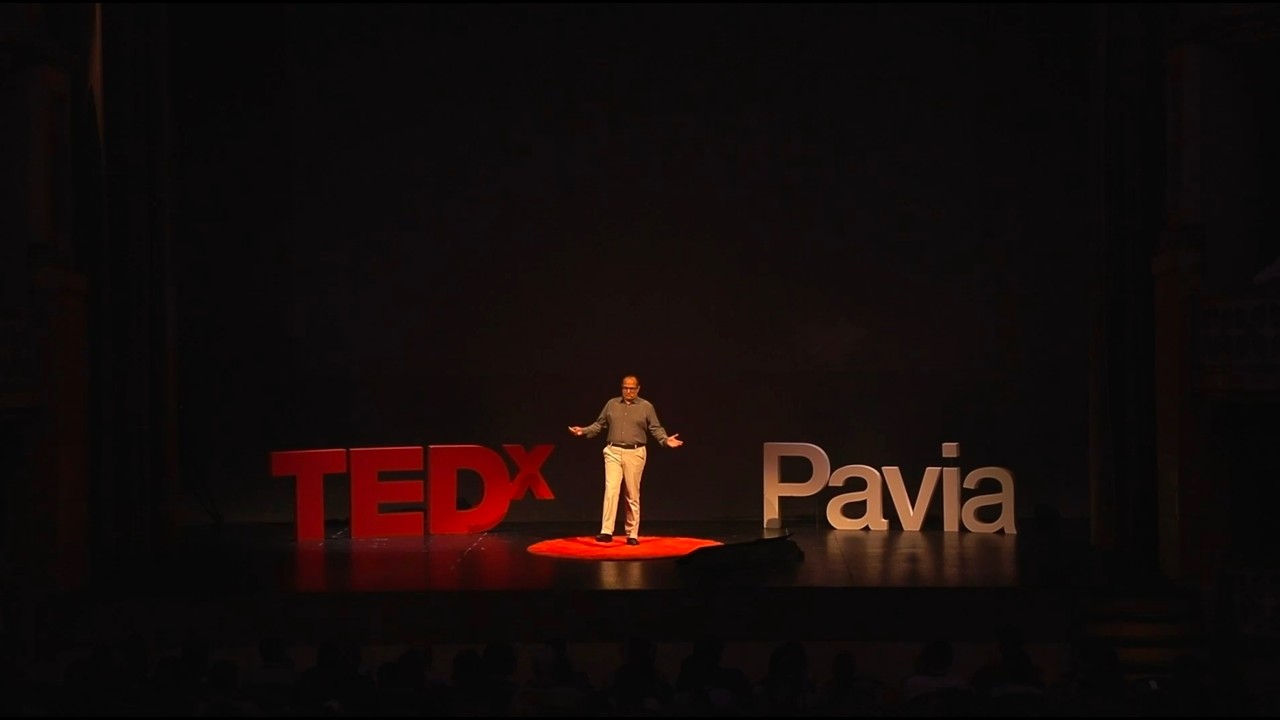
Robot che uniscono | Domenico Formica | TEDxPavia
Robots That Unite | Domenico Formica | TEDxPavia
Title history
- Robot che uniscono | Domenico Formica | TEDxPavia — observed on 20261120-1940 UTC (YouTube)
Keywords
Summary
205 words
Critical Evaluation
Value of the Information & Strength of the Argument
VALUE: The talk provides a valuable insight into a specific area of robotics that is not widely discussed: haptic communication for learning and connection. It presents original research results (the violin study) that are concrete and applicable. The use of Moravec’s paradox is a solid theoretical foundation. ARGUMENTATION: The argumentation is well structured: starting from the general risk of AI, narrowing down to a specific challenge (motor interaction), presenting a hypothesis (using haptics for learning), and supporting it with experimental data. The speaker effectively uses analogies (children vs. robots) and clearly explains complex concepts. The main weakness is that the talk does not provide detailed statistical comparisons or effect sizes, but as a science communication talk, this is acceptable.
Scientific Rigor, Source Quality, Title Accuracy
SCIENTIFIC RIGOR: The speaker is a credible expert with extensive publications. He presents results from his own research projects (CONBOTS) and mentions collaborations with reputable institutions. The talk is based on peer-reviewed studies, though specific references are not provided in the talk itself. The only source in the description is a general TEDx link. HENCE, the sources are indirect. ADEQUATION TITRE/CONTENU: The title ‘Robots that unite’ perfectly captures the talk’s focus on using robotics to connect people rather than replace them. The content stays on topic throughout.
221 words
Title / Content Match
The title 'Robot che uniscono' (Robots that unite) accurately captures the core message of the talk: using robotics to physically connect people and enhance cooperation, as exemplified by the CONBOTS project. The content fully aligns with this theme.
Quality & Reliability
7/10
The talk is delivered by a full professor in biomedical engineering with extensive peer-reviewed publications. It is based on his own research (CONBOTS project) and collaborations with reputable institutions. The scientific content is accurate and grounded in known concepts (Moravec's paradox), but the presentation is aimed at a general audience and lacks detailed citations within the talk. The description contains no specific references to studies, only a general TEDx link, slightly reducing the verifiability score.
Key Moments
Markers derived by PSI from the transcript: the creator did not define chapters.
- Introduction on Prometheus and the balance between technological benefit and risk
- AI generating poems and images; introduction of Moravec's paradox
- Evolution of brain and motor skills; why moving is complex for robots
- Introducing haptic perception and the idea of CONBOTS (connected through robots)
- Applications: learning to write and learning to play violin with haptic devices
- Violin experiment results: haptic-only outperforms audio-visual-only in sync
- Application in rehabilitation; conclusion on responsible innovation
Cited Sources
- TEDx Official Website — General link to TEDx event information, mentioned in the video description.
Concurring Sources
- Moravec's Paradox (Wikipedia) — The talk explicitly references Moravec's paradox; this provides background on the concept.
Contribution & Novelties
The talk presents original research from the CONBOTS project, demonstrating that haptic communication between two people performing a motor task together can improve learning outcomes, specifically in violin playing. This is a novel application of robotics to enhance human-human connection. The speaker also discusses the implications for rehabilitation, which is an emerging field.
Pour aller plus loin :
- Moravec’s paradox (Wikipedia) — Refers to the core concept discussed about difficulty of motor skills for AI.
- Haptic technology (Wikipedia) — Provides background on haptic devices and their uses.
- Shirley Ryan AbilityLab — Mentioned for rehabilitation research collaboration.
- Pope Francis’s encyclical (released 2026) — Referenced in the conclusion, but no specific URL given; query cautiously.
113 words
Radar Profile
The radar shows high scores on quality of information and reliability, slightly lower on quantity (talk is short) and technical level (popular science). This reflects a focused, expert-led talk that prioritizes clear communication over exhaustive detail.