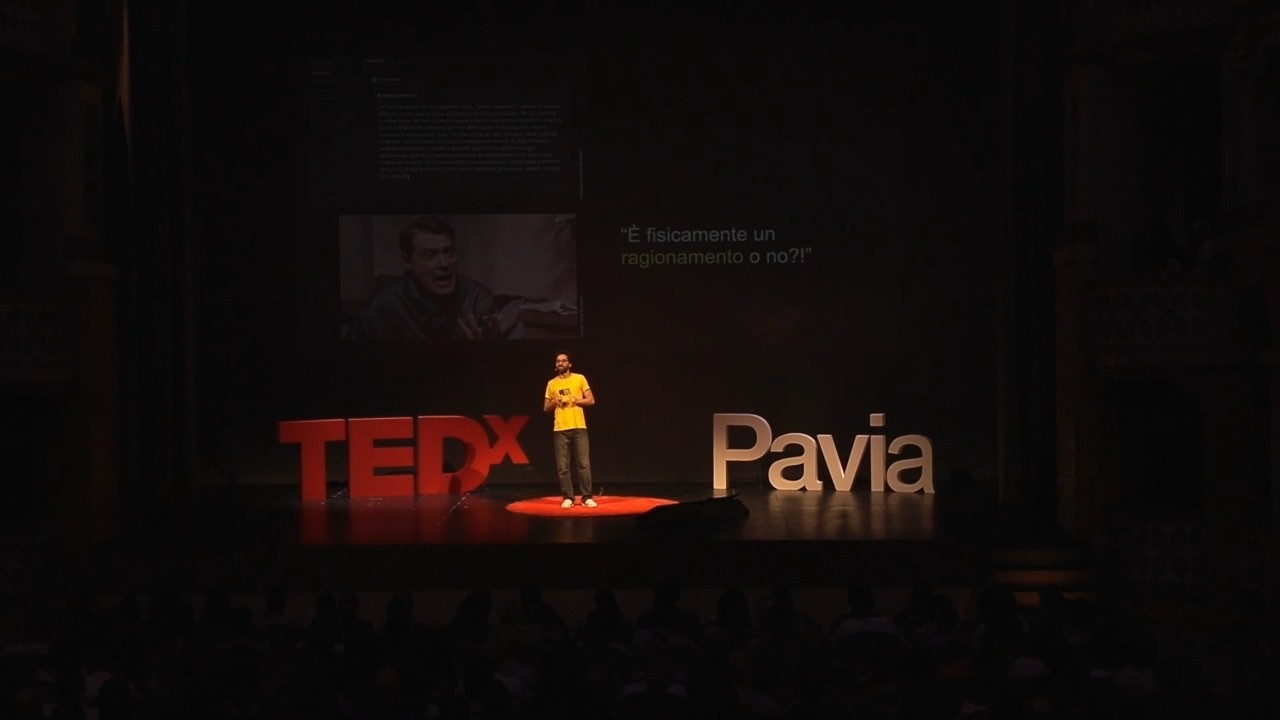
(Ri)conoscere nell’era dell’AI | Francesco Pierri | TEDxPavia
(Re)cognizing in the Age of AI | Francesco Pierri | TEDxPavia
Title history
- (Ri)conoscere nell’era dell’AI | Francesco Pierri | TEDxPavia — observed on 20261120-1939 UTC (YouTube)
Keywords
Summary
200 words
Critical Evaluation
Value of the Information & Strength of the Argument
The talk provides a compelling and accessible overview of key debates in AI, using vivid metaphors to convey complex ideas. The argumentation is logical and well-paced: Pierri sets up contrasts (AI’s successes vs. its trivial failures) and builds toward a nuanced conclusion about the need for human critical thinking. The anecdotal evidence is engaging and effective for a general audience, though it could benefit from more empirical depth. The discussion of sycophancy and the mirror metaphor is particularly insightful, linking to current research on AI behavior. However, the talk does not deeply explore counterarguments or alternative perspectives on AGI, and the distinction between information and comprehension could be more rigorously defined. Overall, the value lies in its ability to provoke reflection rather than providing a comprehensive analysis.
Scientific Rigor, Source Quality, Title Accuracy
The talk demonstrates reasonable scientific rigor for a TEDx format. It references concrete sources such as a book by Karen Hao, the Stanford AI Index report, and Nobel Prize winners, lending credibility to the claims. However, these references are mentioned without precise citations, and the audience is not given direct access to underlying data. The title accurately captures the central theme, though it slightly overemphasizes the cognitive aspect while the talk also touches on practical and pedagogical issues. No comments or audience feedback were provided to assess reception.
230 words
Title / Content Match
The title accurately reflects the central theme of re-examining what it means to know and understand in the age of AI, though the talk also touches on broader societal and educational implications.
Quality & Reliability
7/10
The talk offers a balanced perspective on AI capabilities and limits, drawing on credible examples such as benchmark failures, Nobel prizes, and academic research. While it is not a peer-reviewed study, it aligns with established discussions in AI ethics and cognitive science.
Key Moments
Markers derived by PSI from the transcript: the creator did not define chapters.
- Story about OpenAI's chaotic launch and unpreparedness for ChatGPT's popularity.
- Mention of Nobel Prizes in physics and chemistry awarded to AI researchers.
- Introduction of the car wash test and clock test as examples of AI failures on simple tasks.
- Discussion on AI winters and summers, and the current third summer of AI.
- Explanation of chatbot reasoning as simulated text generation, not true cognition.
- Introduction of the three metaphors: parrot, airplane, and mirror, connecting to AI risks and sycophancy.
Cited Sources
- TEDx official page — Described as the source for the TEDx event format and further information.
- Book by Karen Hao on AI — Referenced as the source of the anecdote about OpenAI's ChatGPT launch party.
- Stanford AI Index Report — Cited for the statistic on chatbot accuracy in the clock test (approximately 50%).
Contribution & Novelties
The talk’s original contribution lies in its synthesis of various perspectives on AI into three memorable metaphors (parrot, airplane, mirror), which help the audience grasp the ambiguous nature of AI: as mimicry, as a powerful tool with risks, and as a mirror reflecting our own biases. This framing is effective for public engagement. The talk also presents a personal perspective from an academic researcher on the responsibilities of educators in the AI era, highlighting the importance of critical thinking and verification skills.
Pour aller plus loin :
- Stochastic parrot — A term coined by Bender et al. to describe large language models as probabilistic systems that do not understand language.
- Sycophancy (psychology) — Behavioral tendency of being overly agreeable, related to the mirror metaphor and AI’s tendency to please users.
- Dartmouth workshop — The 1956 workshop that is considered the founding event of AI as a field, mentioned in the talk.
151 words
Radar Profile
The profile shows strengths in qualitative information quality and reliability, but lower quantities of information and technical depth. This aligns with a foundational, thought-provoking talk aimed at a broad audience rather than a deep technical analysis.