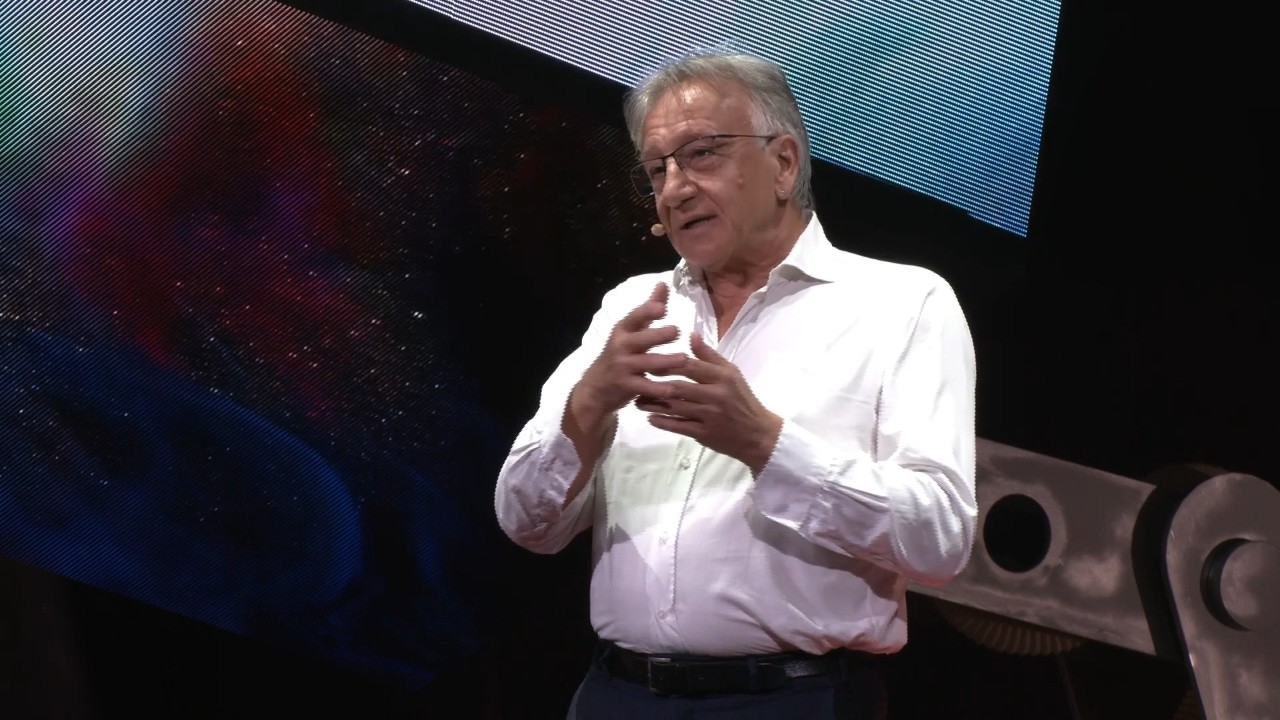
Dalla zappa a Elon Musk: perché il progresso crea sempre disuguaglianza | Michele Boldrin | TEDxBari
From the Hoe to Elon Musk: Why Progress Always Creates Inequality | Michele Boldrin | TEDxBari
Keywords
Summary
255 words
Critical Evaluation
Value of the Information & Strength of the Argument
The informational value lies less in new facts than in a clear conceptual device: technology as a lever that converts a fixed distribution of heterogeneous traits into an increasingly dispersed distribution of income. This framing is economical and does real explanatory work — it accounts at once for why pre-industrial societies were poor rather than egalitarian (a tiny surplus leaves nothing to distribute), why the industrial revolution mattered (substituting animal and human energy with controllable energy), and why the digital transition is felt as a rupture even if its logic is old. Boldrin also performs a useful rhetorical service by separating the positive analysis from the normative question, and by explicitly refusing to tell the audience how much inequality is desirable. He keeps the argument honest about the limits of his discipline: formalisation and statistics are described as filters for eliminating gross errors rather than as truth-producing machines, and he notes that policy advice is credible mainly when it warns against demonstrably harmful measures. The argumentation is nevertheless largely deductive and illustrative rather than evidential. The key premise — that traits are unequally distributed and that technology rewards them increasingly — is asserted as a ‘great hypothesis’ that could be false, with evidence invoked (’there is enormous evidence’) but never shown: no Gini series, no wage-premium data, no historical price series. The link between the thinness of the right tail and the magnitude of modern fortunes is stated rather than demonstrated. The Musk example is anecdotal and compressed, and the attribution of an 800-billion valuation to talent, risk and chance leaves out capital markets, ownership structures and public policy. The talk also slides between inequality of outcome and inequality of opportunity without distinguishing them, and it does not address the counter-argument that some technologies compress returns rather than amplify them.
Scientific Rigor, Source Quality, Title Accuracy
No source is cited in the talk: no paper, no dataset, no author is named except James Watt, Michael Jordan and Elon Musk as illustrative figures. The argument is advanced as expert reasoning, and its authority rests on the speaker’s academic position rather than on traceable evidence. The one epistemic safeguard explicitly formulated — that economics cannot forecast and that formalisation serves to weed out blatant contradictions — is a mark of intellectual rigour but does not itself supply verification. Historical claims about early societies (violence, abduction of women, absence of primitive communism) are asserted without reference and are peripheral to the thesis. The single link in the description points to the generic TEDx site, which offers no supporting documentation. On adequacy between title and content, the title is accurate and the talk delivers the promised arc from the hoe to Musk and AI, with the caveat that ‘always’ is a rhetorical amplifier rather than a demonstrated universal.
473 words
Title / Content Match
The title is faithful to the content: the talk does run from the hoe and the stick through agricultural and energy innovations to AI and Elon Musk, and it argues exactly that technological progress mechanically widens inequality. One nuance only: the word 'always' is asserted rhetorically rather than demonstrated.
Quality & Reliability
6/10
The talk is delivered by an academic economist (professor at Washington University in St. Louis) and its core claims rest on well-established ideas: heterogeneous individual traits, skill-biased technological change and the concentration of returns among the far right tail of a normal distribution of cognitive ability. The reasoning is internally coherent and the speaker explicitly states the limits of economic science (no forecasting, only interpretation and elimination of gross errors). However, the argument is presented discursively, without data, figures, references or citations; the central statement ('inequality is practically inevitable') is a model-based hypothesis that the speaker himself flags as falsifiable, yet the supporting evidence is gestured at ('there is enormous evidence') rather than shown. The Musk/SpaceX valuation example is anecdotal and simplified. Overall: credible expert framing, weak evidential backing.
Key Moments
Markers derived by PSI from the transcript: the creator did not define chapters.
- Opening: the economist as a practitioner of the 'dismal science', a self-deprecating framing of the talk as a list of unpleasant truths.
- Statement of the subject — technological progress, innovation, AI and inequality — and explicit refusal of the normative question of how much inequality is desirable.
- Epistemological caveat: economics cannot predict; mathematics and data serve mainly to eliminate gross errors, not to establish certainties.
- Core thesis introduced: every human differs, and technology determines which differences become economically rewarded — the hoe and the stick as limiting cases.
- Digression on pre-industrial societies: poverty of options rather than primitive communism, with coercion and violence as consequences of scarcity.
- James Watt and the substitution of animal and human energy by controllable mechanical energy as the decisive turning point of the last two centuries.
- Basketball, the violin, the novel and jurisprudence presented as technologies: each innovation creates a market for a specific set of aptitudes.
- The Gaussian distribution of cognitive ability: the right tail is thin in numbers but has been handed an increasingly long lever by post-war technological change.
- The Musk/SpaceX example: a valuation moving from roughly 300 to 800 billion dollars in about a week, attributed to talent, risk-taking and luck.
- Conclusion: AI is not an anomaly but an acceleration; economics stops at the trade-off, and politics must choose collectively how fast to run.
Cited Sources
- TEDx — official programme page (only link provided in the description) — The single link in the video description; it points to the general TEDx programme and provides no documentation for the economic claims made in the talk.
- James Watt and the steam engine — Invoked as the emblematic figure of the transition from animal and human energy to controllable mechanical energy; no specific work is referenced.
- Michael Jordan and the invention of basketball — Used as an illustration that a technology (here a sport) can create enormous value from a specific, unevenly distributed set of physical aptitudes.
- SpaceX listing and Elon Musk's valuation — Cited as an anecdotal illustration of a jump from roughly 300 to 800 billion dollars in about a week; no market data or source is provided in the talk.
Concurring Sources
- Skill-biased technological change (overview) — Supports the talk's core mechanism: technological change shifts relative demand towards higher-skilled, higher-cognitive-ability workers.
- Acemoglu & Restrepo, The Race Between Man and Machine — Academic treatment of automation and inequality that broadly corroborates the idea that the direction of technology shapes the distribution of gains.
- Normal distribution — Confirms the statistical property the speaker relies on: the density of a normal distribution thins rapidly in the tails, while leverage can be applied regardless of numbers.
Dissenting Sources
- The task-displacement / task-reinstatement view of automation (Acemoglu & Restrepo) — The same literature shows that automation also creates new tasks that employ displaced workers, so the net effect on inequality is contingent on institutions and on which tasks are automated, not mechanically increasing.
- Research arguing that AI may compress rather than amplify wage differentials — A body of work on AI as a substitute for high-wage cognitive tasks suggests the technology could reduce rather than widen certain skill premiums — a possibility the talk does not entertain.
- The measurement debate on inequality (consumption vs. income, taxes vs. transfers) — The talk treats 'inequality' as a single quantity; the empirical literature emphasises that measured inequality depends heavily on whether one looks at pre- or post-tax income, wealth or consumption.
Contribution & Novelties
The talk does not present new research; its contribution is pedagogical and framing-related. It offers a compact mental model — technology as a lever acting on an unequal distribution of traits — that explains in one stroke why stagnation is not egalitarian, why the industrial revolution changed the scale of inequality, and why AI feels like a rupture while following an old logic. Its second contribution is methodological and, in the current debate, relatively rare: an economist explicitly refusing to answer the normative question of the optimal level of inequality and assigning that choice to collective political decision, while insisting that the only robust economic advice is often negative (‘do not do what is demonstrably harmful’).
Pour aller plus loin :
- Skill-biased technological change — The standard economics framework behind the talk’s central intuition that technology raises the relative return to cognitive skills.
- Acemoglu & Restrepo, The Race Between Man and Machine (NBER Working Paper 22252) — Formalises the tension between automation displacing tasks and the creation of new ones; a rigorous counterpoint to Boldrin’s more linear account.
- Normal distribution — Background on the Gaussian curve whose right tail the speaker uses to explain the concentration of returns.
- General-purpose technology — Useful concept for situating AI as a widespread, economy-wide lever rather than a sector-specific tool.
- Brynjolfsson & McAfee, ‘The Second Machine Age’ (book, no URL given) — Develops at length the argument that digital technologies reward a narrow set of skills and polarise labour markets.
246 words
Radar Profile
The profile is that of a conceptual, argumentative talk rather than an evidential one: a solid quantity of ideas and a clear logical thread, moderate technical depth limited to informal references to the Gaussian distribution and to the trade-off framework, and a reliability that is bounded by the near-total absence of data and citations. Technical level and information quality sit at a level typical of a well-argued conference talk by a specialist speaking outside his evidence base.