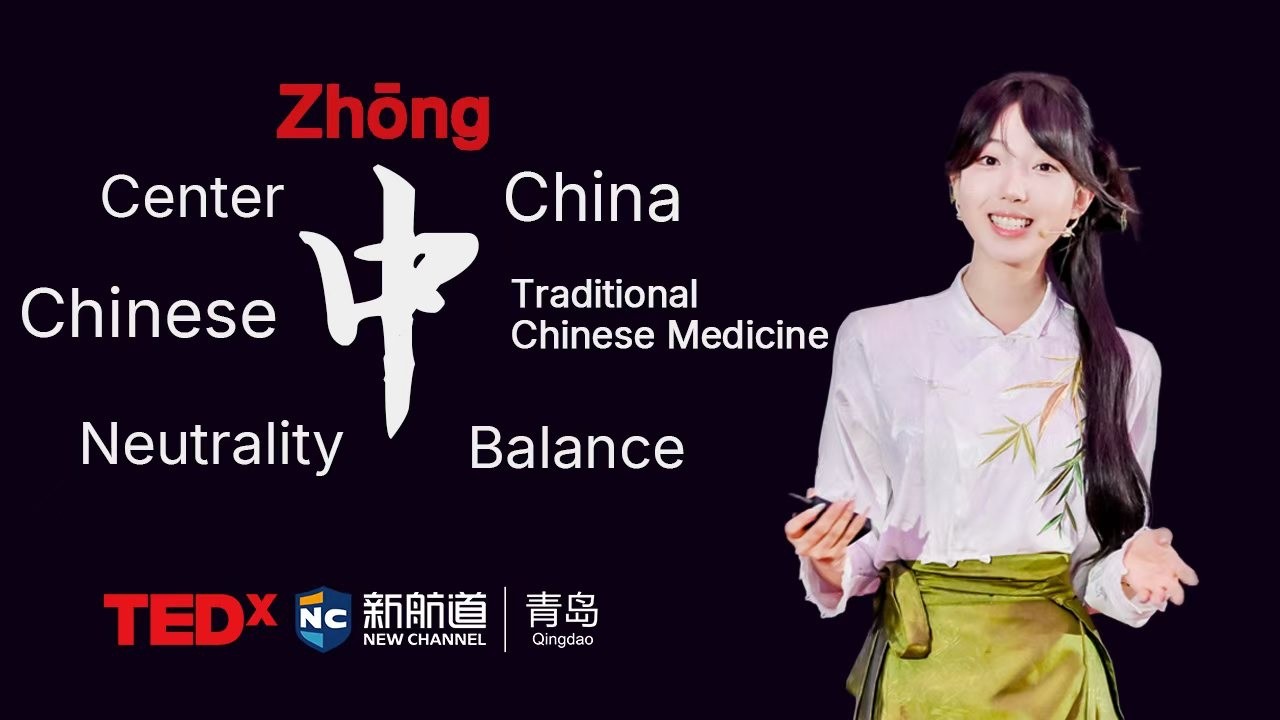
Zhong “中” | Qihui Huang | TEDxNew Channel Qingdao
Keywords
Summary
224 words
Critical Evaluation
Value of the Information & Strength of the Argument
The value of the information lies in its inspirational and cultural perspective rather than scientific depth. The speaker effectively uses personal anecdotes to illustrate the concept of balance, making the abstract TCM philosophy relatable. Her argumentation is coherent, moving from childhood experience to career decisions and culminating in a holistic life view. However, she does not provide empirical evidence or engage with potential criticisms of TCM. The reasoning is subjective and relies on emotional appeal, which weakens its epistemic weight. Nevertheless, the talk succeeds as a motivational narrative about integrating tradition with modernity.
Scientific Rigor, Source Quality, Title Accuracy
The speaker does not cite external scientific sources; her authority comes from her family lineage and personal experience. The talk includes a disclaimer from TED that it is not medical advice, indicating a lack of established scientific foundation. The title accurately reflects the content, focusing on the term ‘zhong’ and its multiple meanings. The narrative is internally consistent, but the reliance on anecdote and tradition without critical evaluation limits its scientific rigor. No comments were provided for analysis.
186 words
Title / Content Match
The title introduces the central concept 'Zhong' and the speaker's name, and the talk indeed revolves around the meaning of 'Zhong' (balance, center) in her life and TCM. It is accurate and appropriate.
Quality & Reliability
4/10
The talk is a personal narrative with anecdotal evidence about traditional Chinese medicine. It lacks scientific rigor, and the disclaimer explicitly states it is not medical advice. The speaker's claims about acupressure points and TCM principles are presented subjectively, without citation to peer-reviewed studies. However, the content is coherent and internally consistent, and it clearly distinguishes personal experience from general medical guidance.
Key Moments
Markers derived by PSI from the transcript: the creator did not define chapters.
- Introduction and baihui acupressure exercise with audience.
- Story of the elderly deaf man treated with acupuncture at a nursing home.
- Reflection on the meaning of 'zhong' as restoring what was lost.
- Decision to create short videos and initial low viewership.
- Impact of a stranger's comment and motivation to continue.
- Discussion of living a 'split life' and blending studies with TCM.
- Helping a classmate during exams with acupressure.
- Final pulse exercise and metaphor of cun, guan, chi for life balance.
Cited Sources
- TEDx Content Guidelines — Referenced in the video description to clarify the voluntary organization of TEDx events.
- TEDx Program — Linked in the description as the official TEDx page.
Contribution & Novelties
The talk offers a personal and modern perspective on traditional Chinese medicine, emphasizing adaptability and balance rather than dogmatic adherence. The speaker’s unique position as a young TCM inheritor using social media provides a contemporary angle on cultural transmission.
Pour aller plus loin :
- Traditional Chinese Medicine — Overview of TCM principles, including acupuncture and herbal medicine.
- Acupressure — Technique based on TCM pressure points, relevant to the baihui and pulse sections.
- Zhongyong (Doctrine of the Mean) — Confucian concept of balance, philosophically related to the speaker’s notion of ‘zhong’.
90 words
Radar Profile
The radar profile shows moderate scores across quantity, quality, and technical level, with a slightly lower reliability. This reflects a personal, anecdotal presentation style that prioritizes narrative and inspiration over rigorous data. The talk is scientifically weak but emotionally engaging, aligning with a human-centric, opinion-based category.