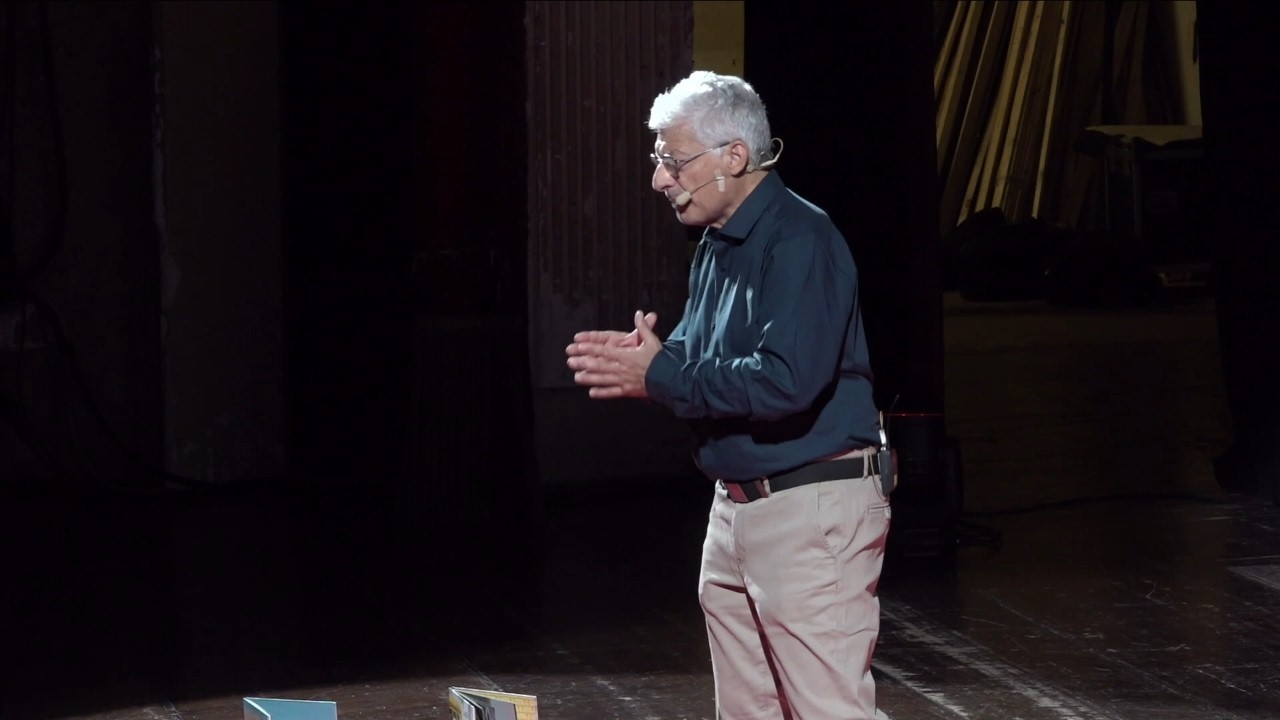
Perché non dobbiamo mai smettere di leggerci storie | Raimondo Vecchio | TEDxCatania
Why we must never stop reading stories to each other | Raimondo Vecchio | TEDxCatania
Keywords
Summary
324 words
Critical Evaluation
Value of the Information & Strength of the Argument
The informational value of the talk lies less in facts than in a framework: it reframes the illustrated album from a literacy tool into an aesthetic object and a relational device. The most useful conceptual contribution is the shift of the objective of read-aloud sessions away from ‘reading promotion’ towards what the speaker calls ‘reading each other inside’ — a claim that the value of the practice is intersubjective rather than didactic. This is a genuinely operational idea for anyone running reading sessions: it changes the posture of the adult from instructor to participant. The observation that children read images while adults read words, and that this asymmetry is itself a resource, is a concrete and testable claim about how picture books work. The talk also makes a defensible developmental argument: that the shared-reading routine is easiest to sustain before adolescence widens the gap, so the cost of abandoning it early is high. The argumentation, however, is entirely inductive and autobiographical. It rests on anecdotes (a child calling him a ‘divertitore’, the visible reaction of children’s gazes), on authority (Calvino, Rodari, Montessori, Don Milani, Lodi, Munari), and on metaphor (dragon, treasure chest, smuggler, food for the soul). No counter-argument is examined: the possibility that some children or parents do not respond, that forced shared reading can be counterproductive, or that the effects attributed to reading may be confounded with the quality of the relationship, are not considered. The rhetorical construction is strong and well-paced — narrative demonstration followed by thesis, then evidence by authority, then closing exhortation — but rhetoric is doing the work that evidence would need to do. The talk is therefore valuable as a professional testimony and a source of practical hypotheses, not as a demonstration.
Scientific Rigor, Source Quality, Title Accuracy
Scientific rigour is low by design: this is a TEDx stage talk, not a research presentation, and no method, sample, measurement or citation apparatus is offered. The references invoked are literary and pedagogical rather than scientific — Jon Klassen’s album, Italo Calvino’s Italian folktales, Gianni Rodari’s poetry, Maria Montessori, Don Milani, Mario Lodi and Bruno Tognolini — and they are used as authorities and illustrations, not as evidence. Some quotations are paraphrased from memory and are recognisably inexact in wording, which is acceptable on stage but weakens their status as citations. The single epidemiological-sounding claim, that the WHO recommends not interrupting shared reading at the entry into primary school, is asserted without a document reference and is loosely attributed; the recommendation exists in substance in paediatric-literacy guidance, but the speaker neither names the text nor its year, making verification impossible from the talk alone. The only verifiable source in the description is the generic TEDx page. On the positive side, the speaker’s expertise is real and long-standing, he distinguishes clearly between his personal conviction and the institutional discourse he distances himself from, and he does not overstate quantified benefits. Title and content are congruent: the promise of an argument against stopping read-aloud is delivered, illustrated and restated in the conclusion, though the talk is narrower than the title implies, being centred on illustrated albums and the parent-child dyad rather than on stories in general.
538 words
Title / Content Match
The title is fully honoured: the entire talk argues that reading aloud should not stop when children learn to read on their own, and the closing exhortation restates it explicitly. The subtitle-free framing is slightly broader than the actual content, which focuses on picture books and parent-child reading rather than on stories in general.
Quality & Reliability
4/10
A practitioner's personal testimony built on nearly forty years of nursery-school teaching and on reading-aloud workshops. The claims are experiential and normative rather than empirical: no data, no study design, no quantified outcomes. The few external anchors (Calvino, Rodari, Montessori, Don Milani, Mario Lodi, Irene Greco, Bruno Tognolini) are literary and pedagogical references, correctly attributed in substance but paraphrased loosely. One attribution is imprecise: the recommendation not to stop shared reading at the transition to primary school is credited to the WHO, whereas this type of wording is more typically found in paediatric-literacy guidance (e.g. American Academy of Pediatrics) and in UNESCO/OECD literacy material. The content is sincere and internally coherent, but it offers no verifiable evidence base.
Key Moments
Markers derived by PSI from the transcript: the creator did not define chapters.
- Reading of Jon Klassen's picture book 'Toh! Un cappello' with voices, as a live demonstration of the practice being defended.
- Analysis of the book's dream ending: instead of taking the hat, the character falls asleep to share the same dream.
- The storyteller's task as 'keeping the arms wide open', and the borrowed self-description as a 'smuggler' of stories.
- Polemical core: illustrated albums are not 'stuff for children' but literature and works of art in which the image dominates.
- Italo Calvino's Italian folktales: fairytales are true because they carry the concrete destinies of human beings; every dragon can be defeated.
- Discovery of the missing party — the adults — and the invention of shared readings for parents and children together.
- Irene Greco's formula 'reading each other inside': words become caresses and 'good food for the soul'.
- Plea not to stop reading aloud when children learn to read, with the WHO recommendation invoked for the primary-school transition.
- Gianni Rodari's poem on doing difficult things because they are right, extended from children to adults.
- Closing exhortation, after Bruno Tognolini: read 'loud, loud, loud' to the people close to us — a bond that lasts a lifetime.
Cited Sources
- Jon Klassen, 'Toh! Un cappello' (We Found a Hat) — Picture book read almost in full at the opening of the talk and used to demonstrate what a read-aloud session looks and sounds like.
- Italo Calvino, 'Fiabe italiane' (Italian Folktales) — Cited as the main working material during the speaker's first thirty years of teaching; the quotation about fairytales containing the concrete destinies of human beings is attributed to Calvino.
- Gianni Rodari, poem 'Le cose difficili' (illustrated by Marianna Balducci) — Read at the end of the talk to argue that difficult things should be done when they are right; the illustrated edition by Marianna Balducci is named.
- Irene Greco, writer — Source of the central formula of the talk: the goal is to 'read each other', not to read books, and to build an open, free and happy relationship with one's children.
- Bruno Tognolini, poet — Invoked at the very end for the injunction to read 'loud, loud, loud' to those close to us; also apparently the source of the 'smuggler' definition of the storyteller, though the name is garbled in the transcript.
- Maria Montessori, Mario Lodi, Don Lorenzo Milani, Bruno Munari — Cited collectively as the Italian pedagogical masters the speaker claims as references.
- WHO recommendation on shared reading — Invoked to support the claim that shared reading should not be interrupted at entry into primary school; no specific document or year is given.
- TEDx — TED conference format, independently organised local events — The only link provided in the video description; describes the format of the event at which the talk was given.
Concurring Sources
- American Academy of Pediatrics — policy statement on literacy promotion in primary care — Paediatric-literacy guidance recommending daily shared reading from infancy and continued support beyond school entry; substantively close to the claim the speaker attributes to the WHO, though the exact attribution should be verified.
- UNESCO — literacy and reading promotion material — Institutional discourse converging with the talk's argument that reading aloud is a relational and developmental practice and not merely a school skill.
- Italo Calvino, 'Fiabe italiane' — The source itself supports the speaker's use of folktales as condensed accounts of human destinies and of the overcoming of fear.
Dissenting Sources
- WHO recommendation as stated in the talk — The speaker asserts that the WHO advises not interrupting shared reading at entry into primary school. The substance is plausible and appears in paediatric-literacy guidance, but the attribution to the WHO is not documented in the talk or its description, and the exact wording cannot be verified from the video alone. The claim should be treated as a paraphrase rather than a citation.
- Evidence base for read-aloud outcomes — The talk attributes therapeutic effects to shared reading — wounds heard, fears defeated, words becoming 'food for the soul' — without distinguishing between what is documented (vocabulary and oral-language gains, quality of the parent-child interaction) and what is a practitioner's interpretation. Experimental and longitudinal literature on shared reading is far more qualified about mechanisms and effect sizes than the talk suggests.
Contribution & Novelties
The talk’s originality is not conceptual — the value of reading aloud to children is well established — but positional. It relocates the purpose of the practice from the child’s literacy to the adult’s own emotional availability, arguing that the adult who listens to a story in the presence of a child is also being addressed, and that this is where the real function of the session lies. Two secondary ideas are worth retaining: the asymmetry between how children read images and how adults read words, treated as a resource rather than a problem; and the practical consequence that sessions should be designed for the pair, not for the child alone, which is what the speaker did by moving from classroom reading to joint parent-child readings. The talk is also a documented case of a long-career practitioner redefining his own trade, from teacher to performer to what he calls a smuggler of stories, which makes it useful as field testimony rather than as evidence.
Pour aller plus loin :
- Dialogic reading — The structured interactive read-aloud method (prompting, expanding, repeating) is the research-grounded counterpart of the practice described here; worth consulting by name to compare with the speaker’s more relational framing.
- Italo Calvino — Entry point to the author whose folk-tale collection the speaker used for three decades, and to his own theory of the speed and lightness of storytelling.
- Italian Folktales — The specific collection referenced; useful for checking the attribution of the quotation about fairytales and human destinies.
- Gianni Rodari — Background on the poet and pedagogue whose verse closes the talk, and on his influential poetics of imagination in education.
- Jon Klassen — Author-illustrator of the album read on stage; his hat trilogy is a standard example of irony carried jointly by text and image, which is precisely the mechanism the speaker describes.
- Maria Montessori — One of the Italian pedagogical references invoked, useful to situate the speaker’s claims within a broader tradition of child-centred education.
329 words
Radar Profile
The profile is dominated by a very low technical score and a moderate information score, reflecting a talk that carries little formal or empirical content but a coherent professional message. Reliability sits in the middle: the speaker's experience is real and the references are genuine, yet nothing is quantified or sourced. The shape is that of human-science testimony rather than technical exposition — rich in meaning and practical implication, thin in verifiable evidence.