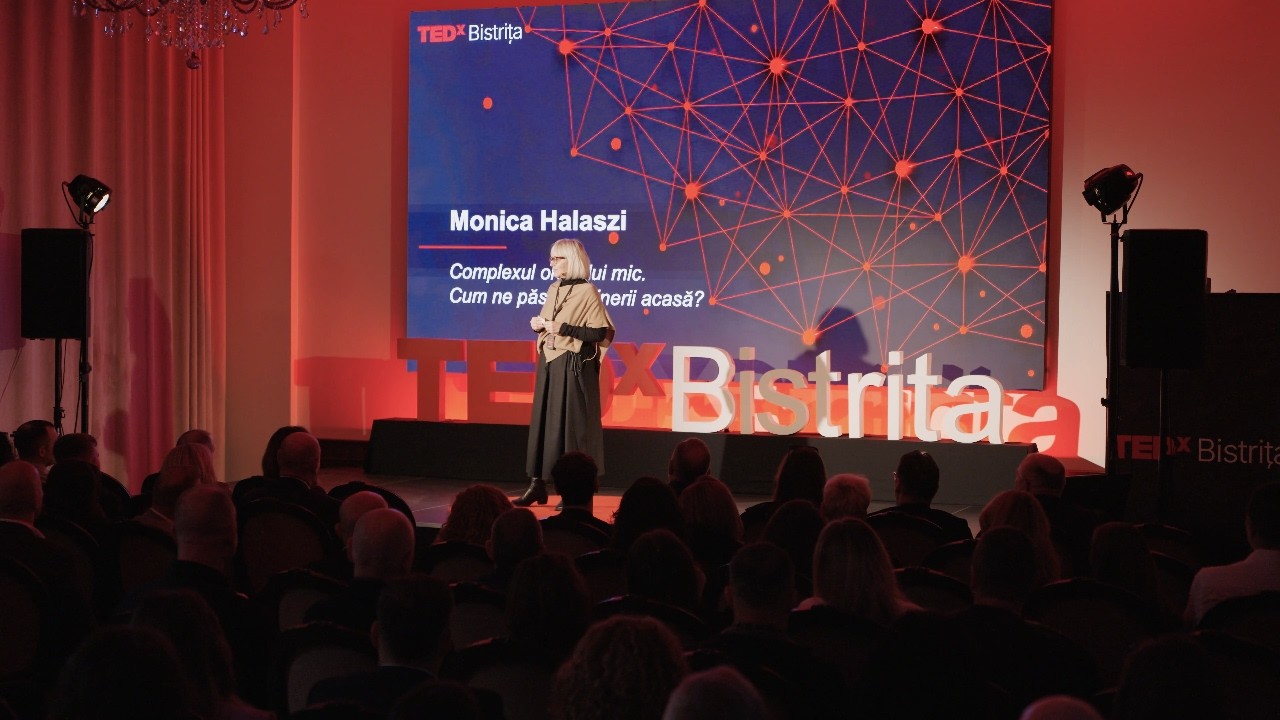
Complexul orașului mic. Cum ne păstrăm tinerii acasă? | Monica Halaszi | TEDxBistrita
The small-town complex. How do we keep our youth at home? | Monica Halaszi | TEDxBistrita
Keywords
Summary
397 words
Critical Evaluation
Value of the Information & Strength of the Argument
The informational value lies less in facts than in a diagnostic framing: the distinction between departure as an experience and departure as the sole measure of personal worth, and the observation that a town’s decline is reproduced by the way its own institutions talk about it. The talk offers concrete, actionable ideas — giving secondary-school pupils small real projects with a right to fail, changing the standard question asked of graduates, treating a return as a success — which are usable by teachers, local officials and community organisers even without supporting data. The argumentation is rhetorically tight and internally consistent: the speaker builds her case through questions to the audience, a personal narrative, a slogan-level diagnosis (‘here it can’t be done’), an explicit concession of small towns’ real weaknesses, a counter-list of their advantages, and a single reframing move that reorganises the whole problem. She is careful to pre-empt two obvious objections — that she idealises small towns, and that she wants to stop young people from leaving — and explicitly disclaims both. The weakness is evidentiary rather than logical: almost every claim is asserted rather than demonstrated, and a few are over-generalised (the claim that schools systematically push pupils abroad, the assertion that distance from the mayor is an advantage, the caricature of social-media bragging). The final call to action is deliberately left open, which preserves its persuasive force but also its indeterminacy.
Scientific Rigor, Source Quality, Title Accuracy
No source is cited anywhere in the talk: no study, no statistical series on internal or external migration from Romanian small towns, no reference to the substantial academic literature on youth out-migration, return migration or shrinking towns, and no local data on Bistrița itself. The only external programme named is Erasmus, mentioned only as biographical detail rather than as evidence. The single link supplied in the description is the generic TEDx page, so there is no documentary trail behind any of the claims. Rigour therefore rests entirely on the credibility of the speaker’s professional experience — three decades in education and direct contact with successive cohorts of pupils — which is a legitimate but non-verifiable form of authority. The talk is intellectually honest in that it states its normative position, concedes the limits of small towns and avoids predicting outcomes. On title and content, the match is strong: the talk defines and illustrates the ‘small-town complex’ exactly as announced, and the promotional framing of ‘keeping young people home’ is addressed — though the speaker deliberately substitutes a different question (‘what town do we build so that they want to return’), which is a refinement rather than a mismatch.
447 words
Title / Content Match
The title is a faithful description of the content: the talk defines the 'small-town complex', examines why young people leave and asks how communities could make return desirable. The title's second half ('how do we keep them home') is slightly at odds with the speaker's own reframing mid-talk, where she argues the real question is what kind of town to build so that young people choose to return.
Quality & Reliability
5/10
The talk is a personal, experience-based argument delivered by a school principal, not a research presentation. It contains no data, no statistics, no cited studies and no verifiable empirical claims; its reasoning rests on anecdote, rhetorical questions and a reframing of a social problem. The internal logic is coherent and the diagnosis (self-fulfilling narratives of decline, the school system's role in legitimising departure, the need to change how return is judged) is plausible and echoed in the wider literature on youth out-migration, but nothing in the talk is documented or testable as presented. Reliability is therefore that of informed expert testimony rather than of evidence-based analysis.
Key Moments
Markers derived by PSI from the transcript: the creator did not define chapters.
- Opening double question to the audience: who grew up in a small town, and who once intended never to return.
- Personal account of leaving Sângeorz-Băi at the age when one is supposed to leave, without a plan but certain she would not return.
- The 'geography of success': the further you go, the more successful you are deemed to be — Bistrița, Cluj, Bucharest, abroad as a family trophy.
- Definition of the small-town complex: not that the young leave, but that they cannot imagine a reason to come back; departure becomes a measure of personal worth rather than a choice.
- How families and schools reproduce the model: social-media posts about graduates admitted ever further away, with more exclamation marks the greater the distance; 'we produce locally and export premium'.
- 'La noi nu se poate' ('here it can't be done') named as the most damaging sentence in Romanian, paired with the excuse 'he was just lucky'.
- Honest acknowledgment of small towns' real limits, followed by their advantages: short distances, dense networks, quick access to decision-makers, visible impact.
- Thought experiment of the young woman returning at 30 and being told 'nothing has changed' — the very reason not to return.
- Reframing the question: not how to keep the young, but what town to build so they will want to return; belonging does not pay a mortgage.
- Call to give teenagers real projects, let them fail, and stop reading a return as a failure; closing question about what each listener will do in the town itself.
Cited Sources
- TEDx — official programme page — Only link provided in the video description; referenced as the framework under which this independently organised TEDx event took place. No substantive reference or study is cited in the talk itself.
Concurring Sources
- Brain drain — Wikipedia — General overview of the emigration of highly qualified people; provides the wider conceptual frame for the phenomenon the speaker describes informally through her graduates leaving Bistrița.
- Erasmus Programme — Wikipedia — The speaker explicitly mentions an Erasmus mobility in her thought experiment about a young woman who leaves and later considers returning; this page documents the programme she refers to.
Contribution & Novelties
The talk’s real contribution is a shift of the problem’s location. Instead of asking how to retain young people — the standard demographic and economic framing, which tends to produce subsidy-and-infrastructure answers — it locates the obstacle in the narratives that families, schools and local communities tell about themselves: the distance-based scale of success, the ‘here it can’t be done’ reflex, and the habit of reading a return as a failure. Two operational ideas follow that are not commonly formulated this way in Romanian public debate: that the school’s explicit mission should include teaching pupils about their own community so that they see themselves as actors in it, and that the decisive experience is a small, real, possibly failing project carried out at 17 in one’s own town. The talk also supplies a compact test for any local revitalisation policy — would a 30-year-old who left be able to say the town has changed?
Further reading:
- Brain drain — https://en.wikipedia.org/wiki/Brain_drain — Conceptual background for the emigration dynamics the speaker describes through her graduates.
- Erasmus Programme — https://en.wikipedia.org/wiki/Erasmus_Programme — The mobility scheme explicitly mentioned in the thought experiment about leaving and returning.
- TEDx — https://www.ted.com/tedx — Format and organisational context of the talk, as given in the description.
- Richard Florida, ‘The Rise of the Creative Class’ — Reference work on what makes a place attractive to young educated people; useful counterpoint to the talk’s cultural-narrative explanation (cited by name, no URL given).
- ‘Place attachment’ and community psychology literature — Body of research on the emotional bond between people and localities, directly relevant to the speaker’s claim that belonging matters but does not by itself create jobs (cited by concept, no URL given).
- Shrinking towns and rural depopulation in Central and Eastern Europe — Research field on demographic decline in small municipalities after 1989; the empirical context the talk addresses without citing (cited by concept, no URL given).
316 words
Radar Profile
The profile is flat-to-low: very low technical level, moderate information quantity and quality, and moderate reliability, reflecting a talk built on rhetoric and lived experience rather than on data. Its strength lies in framing and persuasion, not in verifiable content, which the radar shows as a compact, mid-range polygon with a pronounced dip on the technical axis.