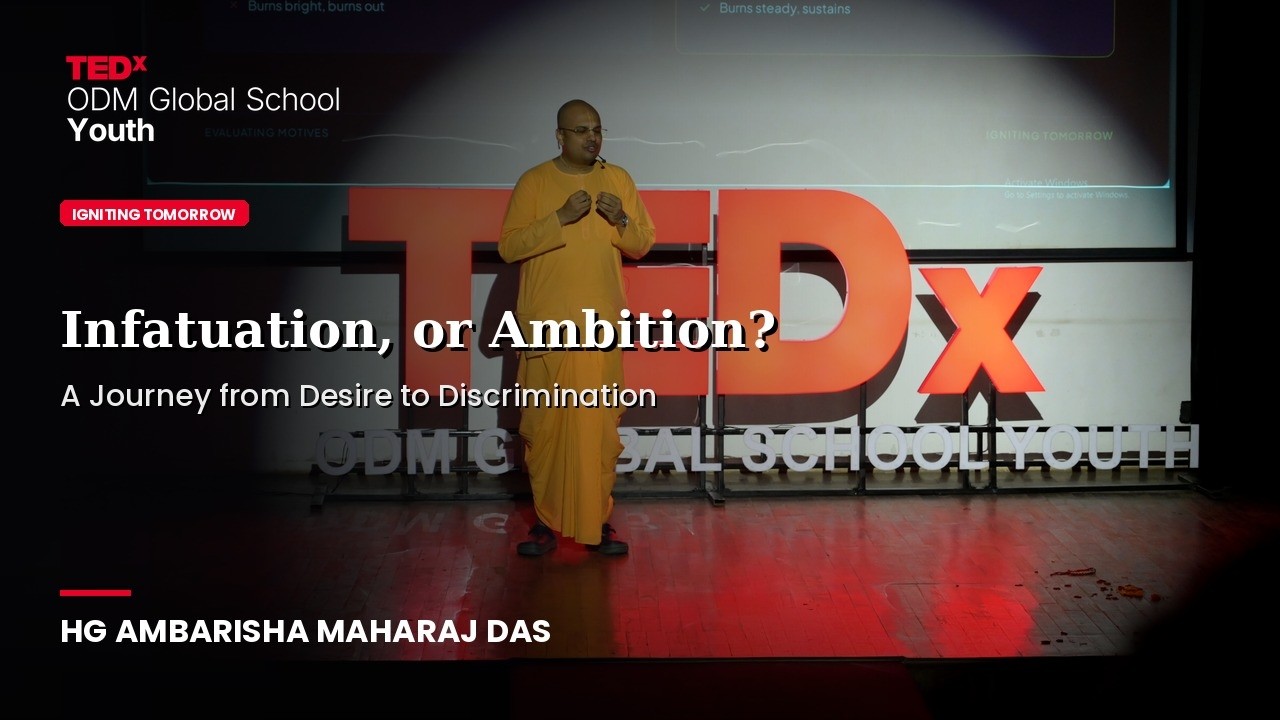
A Journey from Desire to Discrimination | HG Ambarish Maharaj Das | TEDxODM Global School Youth
Keywords
Summary
135 words
Critical Evaluation
Value of the Information & Strength of the Argument
The talk offers valuable insights into the mechanics of desire and self-awareness, drawing on ancient wisdom to address modern challenges. The argumentation is coherent and persuasive, relying on authoritative scripture and logical analogies (e.g., weeds vs. fruitful plants). However, it lacks empirical verification and scientific rigor, relying instead on personal conviction and tradition. The distinction between infatuation and ambition (though implied) is a useful practical framework, but its presentation could be more explicit. The speaker’s credibility as a monk and his personal experience add persuasive weight, though the reasoning is largely anecdotal and prescriptive rather than empirically grounded.
Scientific Rigor, Source Quality, Title Accuracy
The scientific rigor is low; the talk does not cite peer-reviewed studies but relies on the Bhagavad Gita as a source, which is a religious and philosophical text. The quality of sources is appropriate for the genre, but not scientific. The title accurately matches the content, describing the journey from desire to loss of discrimination. There are no external references besides the general TEDx platform link, and no quantitative data. The talk is well-structured and internally consistent, but its claims are not falsifiable in a scientific sense.
200 words
Title / Content Match
The title accurately reflects the content, which traces the psychological descent from desire to loss of discrimination, as described in the Bhagavad Gita.
Quality & Reliability
6/10
The talk is rooted in scriptural authority (Bhagavad Gita) and delivered with clarity, but lacks empirical evidence and systematic argumentation. The practical advice is reasonable but not scientifically validated.
Key Moments
Markers derived by PSI from the transcript: the creator did not define chapters.
- Introduction to the talk and the importance of consciousness.
- Recitation of the Bhagavad Gita verse and explanation of the flow from thinking to action.
- Emphasis on defining one's purpose and introspection.
- Discussion of success and failure, and the weeds of greed and anger.
- Krishna's advice on controlling the mind through practice and detachment.
- Conclusion urging conscious thinking and channeling energy wisely.
Cited Sources
- TEDx Talks official page — The talk was given at a TEDx event; the description links to TEDx general page.
- Bhagavad Gita — The primary scriptural source referenced throughout the talk, specifically chapter 2, verses 62-63.
Contribution & Novelties
The talk offers a fresh perspective on managing desire by integrating ancient Vedic wisdom with practical tools for self-reflection. The key contribution is the explicit connection between unchecked desire and the erosion of judgment, and the recommendation for conscious introspection and detachment. It underscores the importance of motive in distinguishing infatuation from ambition, a nuance often overlooked in mainstream personal development discourse.
Pour aller plus loin :
- Bhagavad Gita — The foundational scripture cited, providing the verse and philosophical context.
- Karma Yoga — A related concept of selfless action that aligns with the talk’s emphasis on contribution over possession.
- Vairagya — The principle of detachment that the speaker recommends for overcoming infatuation.
- Mindfulness — A secular practice that echoes the talk’s call for conscious observation of thoughts and desires.
129 words
Radar Profile
The radar profile shows moderate scores across all dimensions, with highest in quality_of_information and lowest in technical_level. This suggests a talk that is conceptually sound and accessible, but lacks depth in technical rigor and relies heavily on anecdotal authority.