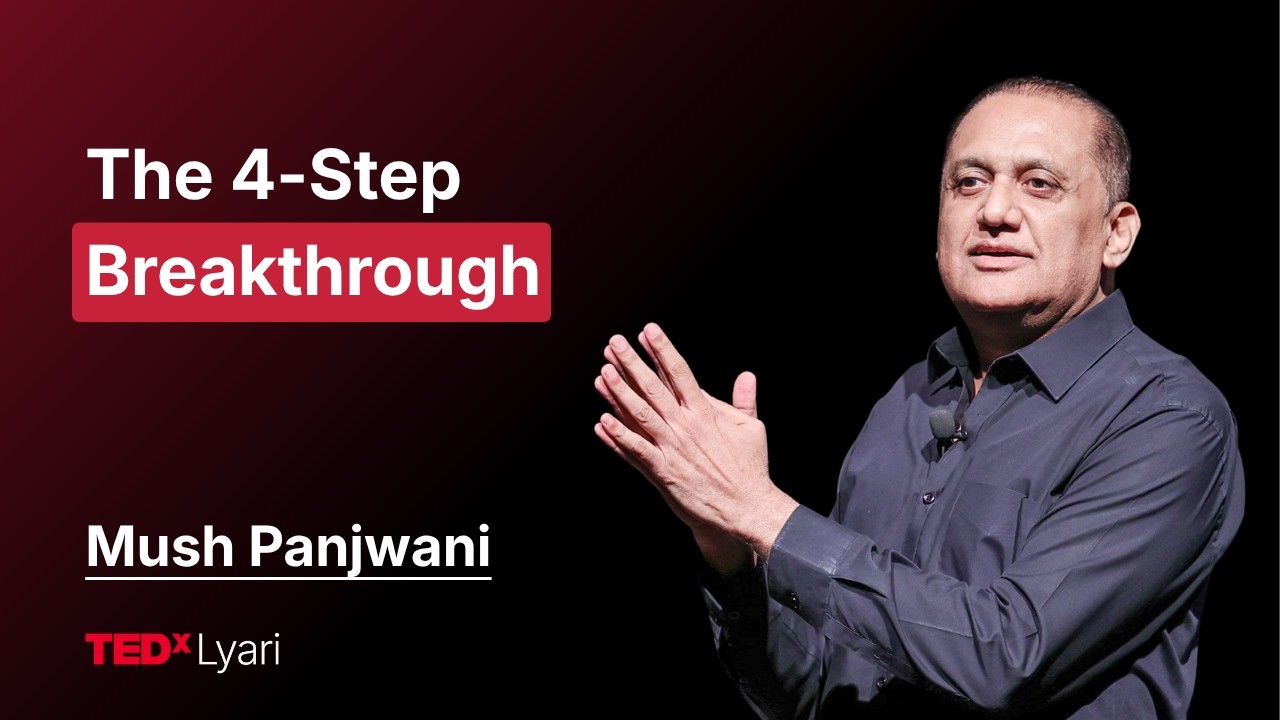
The 4-Step Breakthrough | Mush Panjwani | TEDxLyari
Keywords
Summary
159 words
Critical Evaluation
Value of the Information & Strength of the Argument
The value of this talk lies primarily in its inspirational storytelling and practical simplicity. Panjwani effectively demonstrates how a structured approach can lead to tangible results, using his own life as evidence. However, the argumentation is largely based on personal testimony rather than empirical data. He offers no statistical evidence or controlled studies to support the efficacy of his four-step method, relying instead on selected success stories. The persuasion is emotional and rhetorical, with audience engagement and applause, but the logical framework is straightforward and easy to follow. The speaker’s credibility is established through his professional background and visible achievements, but the lack of external references or scientific validation limits the argument’s robustness. The talk would benefit from referencing established goal-setting theories, but it does offer a memorable and actionable mnemonic.
Scientific Rigor, Source Quality, Title Accuracy
The speaker provides no sources during the talk; the only reference in the description is the generic TEDx link. He mentions reading self-help books like ‘Dream Big’ and ‘Power of the Mind’, but without specifying authors or editions. The talk is more of a motivational narrative than a scientific exposition, so the absence of rigorous sourcing is expected but still a limitation. The title ‘The 4-Step Breakthrough’ appropriately aligns with the content, as the speaker consistently revisits the four steps. No misleading claims about external evidence are made, but the reliability of the content is entirely dependent on the speaker’s personal credibility. The video description offers no additional references, and there are no comments to analyze for public trends.
265 words
Title / Content Match
The title accurately reflects the talk's focus on a four-step framework (dream, goal, plan, action) for personal breakthrough.
Quality & Reliability
5/10
The talk is an anecdotal personal narrative without empirical evidence or citations, but it is coherent and based on four decades of experience in sales, marketing, and coaching.
Key Moments
Markers derived by PSI from the transcript: the creator did not define chapters.
- Introduction to the speaker's childhood in extreme poverty.
- Story of receiving a bicycle to attend college.
- Emphasis on writing down dreams and making a life to-do list.
- Explanation of the four steps: Dream, Goal, Plan, Action with detailed examples.
- Family achievements and final message that starting point doesn't determine destination.
Cited Sources
- TEDx Program — Official TEDx page mentioned in the video description.
Contribution & Novelties
The talk offers a simple, memorable framework for personal achievement, combining common self-help principles into an accessible acronym. While not original in its components, the speaker’s personal narrative adds authenticity and relatability. The practical advice on converting dreams into specific, time-bound goals and actionable plans is consistent with well-established psychological concepts, but presented without explicit connection to academic research.
Pour aller plus loin :
- SMART criteria — Provides a structured method for goal setting, complementary to the speaker’s ‘Goal’ step.
- Goal setting — Overview of the psychological theory behind goal setting and its effectiveness.
- Self-efficacy — Explains the belief in one’s ability to succeed, which underpins the ‘Action’ and perseverance aspects of the talk.
114 words
Radar Profile
The radar profile shows high scores in information quantity and moderate quality, but very low technical level and low reliability. This indicates an accessible, inspirational talk with substantial content but limited scientific depth and external validation.