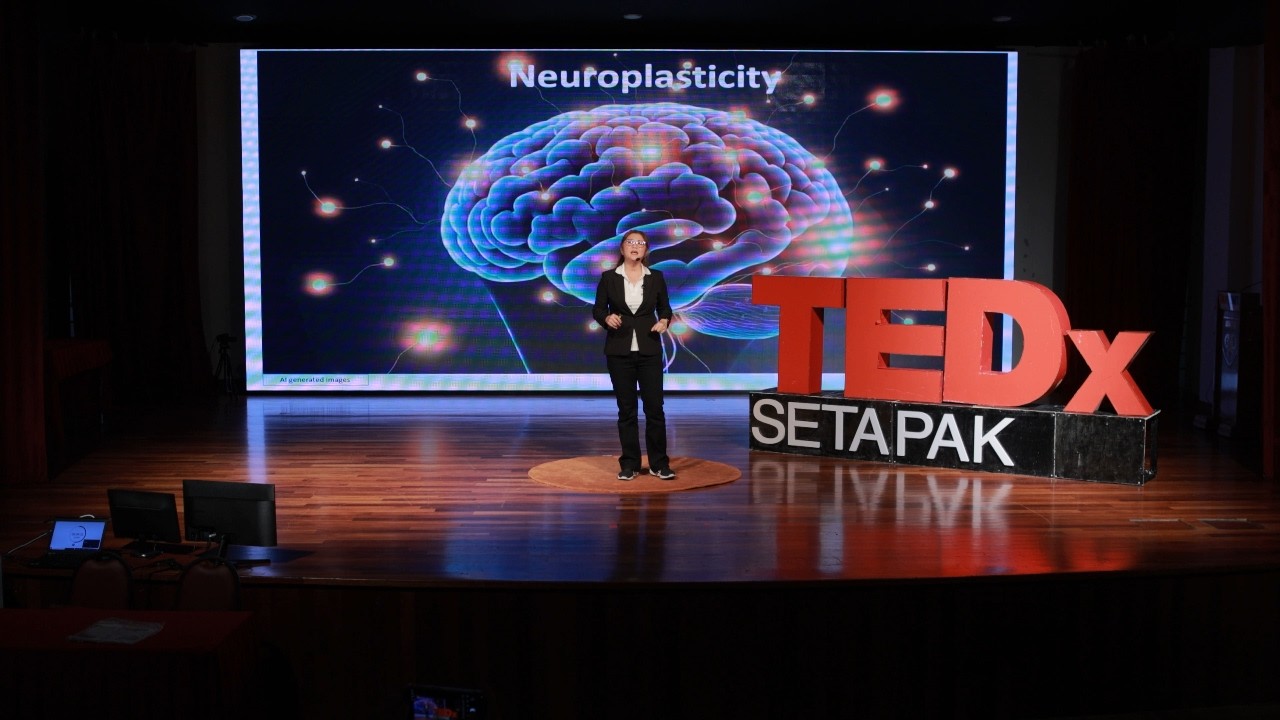
Be Your Own Hero | Chloe Ong Hui Ping | TEDxSetapak
Keywords
Summary
257 words
Critical Evaluation
Value of the Information & Strength of the Argument
The informational value lies almost entirely in the narrative structure rather than in transferable knowledge. The talk offers a coherent, well-sequenced account of one person’s trajectory, and the causal chain it proposes is explicit: an early labelling event, internalisation of the label, a deliberate decision to act, repeated exposure to the feared situation, accumulated competence, and a revised self-description. That chain is intuitively plausible and is what the audience is asked to generalise. The two conceptual anchors — neuroplasticity and the brick-by-brick model of confidence — are deployed as interpretive frames rather than as demonstrated claims. Neuroplasticity is correctly glossed as experience-dependent rewiring that persists across the lifespan, but the account omits the qualifications that matter (the effortful nature of change, timescales, the role of sleep and feedback, the difference between skill acquisition and belief revision). The confidence metaphor is a useful heuristic rather than a model, and the Marco vignette is a hypothetical designed to illustrate reframing rather than to report an event. The Italy assignment story is the strongest passage because it shows the earlier learning actually being used under stress, though it is presented as a success story without the failure modes that would make it instructive. Argumentatively, the talk reasons by analogy and by personal testimony; it makes no attempt to address counter-evidence, such as people who do the same work and do not obtain the same outcome, or the role of structural factors in promotion decisions. A substantial part of the evidence offered is affective rather than probative — applause, a photograph, a gelato. The final claim that ‘biologically we are designed for success’ overstates what the cited science supports and is best read as motivational framing. The talk’s genuine value is as a demonstration of how a self-narrative can be revised and rehearsed, offered as an example rather than as a prescription, and it is at its weakest when it drifts into universal claims about what anyone can achieve.
Scientific Rigor, Source Quality, Title Accuracy
Sourcing is minimal. The only external authority named is a neuroscientist referred to phonetically as ‘Dr. leave’, with no first name, affiliation, publication or quotation, which makes the reference effectively unverifiable from the talk alone. The second reference, to freestyle skier Eileen Gu, is a real public figure used as an anecdotal illustration of focus and discipline attributed to neuroplasticity, but no interview or source is given. No study, dataset, book title or article is cited anywhere, and the single link in the description points to the general TEDx programme page rather than to any supporting material. The scientific content that is present — neuroplasticity as experience-dependent reorganisation, the lifelong capacity for learning — is accurately stated at a general level, and the speaker does not misattribute specific findings. What is missing is any distinction between well-established mechanisms and speculative extension of those mechanisms to self-narrative and career outcomes. The title-to-content fit is strong: the closing line and the whole arc deliver on the promise of becoming one’s own hero, with only mild metaphorical stretch.
515 words
Title / Content Match
The title matches the content: the talk builds entirely around the idea that one should stop waiting for an external saviour and become one's own hero, closing on that exact line. Slight overreach in that the 'hero' framing is mostly a metaphor for self-directed change rather than a developed argument.
Quality & Reliability
4/10
Anecdotal, first-person motivational talk. The central concept (neuroplasticity) is real and correctly described in broad strokes, but the speaker is not a researcher, the cited neuroscientist is named only vaguely ('Dr. leave'), and no study, paper or data is provided. Claims such as 'our brains are biologically designed for success' are rhetorical rather than demonstrated. Nothing is fabricated outright, but evidential support is thin and essentially illustrative.
Key Moments
Markers derived by PSI from the transcript: the creator did not define chapters.
- Introduction: childhood spent reading alone, single-word replies, and the aunt's suggestion to go outside and play with friends.
- Her mother's remarks about weight and future marriage, and the child's realisation that people judge on appearance.
- At twelve, a classmate's birthday party she is not invited to; sitting on the swing in front of her house asking 'am I not good enough?'.
- At fifteen she decides to act on two problems — appearance and communication — and begins reducing portions and joining school activities.
- The 'what if we are all taking our time' reframing: labels applied while someone is still a work in progress, and the promotion example of being bypassed for being 'too quiet'.
- Introduction of neuroplasticity via 'Dr. leave', explained as the brain wiring itself for new habits, skills and self-narratives — and also for harmful ones.
- Eileen Gu cited as an example of neuroplasticity supporting focus and excellence; the speaker then recounts twenty-eight years as a chartered accountant.
- Confidence described as a wall built brick by brick through repetition, illustrated by the hypothetical Italian critic 'Marco' and the choice between breaking the wall and treating criticism as feedback.
- The Italy assignment: leading unfamiliar experts in a difficult conversation with an unhappy third party, and the panic that follows.
- Recall of the swing memory restores calm; the team succeeds, she is invited back for two more years, and she closes with 'the moment you stop waiting for a hero, you start becoming one'.
Cited Sources
- TEDx — official programme page — The only link in the video description; it documents the TEDx format and states that the talk was given at an independently organised local TEDx event (TEDxSetapak).
- Neuroplasticity — concept attributed to 'Dr. leave' (neuroscientist named only phonetically in the talk) — Invoked around 08:10 as the mechanism by which repeated practice rewires the brain for new habits, skills and self-narratives. No first name, affiliation or publication is given, so the reference cannot be traced from the video itself.
- Eileen Gu — Olympic freestyle skier — Cited around 10:20 as an example of an athlete who credits neuroplasticity for her focus, discipline and excellence; no interview or source is referenced in the talk.
Concurring Sources
- Neuroplasticity — Provides the standard scientific account of experience-dependent neural reorganisation, consistent with the talk's general description of the mechanism, including its lifelong character and its capacity to encode maladaptive patterns.
- TEDx — official programme page — Confirms the format and the independently organised local-event context stated in the description.
Contribution & Novelties
The talk’s originality is not conceptual — both neuroplasticity and self-narrative reframing are widely circulated ideas — but rhetorical. It links three elements that are usually treated separately: the labelling of introversion as a deficit, the deliberate use of low-stakes social exposure (library, chess club, choir) as a training ground, and the conversion of criticism into specific practice targets, summarised in the ‘brick by brick’ wall image. The most transferable contribution is the treatment of self-narrative as a learnable skill rather than a fixed trait, paired with the observation that the same plasticity mechanism can consolidate a limiting story as easily as an enabling one. The Italy assignment passage is the most concrete: it shows a rehearsed competence being retrieved under pressure by reactivating an earlier memory of overcoming, which is a recognisable rehearsal technique rather than a novel finding. Listeners should treat the general claims about human potential as motivational framing, not as established science.
Further reading:
- Neuroplasticity — Background on experience-dependent brain reorganisation, the concept the talk builds its mechanism on.
- Mindset — Covers fixed versus growth framing of ability, closely related to the talk’s argument about self-imposed limits.
- Self-concept — Academic overview of how self-descriptions form and change, relevant to the ‘self-narrative’ usage here.
- Impostor syndrome — Bears on the passage where she lists the internal objections (‘I’m not qualified’, ‘I’m not creative enough’) that block action.
- Eileen Gu — Reference entry for the athlete cited as an illustration of focus and discipline.
246 words
Radar Profile
The profile is strongly skewed toward accessibility and away from technical depth: high on communicative clarity and on the human-interest dimension, low on technical level and on evidential support. Information quantity sits mid-range because the talk is dense in anecdote but sparse in verifiable content, and overall reliability is capped by the absence of traceable sources. This is a narrative-driven profile, not an analytical one.