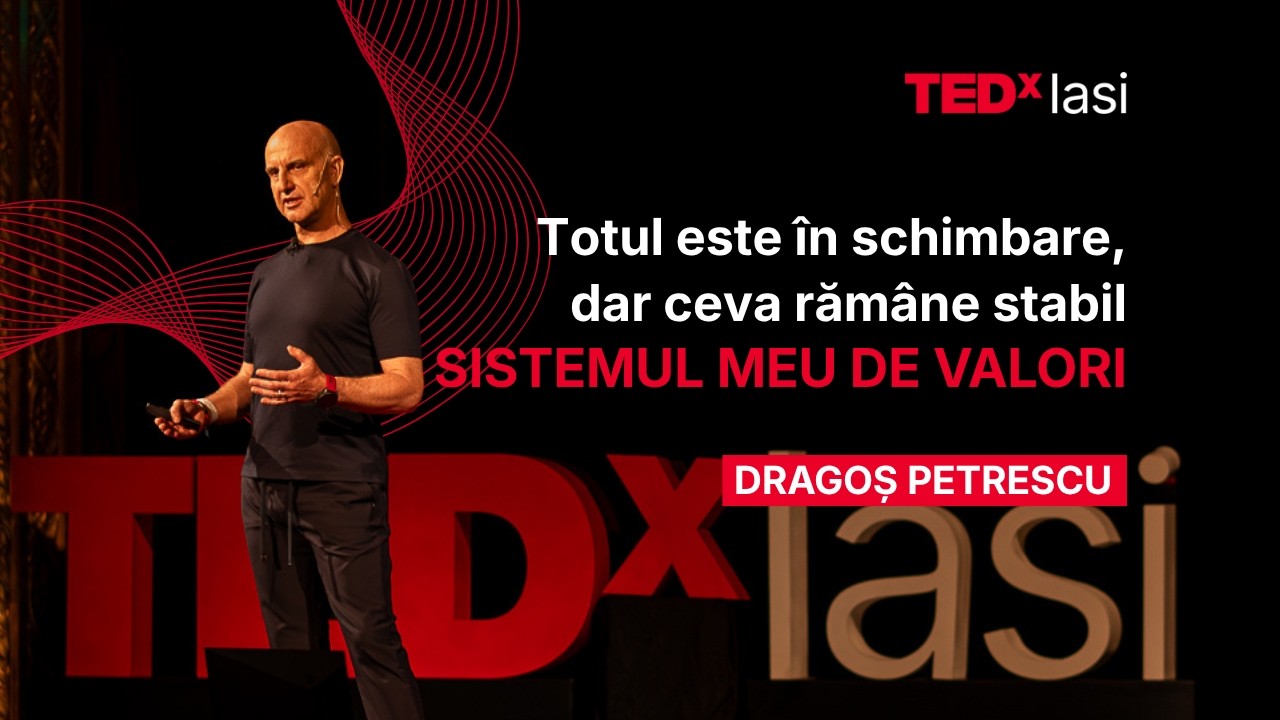
Greșelile sunt motorul transformării | Dragoș Petrescu | TEDxIasi
Mistakes are the engine of transformation | Dragoș Petrescu | TEDxIasi
Keywords
Summary
225 words
Critical Evaluation
Value of the Information & Strength of the Argument
The value of the information lies in the first-hand accounts of entrepreneurial failures, which are less common than success stories and offer concrete, relatable lessons. The main takeaways are practical: recognize mistakes quickly, admit them publicly to enable team learning, and maintain a stable value system. The argumentation is logically structured: it moves from personal case studies to a general framework about human behavior and organizational resilience. However, it remains anecdotal and does not provide statistical evidence or comparison with other companies. The credibility of the argument rests heavily on the speaker’s long career and authenticity, which makes it persuasive in a motivational context but not scientifically rigorous.
Scientific Rigor, Source Quality, Title Accuracy
The talk does not cite any external studies or scientific literature; the only source mentioned is the general TEDx website in the description. The speaker relies exclusively on personal experience, which limits the scientific rigor and generalizability of the claims. The quality of the sources is therefore low in an academic sense, though acceptable for an expert opinion talk. The title ‘Mistakes are the engine of transformation’ faithfully matches the content, as each example is used to illustrate how errors drive change. There is no attempt to quantify or verify the insights, and some statements about leadership and values are presented as self-evident truths. In conclusion, the talk is coherent and honest, but its scientific value is modest without accompanying evidence.
244 words
Title / Content Match
The title accurately reflects the core message: mistakes are presented as a driving force behind transformation, and the talk develops this idea through personal business failures.
Quality & Reliability
6/10
The talk offers a personal, experience-based account without external data or references; reliability rests on the speaker's long entrepreneurial track record but the claims are not independently verifiable.
Key Moments
Markers derived by PSI from the transcript: the creator did not define chapters.
- Opening questions about feeling misunderstood and taking wrong decisions.
- Introduction of City Grill, 42 restaurants, and the 'cemetery' of over 20 closed locations.
- First expansion to Timișoara and Constanța fails, both restaurants closed in under a year.
- 2015 seismic law forces the closure of two prestigious city-center restaurants.
- Backwerk master franchise: four locations closed after about two years due to price strategy and market readiness.
- Pandemic crisis: keeping teams, paying costs, and severing ties with two landlords who refused support.
- Core message: mistakes persist; the change is in speed of recognition and public acknowledgment.
- Personal evolution from faster, less people-focused decisions to slower, more precise, people-centered choices.
- Stable value system as foundation and final question to the audience.
Cited Sources
- TEDx Program — Official description mention of TEDx event format and local organization.
Contribution & Novelties
Original contribution: This talk reframes the common notion of ’learning from mistakes’ by arguing that the frequency of mistakes remains constant; instead, what evolves is the speed of recognition and the public ownership of errors. It offers a practical entrepreneurial perspective that can be applied to personal life, emphasizing a stable value system as the foundation for rebuilding after failures. The speaker does not introduce novel academic concepts but repackages existing leadership principles within an authentic narrative.
Pour aller plus loin :
- Growth mindset — Directly relevant to the idea that abilities and reactions can be developed.
- Psychological safety — Supports the importance of admitting mistakes publicly within a team.
- Organizational learning — Discusses how businesses learn from failures.
- Emotional intelligence — Relates to self-awareness and managing reactions to setbacks.
130 words
Radar Profile
The radar shows a talk with moderate informational quantity and quality, low technical level, and average reliability. This reflects an accessible personal narrative rather than a data-driven scientific analysis, with the main strength being authentic experience rather than methodological rigor.