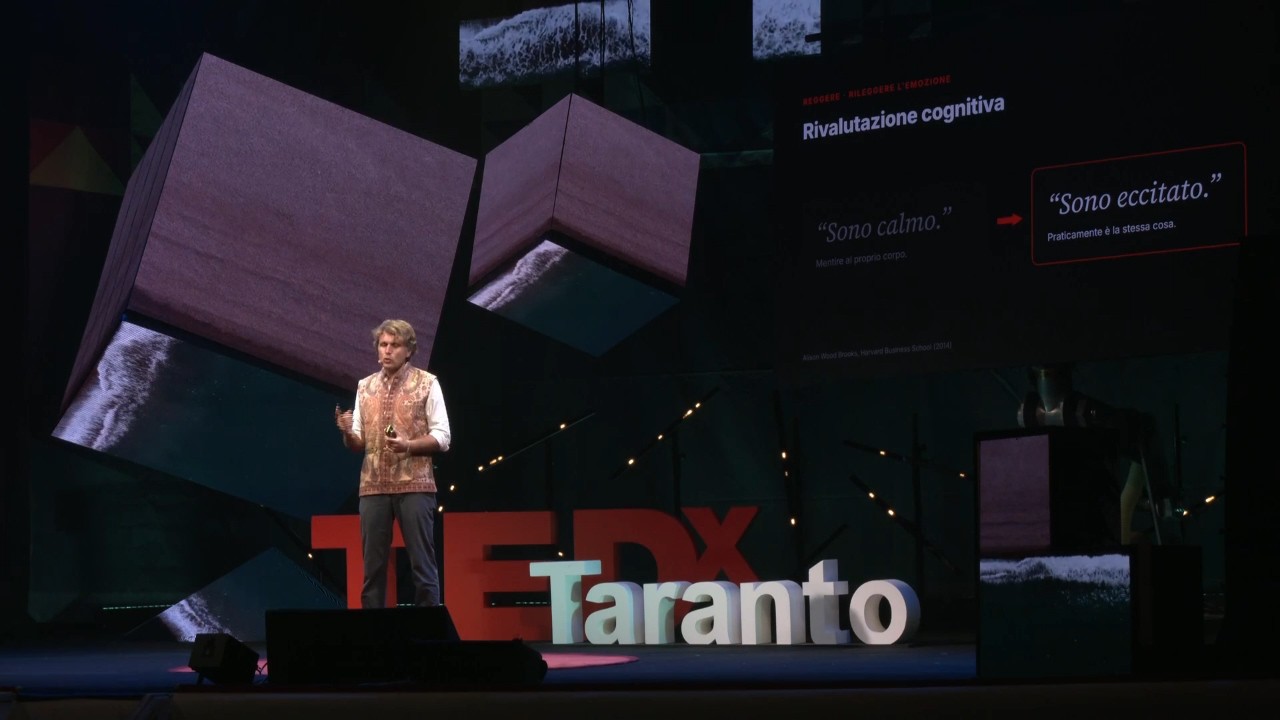
Cos'è la Resistenza Emotiva e perché è la vera competenza del futuro | Nicolò Andreula | TEDxTaranto
What Is Emotional Resistance and Why It Is the Real Skill of the Future | Nicolò Andreula | TEDxTaranto
Keywords
Summary
249 words
Critical Evaluation
Value of the Information & Strength of the Argument
The informational value lies less in new findings than in the assembly: the speaker takes a scattered set of well-known ideas from organisational psychology and emotion-regulation research and orders them into a memorable, immediately usable three-part structure (re-read, detach, recover). Each skill is paired with at least one concrete operational device — the emotion wheel for granularity, the ‘I am excited’ reframe for reappraisal, the ten-minute reset and extended-exhalation breathing for recovery — which makes the content transferable to a listener’s working day. The diagnostic framing of the manager’s day as a sequence of ‘hot’ and ‘cold’ moments is a genuinely clarifying move: it explains why the removal of routine analytical work is not merely a productivity change but a change in the emotional duty cycle. The weakest informational elements are the quantitative ones: the ‘10 km to marathon’ image, the ten-minute recovery figure and the claim that a short break measurably reduces emotional fatigue are asserted rather than evidenced, and the boundary conditions (for whom, under what workload, with what effect size) are never stated. On argumentation, the structure is clean and the sequencing is didactic, but the persuasive weight rests heavily on analogy (muscle training, captain and crew, archer and arrow) and on personal anecdote — Tokyo 2015, the surgeon parents in the audience, the backstage nerves before the talk. These anecdotes are used as proof of concept rather than as illustration, which is a recurrent slippage: a single managerial failure is offered as validation of a general model of leadership. There is also a dialectical shortcut in the empathy-versus-compassion section, where a conceptual distinction is presented as a settled neuroscientific分区 (’two trainings for two different brains’) without acknowledging that the two constructs overlap in the literature and are measured with instruments that do not map cleanly onto the popular definitions used on stage. The strongest argumentative move is the honest one at the end: the speaker repeatedly returns the burden to individual practice rather than to institutions, which is internally consistent with his thesis and gives the talk a clear actionable conclusion, even if it also conveniently sidesteps the structural causes of emotional exhaustion that his own emotional-labour reference implies.
Scientific Rigor, Source Quality, Title Accuracy
On scientific rigour, the talk sits at the level of informed popularisation rather than verified exposition. The historical anchor is solid and correctly attributed: emotional labour is indeed Arlie Hochschild’s concept, developed from her study of flight attendants, and the deep acting / surface acting distinction the speaker uses is a real and well-documented strand of that literature. Tiffany Watt Smith is a real scholar and The Book of Human Emotions a real book. Beyond these two named anchors, however, the sourcing dissolves: the Harvard experiment on telling oneself ‘I am excited’ is attributed to an unnamed professor with no study title, journal or year; the neuroscience of compassion versus empathy is invoked as a general authority (‘at the neuroscientific level’) without a single researcher, paper or imaging result; the vagus nerve, cold-water exposure and extended exhalation are bundled into a single sentence of physiological justification. The claim that ‘science tells us’ ten minutes suffices to restore emotional lucidity is the kind of precision without provenance that most inflates apparent rigour. Several passages also convert contested or context-dependent findings into categorical statements — notably that empathy is inherently depleting while compassion is protective, and that emotional labour can be neutralised by individual training alone, which understates the organisational determinants emphasised in the very literature cited. The absence of any discussion of effect sizes, replication status or conflicting results is the main rigour deficit. On source quality, the reference base is respectable but presented without traceability: a listener cannot reconstruct the evidence chain from the talk, and the only external link associated with the video is the generic TEDx organisational page, which points to no bibliography. On title/content fit, the title is accurate and the talk delivers what it announces; the mismatch is marginal and concerns emphasis rather than substance, since the ‘competence of the future’ claim is asserted in the opening and closing frames but argued mainly through present-day managerial experience rather than through evidence about future labour markets.
707 words
Title / Content Match
The title's promise (define emotional resistance and argue it is the key competence of the future) is honoured: the talk defines the concept, distinguishes it from emotional intelligence and delivers three named skills. The only gap is that the 'why it is the competence of the future' argument rests on a brief AI/automation premise rather than a developed demonstration.
Quality & Reliability
5/10
The talk is built on a genuine and well-established research tradition (emotional labour, deep vs. surface acting, cognitive reappraisal, empathy vs. compassion) and names two real authors (Arlie Hochschild, Tiffany Watt Smith). However, most scientific claims are invoked anonymously ('science tells us', 'a Harvard professor did this experiment'), no study, journal or date is cited, several empirical statements are compressed into rhetorical shortcuts, and the speaker explicitly concedes that he asked a non-specialist for the 'how to train it' answer and then improvised his own. The result is a coherent and practically usable framework presented with more scientific authority than the sourcing on stage actually supports.
Key Moments
Markers derived by PSI from the transcript: the creator did not define chapters.
- Opening on Article 1 of the Italian Constitution ('a Republic founded on labour') used to argue that responsibility for adapting to change is also individual.
- Introduction of emotional labour via Tiffany Watt Smith and The Book of Human Emotions, framed as 'the fatigue of feeling and expressing emotions'.
- Attribution of the concept to Arlie Hochschild's 1980s study of flight attendants required to remain smiling and empathetic under turbulence and complaints.
- Extension of the 'contract smile' beyond cabin crew to humanoid robots in bars, hotels and hospitals, and the argument that humans must become more human to remain preferable.
- The manager's day reframed as 'hot' moments (listening, reassuring, inspiring people) and 'cold' moments (spreadsheets, reports), the latter disappearing into algorithms and removing recovery time.
- First skill, re-reading: deep acting versus surface acting, and the claim that authentic reappraisal is less depleting than faked emotion.
- Emotional granularity: using an emotion wheel and a wider vocabulary to distinguish frustration, anxiety and tiredness, with a critique of emoji as emotional shorthand.
- Cognitive reappraisal: the Harvard experiment comparing 'I am calm' with 'I am excited', extended to tennis players and to the pressure of a US Open final.
- Second skill, detaching: the empathy-versus-compassion distinction, empathy fatigue, and detached participation illustrated by the surgeon parents and by Arjuna and Krishna in the Bhagavad Gita.
- Third skill, recovering: ten-minute breaks, cold-water exposure, exhalations longer than inhalations and the vagus nerve, then detachment, relaxation and absorbing distraction — explicitly not phone scrolling.
- Closing argument: emotional resistance is trainable and is an individual responsibility that must be actively defended as a competitive human advantage in an AI workplace.
Cited Sources
- Arlie Russell Hochschild — research on emotional labour (The Managed Heart, 1983) — Explicitly named as the originator of the emotional labour concept, derived from a study of flight attendants' required smiling and empathy.
- Tiffany Watt Smith — The Book of Human Emotions (Italian edition: Atlante delle emozioni umane) — Named as the emotion specialist whose conversation prompted the talk; the speaker attributes the revival of the emotional labour concept to her and asks her how emotional resistance can be trained.
- Unnamed Harvard professor's experiment on anxiety reappraisal as excitement — Described as an experiment in which students facing a stressful task performed better after saying 'I am excited' than after saying 'I am calm'; no name, publication or year is given.
- The Bhagavad Gita — the exchange between Arjuna and Krishna — Invoked to illustrate 'detached participation': 'you have a right to action, not to the fruits of action'.
- TEDx — official organisation page — Only external link supplied with the video, describing the independently organised TEDx format; it contains no bibliography for the scientific claims made.
Concurring Sources
- Emotional labor — Wikipedia — Confirms the attribution to Arlie Hochschild, the flight-attendant origin of the concept, and the surface acting versus deep acting distinction used in the first part of the talk.
- Cognitive reappraisal — Wikipedia — Confirms that reappraisal is an established, widely studied emotion-regulation strategy, supporting the talk's second skill and its reinterpretation of anxiety as excitement.
- Compassion fatigue — Wikipedia — Confirms that sustained empathic engagement in caregiving and service roles is associated with measurable exhaustion, which underpins the talk's diagnosis of empathy fatigue.
Dissenting Sources
- Compassion fatigue — Wikipedia — The talk presents compassion as the sustainable alternative to depleting empathy. The caregiving literature shows that compassion-based professional engagement is itself associated with burnout and secondary traumatic stress, so the empathy/compassion opposition is less protective than the speaker implies. Meta-analytic work on emotional labour (Hülsheger and Schewe, 2011, Journal of Occupational Health Psychology) further finds that deep acting is also positively related to strain, only less strongly than surface acting — a nuance the talk flattens into a clean opposition.
- Vagus nerve — Wikipedia — The talk offers cold-water exposure and exhalation-longer-than-inhalation breathing as science-backed recovery tools via vagal activation. The physiological rationale is plausible and documented, but the specific claim that ten minutes of such practice measurably restores emotional lucidity in working conditions is an extrapolation well beyond what the cited-level evidence supports, and no dose, protocol or outcome measure is given.
Contribution & Novelties
The genuine contribution is terminological and structural rather than empirical. By naming ’emotional resistance’ as a capacity distinct from emotional intelligence, the speaker gives a label to a widely felt but poorly articulated problem: the fact that emotional work is now a continuous duty rather than an episodic one, and that the removal of routine analytical tasks has eliminated the low-demand intervals that used to function as recovery. The second contribution is the operational translation of that idea into three trainable skills with concrete devices attached, which turns an abstract appeal to ‘be more human’ into a checklist. The third is a rare acknowledgement, within a motivational register, that empathy itself can be a liability and that a shift toward compassion and deliberate detachment is not coldness but sustainability. What the talk does not deliver is new evidence: everything it presents is a re-description of existing organisational psychology and emotion-regulation research, recombined for a general audience.
Further reading:
- Emotional labor — Background on Hochschild’s concept, surface versus deep acting, and the strain outcomes the talk summarises.
- Cognitive reappraisal — The emotion-regulation strategy underlying the ‘I am excited’ reframe and the reinterpretation of pre-performance stress.
- Compassion fatigue — Useful counterweight to the talk’s empathy/compassion binary, since compassion-based caring roles are themselves documented as depleting.
- Bhagavad Gita — Context for the Arjuna and Krishna passage used to illustrate detached participation; the related concept is usually discussed as nishkama karma (action without attachment to results).
- Tiffany Watt Smith, The Book of Human Emotions — The reference point the speaker explicitly names; relevant for the historical and cultural variability of emotional vocabularies, which supports the ’expand your emotional vocabulary’ argument.
- Emotional granularity — The research construct behind the emotion-wheel exercise; worth consulting directly, since the talk presents the idea without its measurement literature.
299 words
Radar Profile
The profile is that of a well-crafted popular talk: information quantity and quality sit in the mid range, technical depth is deliberately low, and global reliability is moderate. The strong practical value and clear structure pull the profile upward, while the absence of traceable, attributable evidence holds reliability back.