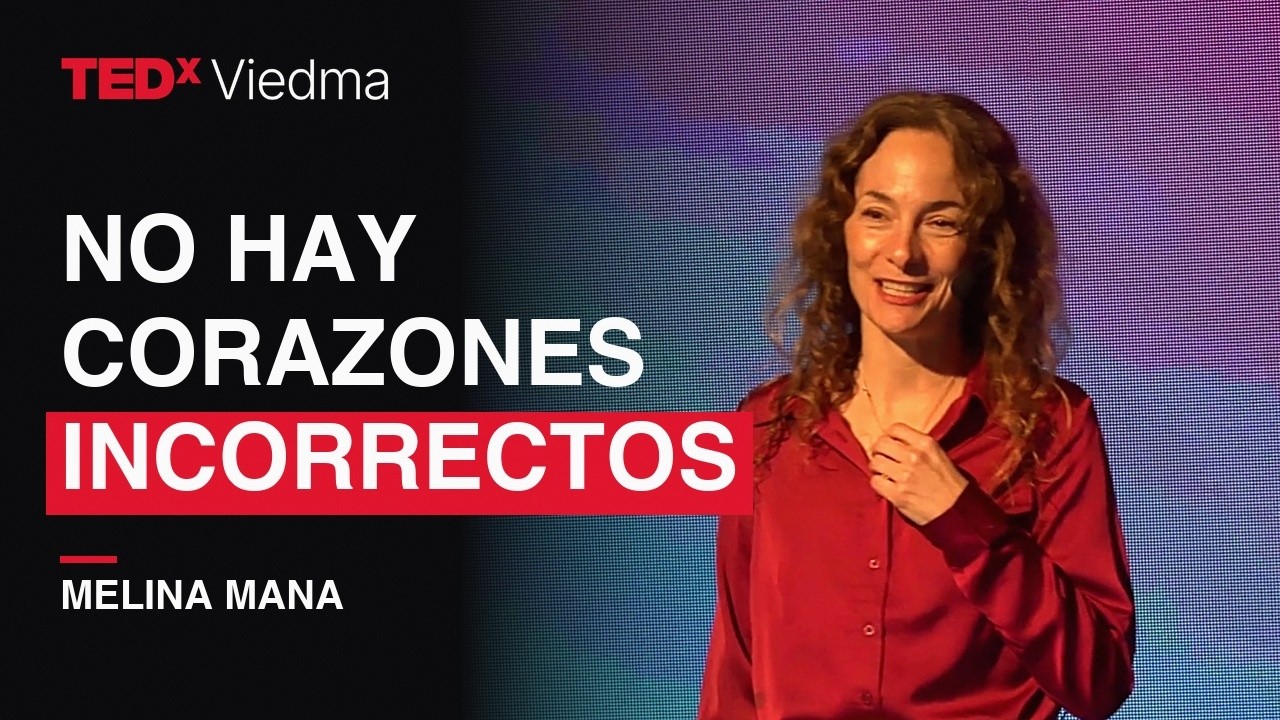
No hay corazones incorrectos | Melina Mana | TEDxViedma
There are no wrong hearts | Melina Mana | TEDxViedma
Keywords
Summary
A ten-minute TEDx talk by Melina Mana, a cardiologist and founder of Cardium, built around a deceased patient named Rosa. Rosa kept bringing relatives and neighbours to the consultation but never booked an appointment for herself, always answering ‘I’m fine, not yet’ — until she died shortly after finally being seen. Mana uses this story to point at a paradox: people who clearly understand the importance of cardiac check-ups, and who bring their loved ones in, indefinitely postpone their own prevention.
Her explanation is a bias in the information everyone shares. She proposes a thought experiment: imagine three centuries of medical science devoted exclusively to the right foot, then imagine someone with pain in the left foot dismissing it because it is not the foot that has been studied. This, she argues, is what happened with the female circulatory system, which only began to be seriously studied roughly twenty-five years ago.
She recalls being taught that acute coronary syndrome presents as central chest pressure radiating to the arm and neck — a picture largely derived from male patients. In women, she notes, classic symptoms may be absent and an infarction can manifest as profound fatigue, breathlessness, or pain confined to the arms or back. Cardiovascular disease, she stresses, kills more women than men.
She then cites a 2016 study of over a thousand hospitalised patients in which those treated by a female physician died less often, and follow-up work that traced the effect not to sex itself but to the quality of the clinical encounter: exchange of information, shared decision-making, a human bond.
She closes with three lessons drawn from Rosa: that humanity walking on one leg goes nowhere, that self-care cannot be postponed without shifting the burden onto those one claims to protect, that the heart gives no warning, and that science without conscience is of no use.
309 words
Critical Evaluation
Value of the Information & Strength of the Argument
The informational payload is modest but real. The talk delivers three substantive claims: that cardiovascular disease is the leading cause of death in women; that clinical teaching and research have historically been built on male presentations, so that female symptom profiles are under-recognised; and that the physician–patient relationship is measurably associated with outcomes. Each is defensible and each is under-documented here. The speaker gives one date (2016) and one order of magnitude (‘more than a thousand patients’) for the study she invokes, but never names it, its journal, or its effect size, and never quantifies the mortality gap between women and men, the proportion of atypical presentations, or the size of the survival difference attributed to physician sex. The result is a talk that is informative in direction but not in magnitude.
The argumentation is competent in its rhetorical construction. The ‘right foot / left foot’ thought experiment is a clean and genuinely illuminating way of making a sampling bias intuitive, and it does real explanatory work: it converts an abstract epidemiological point into a felt asymmetry. The Rosa narrative frames the talk and returns at the end, giving the argument a closed structure. The pivot from ’treated by a woman’ to ’the characteristics of the encounter’ is the strongest logical move in the talk, because it explicitly refuses the superficial reading (sex of the physician) in favour of the mechanism (quality of interaction) — a move the speaker attributes to the researchers themselves, which is accurate to how that literature was subsequently interpreted.
The weaknesses are equally clear. Some inferences are asserted rather than argued: the claim that patients who bring relatives necessarily understand the importance of screening is a plausible premise, not a demonstrated one, and the leap from ’they know’ to ’therefore the obstacle must be informational bias’ excludes competing explanations (cost, access, anxiety avoidance, competing obligations) that the talk does not mention. The metaphor of the left and right foot, elegant as it is, compresses a complex phenomenon — the historical exclusion of women from clinical trials, differences in presentation, diagnostic bias, and disparities in treatment — into a single mechanism. The final maxim, ‘science without conscience is of no use’, is a moral conclusion rather than a demonstrated one. Overall the reasoning is coherent and honest about its anecdotal anchor, but it substitutes vivid framing for the quantitative grounding that would make the case compelling to a sceptical listener.
Scientific Rigor, Source Quality, Title Accuracy
On scientific rigour, the talk is careful about what it does not overclaim but loose about what it does. The speaker avoids presenting the sex-of-physician finding as a biological effect and explicitly redirects it toward the relational mechanism — an intellectually honest move that many popular accounts of the same study get wrong. She also correctly situates the shift in women’s cardiovascular research in a recent timeframe rather than presenting it as settled history. Against this, the scientific apparatus is essentially absent: no study is named, no author, no journal, no numerical result, and no distinction is drawn between observational association and causation, which matters greatly for a finding linking physician sex to in-hospital mortality. The epidemiological claim that cardiovascular disease kills more women than men is stated without the age structure or the caveat that men still dominate at younger ages, a nuance the format arguably requires.
On the quality of sources, the talk cites one empirical study in passing and otherwise relies on the speaker’s professional experience. The video description contains no bibliography — only the generic TEDx link — so a viewer cannot trace the 2016 study, the symptom literature, or the data on cardiovascular mortality. The reference to what she was taught in medical school functions as an oral-history source rather than a documented one. There is nothing fabricated or pseudo-scientific here; the sourcing is simply thin and unverifiable from the material provided.
On title–content adequacy, ‘There Are No Incorrect Hearts’ is a poetic formulation that captures the concluding idea that heart disease does not discriminate, but it could equally describe a talk on grief, organ donation, or ethics. The description corrects this by naming prevention, cardiac care and the physician–patient bond, but the title alone does not orient the viewer toward the actual content, which is women’s cardiovascular health.
723 words
Title / Content Match
The metaphorical title 'There Are No Incorrect Hearts' fits the closing message — the heart does not choose who it affects — but it says nothing about the actual subject, which is cardiovascular prevention in women and the doctor–patient relationship. It is evocative rather than informative.
Quality & Reliability
6/10
The talk rests on a genuine clinical experience of the speaker, a practising cardiologist, and refers to a real body of research (a 2016 study on physician sex and in-hospital mortality, plus the broader literature on cardiovascular disease in women). But the presentation is oral and persuasive rather than evidential: no study is named, no figures (effect sizes, cohorts, dates beyond '2016') are given, no bibliographic reference appears in the description, and the argument relies heavily on a metaphor and a personal anecdote. The core claims are consistent with the established literature, but the viewer cannot check them from what is provided.
Key Moments
Markers derived by PSI from the transcript: the creator did not define chapters.
- Opening: the speaker introduces Rosa, the patient who brought everyone to the consultation except herself.
- The tree-of-life pendant given by Rosa's family after her death, and the question the speaker keeps asking in her consulting room.
- The paradox: relatives who know every detail of a patient's history but answer 'not yet' when asked about their own check-up.
- The thought experiment: three centuries of medical science devoted only to the right foot, and the dismissal of pain in the left.
- Translation of the metaphor into cardiovascular disease in women, the leading cause of female mortality.
- How female infarction symptoms differ from the classic male presentation taught in medical school — fatigue, breathlessness, arm or back pain.
- The 2016 study: hospitalised patients treated by female physicians died less often, and follow-up work isolating the clinical encounter as the mechanism.
- The value of the physician–patient bond: exchange of information and shared decision-making as the operative variable.
- Closing lessons from Rosa: self-care cannot be postponed, the heart gives no warning, and 'science without conscience is of no use'.
Cited Sources
- TEDx — official programme page — The only link provided in the video description; documents the independent TEDx format under which the talk was given.
- Unnamed 2016 study on physician sex and in-hospital patient mortality — Invoked around 06:45 as a study of more than a thousand hospitalised patients showing lower mortality among those treated by female physicians, with follow-up analyses attributing the effect to the quality of the clinical encounter. The talk gives no author, journal or title, so no verifiable reference can be attached.
Concurring Sources
- Comparison of Hospital Mortality and Readmission Rates for Medicare Patients Treated by Male vs Female Physicians (Tsugawa et al., JAMA Internal Medicine, 2016) — The study most plausibly matching the 2016 finding described in the talk: a large Medicare cohort in which patients treated by female internists had slightly lower mortality and readmission rates.
- World Health Organization — Cardiovascular diseases — Institutional reference confirming that cardiovascular disease is the leading cause of death globally, for women as well as men.
- American Heart Association — Professional body whose awareness campaigns and prevention guidance underlie the talk's emphasis on check-ups, risk factors and symptom recognition.
Contribution & Novelties
The talk’s originality lies less in its factual content — the epidemiological points are established — than in its framing. The ‘right foot / left foot’ fable is an efficient pedagogical device for conveying what a research sampling bias feels like from the inside, and the speaker’s willingness to move past the eye-catching headline (‘patients of female doctors survive more often’) to the underlying mechanism (‘what matters is the quality of the encounter’) is a more disciplined reading than the finding usually receives in popular coverage. The chain of reasoning that links a woman’s failure to book her own appointment to a centuries-long blind spot in cardiology is the talk’s genuine intellectual contribution.
Pour aller plus loin :
- Tsugawa et al., 2016 — Physician sex and patient outcomes (JAMA Internal Medicine) — The likely source behind the 2016 study cited in the talk; useful for reading the actual effect sizes and the observational caveats.
- Cardiovascular disease — Wikipedia (https://en.wikipedia.org/wiki/Cardiovascular_disease ) — Background on mechanism, risk factors and global burden.
- Ischaemic heart disease — Wikipedia (https://en.wikipedia.org/wiki/Coronary_artery_disease ) — Context for the symptom variability and the notion of atypical presentation discussed in the talk.
- Sex differences in medicine / women’s heart health — a concept worth exploring by name: the historical under-representation of women in cardiovascular clinical trials, and the resulting diagnostic bias.
- Shared decision-making in clinical practice — a concept worth exploring by name: the evidence base showing that information exchange and patient participation in decisions correlate with adherence and outcomes.
250 words
Radar Profile
The profile is that of an experience-based, communication-oriented talk: information density and technical depth are deliberately kept low, while the reliability score holds at mid-range thanks to a genuine professional anchor and an honest reading of the research cited. The gap between technical level and informativeness reflects a format that trades precision for persuasiveness rather than a speaker who lacks either.