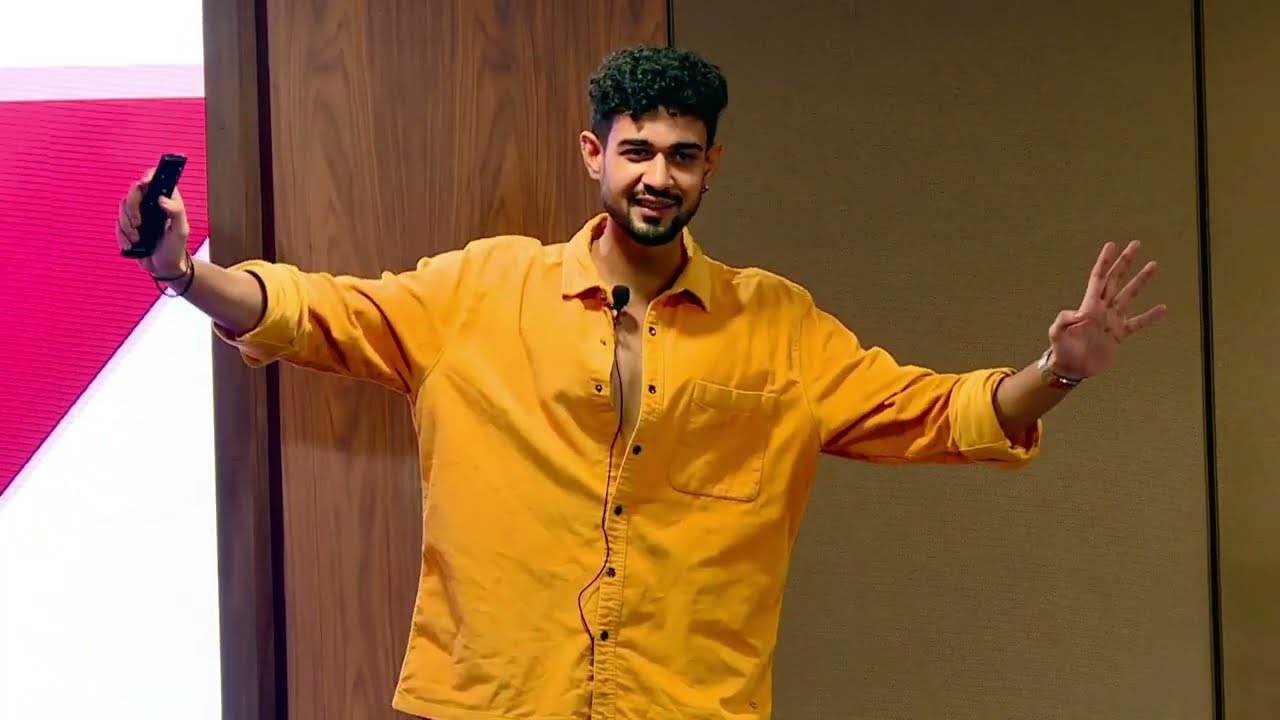
The Freedom to Explore | Ron Kariappa | TEDxNMIMS Indore
Keywords
Summary
172 words
Critical Evaluation
Value of the Information & Strength of the Argument
The value of this talk lies in its relatable personal narrative and its timely message about career flexibility in a world where skills rapidly evolve. The argumentation is built on a strong emotional appeal and logical progression: the speaker recounts specific turning points (lockdown change, modeling, moving to Mumbai) to illustrate the benefits of questioning assumptions. However, the evidence is entirely anecdotal; while this makes the talk authentic and persuasive to a general audience, it lacks empirical support or systematic analysis. The speaker also invokes a World Economic Forum statistic (39% of core skills changing by 2030) without providing a source, which weakens the scientific credibility. Nonetheless, the rhetorical structure effectively encourages introspection and offers a clear framework for personal growth.
Scientific Rigor, Source Quality, Title Accuracy
Scientifically, this talk does not present original research or cite academic sources; it is a personal testimony. The only external link in the description is to the general TEDx page, not to specific studies. The mention of the World Economic Forum is unsubstantiated by a direct reference. The title accurately matches the content, emphasizing the freedom to explore beyond conventional paths. The narrative is internally consistent, and the speaker’s authenticity adds to its trustworthiness, but the lack of verifiable data limits its scientific rigor. No audience comments were provided for analysis.
227 words
Title / Content Match
The title 'The Freedom to Explore' accurately reflects the core message about breaking free from predetermined career paths and embracing experimentation and unlearning.
Quality & Reliability
6/10
The talk is a personal testimonial with anecdotal evidence, not a scientific study. It is coherent and inspiring but lacks external validation. The speaker's authenticity and the logical flow of his narrative give moderate credibility, but the absence of verifiable data or references (except a passing mention of a World Economic Forum statistic) limits its scientific weight.
Key Moments
Markers derived by PSI from the transcript: the creator did not define chapters.
- Introduction: Ron Kariappa defines unlearning as questioning beliefs about oneself.
- Talks about following the conventional engineering path and feeling out of place.
- COVID lockdown led to self-reflection and losing 30 kilos, realizing he could change.
- Entering modeling and discovering a new side of himself, unlearning the idea of fixed identity.
- Moving to Mumbai without certainty of success, emphasizing the need to start before being ready.
- Conclusion: calls for unlearning and asks what you need to unlearn, not just learn.
Cited Sources
- TEDx page — General TEDx resource mentioned in the video description.
Contribution & Novelties
The talk’s original contribution is a personal, relatable perspective on unlearning as a crucial complement to learning, especially for young people navigating career choices. It challenges the notion of a single predetermined path and advocates for experimentation and self-questioning. While the concept is not new, the speaker’s concrete experiences add a practical dimension.
Pour aller plus loin :
- Unlearning (Wikipedia) — Explores the psychological and educational concept of discarding outdated knowledge or beliefs.
- Growth mindset (Wikipedia) — Carol Dweck’s theory on the belief that abilities can be developed, relevant to the speaker’s emphasis on change.
- Career counseling (Wikipedia) — Discusses how guidance can help individuals explore options, echoing the talk’s call for freedom in career paths.
116 words
Radar Profile
The radar profile shows a moderate quantity and quality of information, with a very low technical level, reflecting a motivational and anecdotal approach. Reliability is moderate, as the talk relies on personal experience rather than scientific evidence, but its coherence and authenticity provide some credibility.