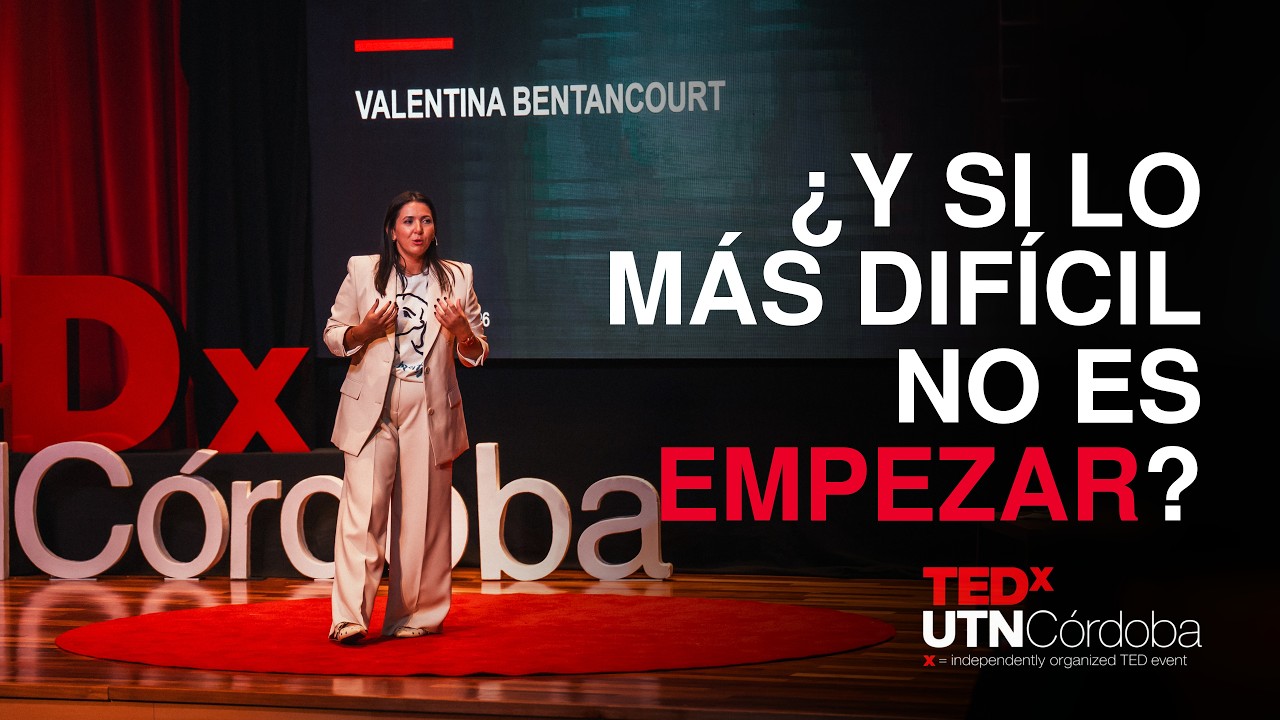
Sostener, lo que nadie nos enseña | Valentina Bentancourt | TEDxUTN Córdoba
Sustaining, what no one teaches us | Valentina Bentancourt | TEDxUTN Córdoba
Keywords
Summary
251 words
Critical Evaluation
Value of the Information & Strength of the Argument
The value of the talk lies in its reframing rather than in any factual contribution. The central distinction between the instant of starting and the daily labour of sustaining is genuinely useful and is grounded in a concrete case: a business that has existed for sixteen years, quantifiable in 5,840 days, with a stated shift in the founder’s role from production to management. The three lessons — willingness to change, accepting that growth feels like loss, and the temporal dimension of commitment — form a coherent progression rather than a list, and the anecdote of the cook who plated dishes differently from her own is used effectively to illustrate the ego problem in delegation. The argument’s strength is its consistency: the cooking analogy is announced as a deliberate frame and is then sustained throughout without being strained. Its weakness is that everything rests on the authority of a single personal trajectory. There is no counter-example, no case where sustaining was the wrong choice, no attempt to distinguish a project worth persisting with from one that should be abandoned beyond the general injunction to ’let go of what no longer serves’. The talk acknowledges that sustaining is not endurance at any cost, but leaves the criteria for that judgement undefined. The shift from descriptive observation (’this is what happened to me’) to prescriptive advice (’this is what leadership is’) is made without argumentative support. As a reflective, well-crafted narrative it is convincing; as a claim about how persistence and motivation actually work, it remains an untested hypothesis.
Scientific Rigor, Source Quality, Title Accuracy
Scientifically, the talk makes no claim to rigour and cites no research, no study and no external author; the only reference linked in the description is the generic TEDx organisation page, which documents the event format rather than any of the ideas expressed. The concepts mobilised — identity change, ego and delegation, the temporal structure of commitment, the critique of the ‘do what you love’ maxim — are all well-established themes in organisational psychology and motivation research, but they are invoked implicitly and without attribution, so a viewer receives the conclusions without the means of checking them. The evidence offered is anecdotal and unverifiable by nature: a single business, a single founder, no figures, no comparison group, no discussion of cases where the same approach failed. The quantification present is decorative (16 years, 5,840 days) rather than analytical. On the other hand, the talk is intellectually honest about its own scope: it presents itself explicitly as a life lesson drawn from a personal trajectory, not as research, and it avoids overclaiming causal effects, framing its conclusions as ‘perhaps’ and ‘after sixteen years I believe’. The fit between title and content is strong: ‘Sustaining, what nobody teaches us’ announces a reflection on persistence, and persistence is the object of the talk from first sentence to last, with the closing line reasserting the thesis that sustaining is transforming without losing the essence.
501 words
Title / Content Match
The title matches the content closely: the whole talk is built on the distinction between starting and sustaining, and returns to it explicitly at the opening, midpoint and close.
Quality & Reliability
4/10
A first-person account from a pastry chef and co-founder of a 16-year-old culinary business. The reasoning is internally coherent and the examples are drawn from lived managerial experience, but the talk offers no data, no quantified results, no cited research and no verifiable external evidence; every claim rests on personal testimony and analogy between cooking and life. It is honest and well-structured as an experiential narrative, not as a source of demonstrable knowledge.
Key Moments
Markers derived by PSI from the transcript: the creator did not define chapters.
- Opening thesis: we confuse starting with building; starting lasts an instant, sustaining is a decision taken every day.
- The founding question of the talk: what do we do when the emotion of the beginning disappears?
- Self-introduction: 16 years in gastronomy, creative chef and partner at María Antonieta; the admission of periods of fatigue and doubt.
- Cooking framed as a school for life — a recipe can be perfect and still fail, as can a project.
- First lesson: to sustain, you must be willing to change — having to learn to hire, negotiate, fire, lead and say no.
- The paradox of growth: growing sometimes feels like losing control, centrality and the need to be right.
- The cook who plated dishes differently: the ego shock of no longer being the best, and the redefinition of leadership as creating space for others.
- Critique of the culture of extraordinary beginnings and of the maxim 'do what you love and you will never work a day'.
- Sixteen years as 5,840 days: the value built on ordinary days, the 'Tuesdays' when nobody congratulates you.
- Closing thesis: sustaining is not staying still or enduring at any cost, it is transforming without losing the essence.
Cited Sources
- TEDx — independently organised TED events — Only link provided in the video description; documents the TEDx event format under which the talk was given, not a source for any of the ideas expressed.
Concurring Sources
- Grit (personality trait) — Research on perseverance and consistency of interest for long-term goals converges with the talk's thesis that sustained commitment, not initial enthusiasm, distinguishes completed projects.
Contribution & Novelties
The talk’s originality is not conceptual — persistence, identity change and delegation are long-standing themes — but rhetorical and experiential. It proposes a clean operational distinction between the instant of starting and the daily decision to sustain, and it gives that distinction a temporal texture through the image of the ordinary ‘Tuesday’ as the real unit of construction. It also contributes a specific and seldom-heard observation on the emotional cost of delegation: the founder describes the discomfort of encountering an employee who does the core craft better than she does, and the redefinition of her role from best practitioner to creator of a space where others can excel. Finally, it directly challenges the widely circulated maxim that loving your work means never working again, replacing it with the more sober idea that affection for a project does not immunise against fatigue — a useful corrective to motivational discourse.
Further reading:
- Grit (personality trait) — Overview of the psychological construct of perseverance for long-term goals, the research tradition closest to the talk’s central notion of sustaining.
- Carol Dweck — Growth mindset research, relevant to the talk’s claim that identity must be revised repeatedly rather than defended.
- Impostor syndrome — Useful complement to the segment on ego, indispensability and the discomfort of no longer being the best at one’s craft.
- Psychological contract and role transition in founder-led firms — academic literature on the shift from technical founder to manager, which describes the same identity dislocation the speaker recounts.
- Self-determination theory and the distinction between intrinsic motivation and sustained commitment — relevant to the talk’s implicit claim that initial enthusiasm is an unreliable predictor of persistence.
273 words
Radar Profile
The profile is dominated by a very low technical level and only modest information density, offset by a reasonably high quantity of information for an eleven-minute talk, carried by a coherent and well-organised narrative. Reliability sits in the lower-middle range because everything rests on a single unverifiable personal trajectory with no data or cited research. The shape is typical of an experiential personal-development talk: strong on structure and framing, weak on evidence and measurable depth.