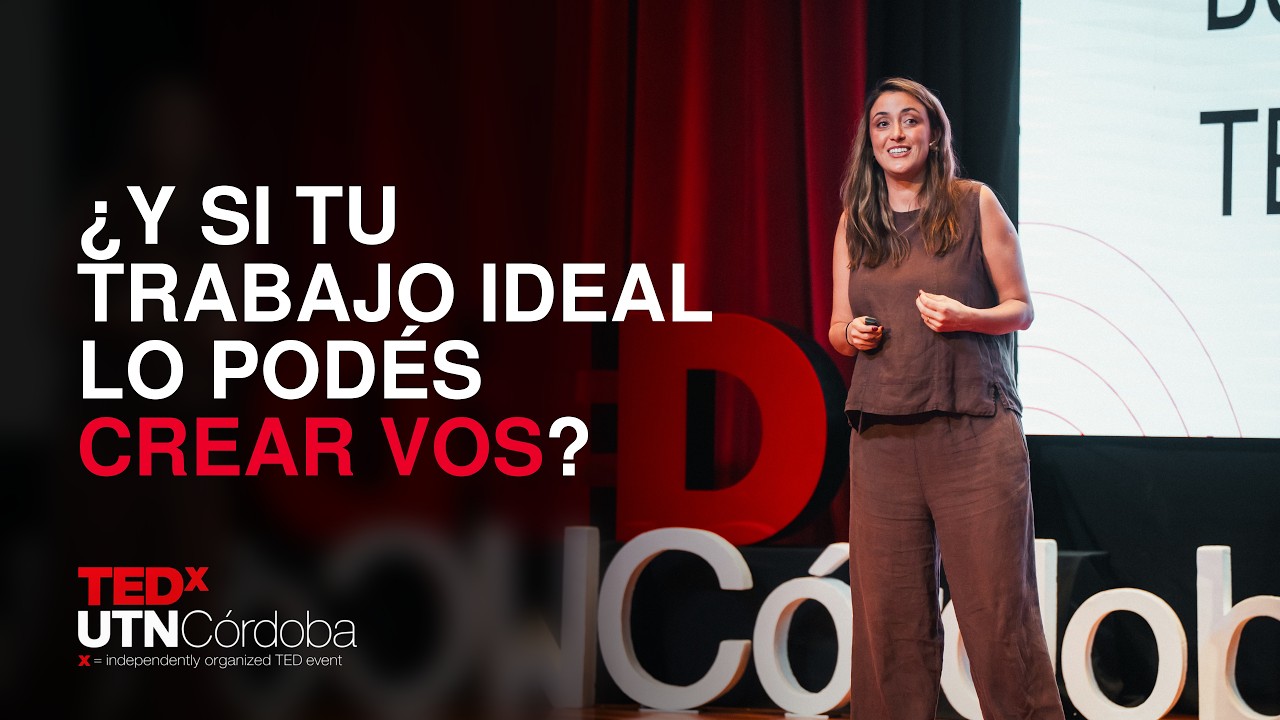
El mapa mas importante no esta en google maps | Agustina López | TEDxUTN Córdoba
The most important map is not on Google Maps | Agustina López | TEDxUTN Córdoba
Keywords
Summary
287 words
Critical Evaluation
Value of the Information & Strength of the Argument
The informational value is essentially anecdotal and transferable only as heuristic. What the talk delivers is a set of memorable operational metaphors — the blue route versus the grey ones, ‘recalculating’ instead of failing, points of interest appearing only in motion, the offline map as internal compass — each of which packs a real decision-making idea into a single image. The concrete material is thin: a three-year unpaid period, a resignation in 2021, a follower count, group trips to Tanzania and Morocco, a 25-km trek. No figures on growth, revenue, failure rates or outcomes accompany these milestones, so the audience cannot assess how representative the trajectory is. The argumentation is inductive and single-case throughout: the speaker generalises from her own path to ‘any project’ via an explicit three-step schema (clear destination, honest current location, initiate), which is coherent and clearly stated but rests on one data point. The rhetorical construction is effective and honest about its limits — she repeatedly concedes that she had no plan, that results were slow, and that luck and timing played a role — which strengthens internal consistency without supplying external validity. The ‘Eiffel Tower has one-star reviews’ analogy is persuasive as a resilience device but conflates product criticism with personal criticism, an equivalence the talk does not examine. Overall: high rhetorical value, low evidentiary value; useful as a framing toolkit, not as evidence about what works.
Scientific Rigor, Source Quality, Title Accuracy
Scientific rigour is minimal and, fairly, not the register the format claims: there is no hypothesis, no measurement, no comparison group, and no engagement with the substantial literature on entrepreneurship survival rates, content-creator economics or social-media algorithm dynamics. The two external references are humanistic rather than empirical — a line attributed to Pablo Neruda (‘if you don’t climb the mountain you’ll never enjoy the landscape’) and Viktor Frankl’s Man’s Search for Meaning — and both are used as motivational anchors rather than as evidence; the Neruda attribution in particular circulates widely as an aphorism whose textual provenance is not established anywhere in the talk. Source quality therefore rests entirely on personal testimony and on the speaker’s own track record, verifiable only in principle via her public accounts. The only documentary link supplied in the description is the generic TEDx organisational page, which provides no supporting material for any claim made. On title/content fit, the title is a faithful description of the talk’s central metaphor rather than a hook that overpromises, and the content delivers exactly the announced theme; this element does not materially affect the overall assessment.
434 words
Title / Content Match
The title is accurate: the talk explicitly contrasts the map on the phone with an inner 'map' for navigating life decisions, and the metaphor structures the whole speech. Only the promotional TEDx suffix is generic.
Quality & Reliability
3/10
The talk is a first-person entrepreneurial narrative built on an extended metaphor (Google Maps as a guide to career decisions). It contains no data, no methodology, no cited studies and no verifiable claims beyond the speaker's own biography; its value is experiential rather than evidential. The internal logic is coherent and the speaker is transparent about her own uncertainty ('I had no plan'), which supports a middling score rather than a low one, but nothing in the content is independently checkable.
Key Moments
Markers derived by PSI from the transcript: the creator did not define chapters.
- Opening poll: who wants to travel and be paid for it — used to connect the audience to her own 2018 desk-bound situation.
- Introduction of the Google Maps metaphor: the single blue algorithmic route versus the grey alternatives nobody taps.
- The 'grey road' decision: three years of posting travel content alongside her job, without strategy and without income.
- Her 2021 resignation and the key reframe: same app, same algorithm — the difference was moving from consuming to creating.
- 'Recalculating': the app never tells you that you failed, it computes a new route from your current position.
- Points of interest only appear while moving; listening to her community's fear of solo travel produced women-only trips to Tanzania and Morocco.
- Handling criticism: even the Eiffel Tower has one-star reviews, and intimate-circle criticism weighs heaviest; build a shell.
- The offline map: when signal, likes and applause cut out, you need to know your own destination rather than the platform's.
- The Laguna de los Tres trek: 25 km, and one final kilometre that took an hour of crying — choosing is renouncing.
- Three conditions for Google Maps and for life: a clear destination, an honest current location without comparison, and pressing start.
Cited Sources
- TEDx — official programme page — The only documentary link in the description; it documents the TEDx format and the independently organised local event (TEDxUTN Córdoba) but supports none of the talk's substantive claims.
- Viktor E. Frankl, Man's Search for Meaning — Explicitly recommended by the speaker, who quotes the idea that everything can be taken from a person except the freedom to choose their attitude toward any circumstance.
Concurring Sources
- Carol Dweck — mindset research — Supports the talk's central cognitive reframe: interpreting a setback as information for the next attempt rather than as a fixed verdict on ability.
- Man's Search for Meaning — Concordant with the speaker's closing argument that the one thing that cannot be taken away is the freedom to choose one's attitude toward circumstances.
Dissenting Sources
- Survivorship bias — The narrative presents one successful exit from a salaried job into content creation and an agency; the vast majority of comparable attempts do not produce a million-follower community or a viable agency, and the talk offers no base rate against which to read its own trajectory.
Contribution & Novelties
The talk brings no new knowledge in any scientific sense: it is a single-case entrepreneurial testimony whose originality lies entirely in the quality of its metaphor system. Its genuinely useful contribution is conceptual rather than factual — translating abstract advice about pivoting and resilience into interface-level images that an audience already knows (the unchosen grey route, the ‘recalculating’ prompt, points of interest that only surface in motion, the downloadable offline map). The ‘recalculating instead of failing’ framing in particular offers a clean way to separate an error from a verdict, and the observation that the differentiating factor was not a different platform but a different use of the same platform is a sharper point than most motivational accounts of social-media success. Read as a heuristic toolkit for a first entrepreneurial move, it is memorable and internally consistent; read as evidence about outcomes, it is silent.
Further reading (Pour aller plus loin):
- Survivorship bias — Directly relevant corrective: the talk describes a successful trajectory, and this article explains why success stories alone cannot estimate the probability of success.
- Man’s Search for Meaning — The book the speaker credits with changing her life and the source of her closing argument on choosing one’s attitude.
- Carol Dweck — Research on growth versus fixed mindset, the closest empirical framework to the talk’s ‘recalculation rather than failure’ reframe.
- Google Maps — Background on the routing, points-of-interest and offline-map features used as the talk’s structuring metaphor.
- Pablo Neruda — The author to whom the speaker attributes the mountain-and-landscape line; the aphorism circulates widely but its textual origin is not established in the talk.
267 words
Radar Profile
The profile is heavily skewed toward the lower half: almost no technical content and a thin informational payload, offset by a moderate self-assessed coherence because the speaker's reasoning is transparent and internally consistent. Information quantity and quality sit at a similar middling-low level, and overall reliability is bounded by the purely anecdotal nature of the evidence. The shape is typical of a motivational single-case testimony rather than of an analytical presentation.