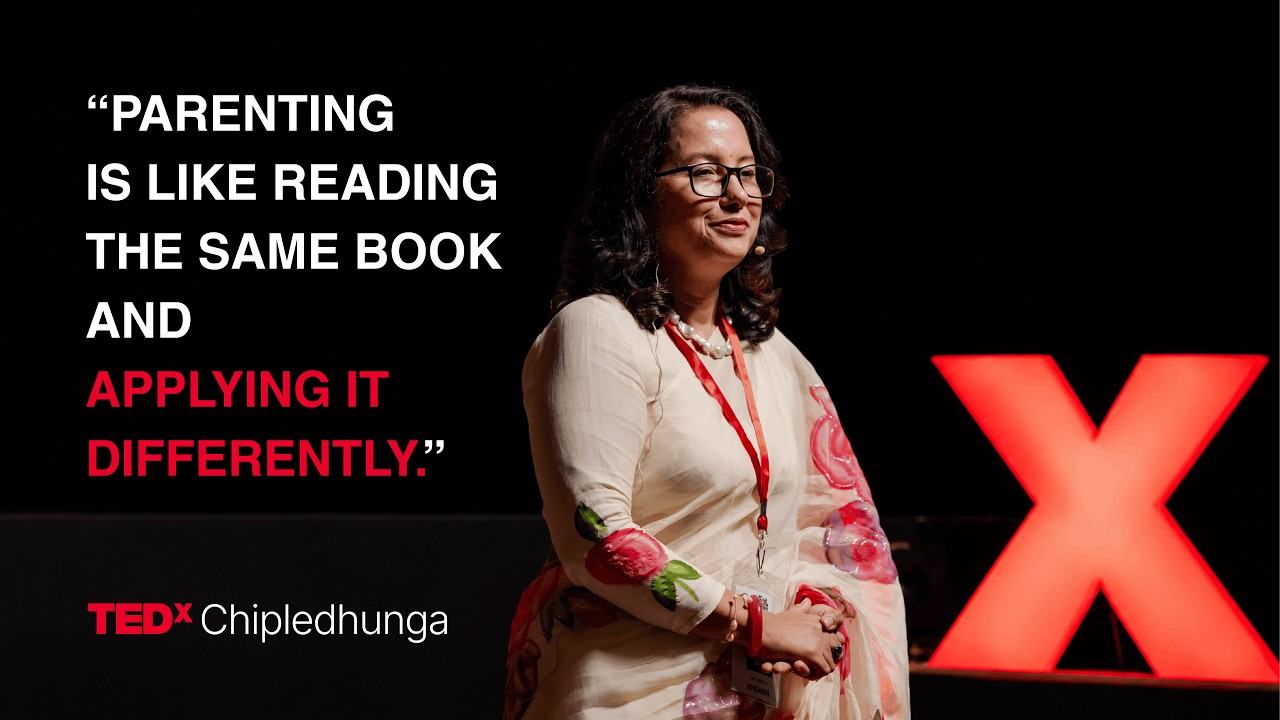
Parenting Is Like Reading The Same Book And Applying It Differently | Milan KC | TEDxChipledhunga
Keywords
Summary
258 words
Critical Evaluation
Value of the Information & Strength of the Argument
The informational value lies chiefly in the ethnographic description of a specific setting: a Nepali childhood in the 1970s–80s, the transition at the turn of the millennium, and the present configuration of family life. For a reader unfamiliar with South Asian family structures, the account of community-wide authority over children, of mothers excluded from decision-making, and of the shift in women’s status is concrete and grounded in lived context. The value drops sharply on the prescriptive side, where the talk offers generic advice – be calm, be patient, listen, communicate, do not fix every problem – that could be attached to almost any parenting discourse and is not operationalised in any way. The argumentative structure is a chronological comparison followed by a normative conclusion, but the comparison is never made rigorous: the three periods are ideal types built from recollection, the causal links between a given practice and a given child outcome are asserted rather than traced, and confounding factors such as urbanisation, schooling, migration or economic change are not discussed. There is an internal tension at the heart of the thesis: the speaker states that parenting is becoming ‘more permissive’ while simultaneously describing contemporary parents as over-protective, hyper-attentive managers of their children’s lives – two diagnoses that point in opposite directions and are not reconciled. The rhetorical questions (‘how will children learn to handle failure?’) do argumentative work in place of evidence. The talk is coherent, humane and clearly delivered, and its central caution against both blind inheritance and total control is reasonable, but the reasoning remains associative rather than demonstrative.
Scientific Rigor, Source Quality, Title Accuracy
No source is cited anywhere in the talk: no researcher, no study, no book, no statistic, no institutional report. The only reference material offered is the generic TEDx link in the description. The historical claims about the 1970s and 1980s are presented as personal memory and community observation, with no engagement with demographic or educational history that could substantiate them. Empirical constructs that would normally be invoked here – parenting styles, attachment, resilience, executive function – are used descriptively or implicitly, never named or examined. The speaker’s credentials are genuine and relevant, and she does not overclaim scientific authority; she speaks as a practitioner reflecting on two decades of engagement with families, which is a legitimate but limited form of evidence. The result is a talk with high contextual authenticity and low evidentiary traceability: nothing in it can be checked, and nothing in it is presented as checkable. On title fit, the announced metaphor of reading the same book differently appears only in the final sentence; the title promises a conceptual framing that the body of the talk does not deliver, and a listener expecting a sustained argument about the transmission of parenting models across generations gets a descriptive survey instead.
478 words
Title / Content Match
The title's metaphor – parenting as reading the same book but applying it differently – appears only in the closing sentence and is not developed; the body of the talk is a generational portrait of parenting practices. The title is evocative but loosely tied to the actual content.
Quality & Reliability
3/10
The speaker has genuine professional standing (school founder and principal, PhD scholar in early childhood education), but the talk rests entirely on personal observation and anecdote. No data, no study is named, no figure is given, and no comparative or longitudinal evidence is presented. The three-generation framing is a rhetorical device rather than a documented historical analysis, and several claims (rising permissiveness, declining resilience) are asserted rather than demonstrated. The content is plausible and internally coherent but evidentially thin.
Key Moments
Markers derived by PSI from the transcript: the creator did not define chapters.
- Opening invitation to the audience to recall their own parents, and framing of the talk as three generational parenting stories.
- Portrait of 1970s–80s families: fathers as providers issuing commands with little interaction, mothers overloaded with household work and excluded from decisions.
- Children of that era raised by siblings, cousins and the wider community, with abundant free play but strict discipline and corporal punishment, and limited encouragement toward higher education.
- Transition to the new millennium: mothers in the workforce, more involved fathers, and the arrival of mobile phones, the internet and social media.
- Free play replaced by digital devices, grandparents' knowledge set aside, and the question of whether more educated and progressive parents actually raised happier children.
- The post-COVID and artificial-intelligence era: higher social value placed on women, more sensitive fathers, but parents managing every little task of the child's life.
- Diagnosis that parenting across the three periods has become more permissive, followed by a critical re-reading of what each generation lacked.
- Prescription for balanced parenting: calm, patience, daily interaction, close observation of a child's changing nature, and the idea that children are not empty vessels.
- Communication as the most valuable gift to a child, the call to let children meet difficulty and failure, and the cultural grounding of identity.
- Closing formulation of the title metaphor: parenting is reading the same book but applying it differently.
Cited Sources
- TEDx — official programme page — The only link provided in the video description; it documents the TEDx format and the independent organisation of the event, and does not support any of the substantive claims made in the talk.
Concurring Sources
- Parenting styles — Wikipedia — Supports the talk's core recommendation of a middle path between strictness and permissiveness, corresponding to the authoritative style associated with better child outcomes.
- Diana Baumrind — Wikipedia — Provides the empirical and conceptual grounding for the balance the speaker advocates but never cites.
- Psychological resilience — Wikipedia — Concordant with the argument that shielding children from failure and difficulty limits the development of coping mechanisms.
Dissenting Sources
- Helicopter parent — Wikipedia — The research literature on over-involved parenting measures control, monitoring and autonomy restriction – a dimension distinct from permissiveness. It therefore complicates the talk's central claim that parenting is becoming 'more permissive' while simultaneously describing contemporary parents as over-protective managers of their children's lives; the two diagnoses belong to different axes of the parenting-styles framework and are not reconciled in the talk.
Contribution & Novelties
The originality of the talk is contextual rather than conceptual. It documents a specific and rarely narrated transition: how parenting norms shifted across three generations in a Nepali urban setting, moving from community-wide authority, corporal punishment and marginalised mothers toward engaged fathers, educated mothers and intensive, anxiety-driven management of children’s lives. The observation that mothers’ entry into the workforce coincided with the deliberate devaluation of grandparents’ knowledge, framed as a rejection of ’tradition as barrier to progress’, is the most sociologically interesting element and is not a standard trope of Western parenting literature. The closing contrast between over-protection and the loss of failure-experience is familiar, but the speaker’s insistence that the same generation can be simultaneously more permissive and more controlling captures a real ambiguity in contemporary parenting that is usually described with a single label.
Pour aller plus loin :
- Diana Baumrind — The developmental psychologist whose demandingness/responsiveness framework underpins most of the ‘balance between strictness and permissiveness’ argument the talk gestures at without naming.
- Parenting styles — Overview of the authoritative, authoritarian, permissive and neglectful typology, useful for testing the talk’s claim that contemporary parenting is becoming uniformly ‘more permissive’.
- Psychological resilience — Summarises what is actually known about how children develop coping capacity, the outcome the speaker invokes repeatedly without evidence.
- Early childhood education — Field overview situating the speaker’s professional domain (Montessori practice, play pedagogy, curriculum development) in a broader research context.
- Lev Vygotsky and the zone of proximal development — Relevant to the talk’s implicit claim that guidance should be calibrated to what a child can already almost do; cited by name because no single canonical address is reliable enough to link.
- Intergenerational transmission of parenting practices — A substantial research literature examining whether parenting behaviours are reproduced or deliberately counteracted across generations, which is precisely the question the title metaphor raises but the talk never addresses empirically.
313 words
Radar Profile
The profile is sharply asymmetrical: information quantity and quality sit in the middle-low range, technical depth is minimal, and overall reliability is moderate, reflecting a talk that is contextually rich but evidentially bare. The very low technical score is the defining feature – there is no methodology, no data and no engagement with research constructs. The profile is characteristic of a practitioner's reflective testimony rather than a scientific exposition.