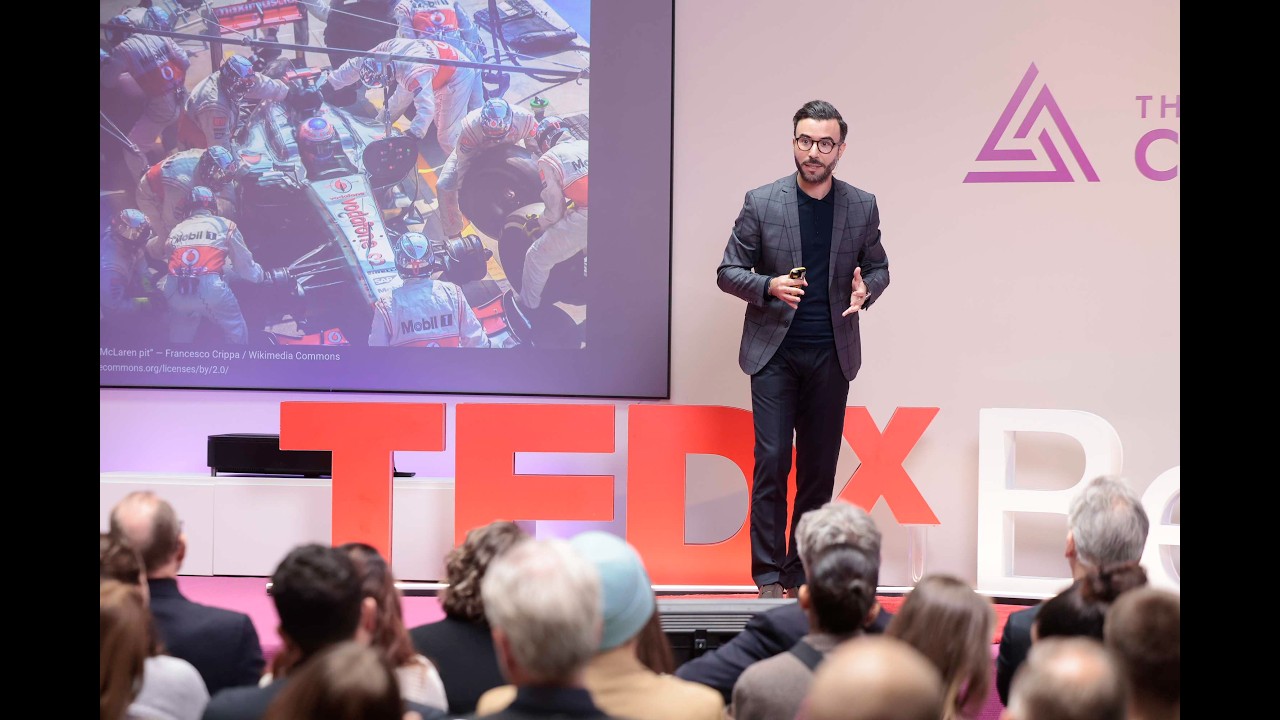
When good management kills innovation | Abdelmoula El Hadi | TEDxBerlin Salon
Keywords
Summary
310 words
Critical Evaluation
Value of the Information & Strength of the Argument
The informational value lies less in new facts than in the operational vocabulary it supplies for a widely felt but rarely named problem. Three contributions stand out: the reframing of innovation suppression as a by-product of competent management rather than of incompetence; the explicit split between exploration and delivery as two modes requiring different support structures from the same people; and the ‘safe test windows’ mechanism, a concrete, transferable design — trial slots reserved inside production planning, compensated through an annual trials budget, coordinated by a monthly planning review — that makes experimentation visible and costable inside a constraint-heavy environment. The closing three-question audit (what does it protect, what might it prevent, does it still fit the work) converts the diagnosis into a low-cost, repeatable procedure. The metaphors are doing real analytical work rather than decorating: the watermelon shows that a structure can deform growth while appearing to support it, and the pit stop separates the moment when a method must be executed exactly from the moment when that same method must be questioned.
The argumentation, by contrast, is inductive and testimonial throughout. It proceeds by anecdote stacked on anecdote — the imported playbooks, the colleague’s email, the discovery by ‘pure chance’ of a German plant manager’s practice — and then generalises from one organisation’s trajectory to a leadership paradox claimed to be general. No competing explanation is examined: the shift toward incremental work could equally be attributed to resource allocation, incentive design, hiring, or portfolio strategy, none of which is isolated. The single quantitative anchor (~50% revenue growth from newly launched products, 2020-2025) is presented with the honest caveat that trials planning alone did not cause it, which protects the speaker’s integrity but also removes the empirical support the figure might have carried; without a counterfactual, a denominator, or the size of the wider change programme, the number functions rhetorically rather than evidentially. The causal claim is plausible and consistent with the described sequence, but it is not tested, and no failed case or contrary example is offered to probe its limits. The emotional account of his friend’s death is used as a normative anchor for the non-negotiable character of safety constraints, and it is effective in that role, though it substitutes conviction for argument on the trade-off between protection and freedom. What remains genuinely strong is the internal coherence of the model: exploration and exploitation pulled apart, structure differentiated by mode of work, and a simple protocol that any team could apply and falsify in practice.
Scientific Rigor, Source Quality, Title Accuracy
The talk cites no source of any kind: no study, no internal report, no external author, no dataset, no method note. The only reference in the video description is the generic TEDx organisation page (https://www.ted.com/tedx ), which documents the event format, not the content. The quantitative claim on newly launched product revenue is given as an approximate figure over a five-year window, without baseline, scope, currency, or the composition of the wider change programme to which the speaker himself attributes part of the effect — a caveat that is to his credit but leaves the claim unverifiable from the material presented. Industry-specific assertions (trial slots depending on knowing the right person, paperwork crowding out site presence) are presented as lived experience rather than measured facts, which is appropriate to the format but limits their evidentiary weight. The reasoning is internally consistent and the speaker repeatedly marks the boundary between what he observed and what he infers, which is a genuine mark of intellectual honesty, but there is no attempt at triangulation, no counter-example, and no engagement with the substantial literature on organisational ambidexterity, process formalisation, or safety management that would either support or qualify his thesis. The talk is a practitioner account, not a review of evidence.
On title/content adequacy, the match is strong: the proposition announced in the title is stated within the first minutes, developed through the speaker’s own case, restated before the safety passage, and returned to verbatim in the closing line. A viewer attracted by ‘good management kills innovation’ gets exactly that argument, with illustrations and an actionable protocol, and is not sold a different subject. The only nuance is that the evidence offered is narrower than the title’s generality — one career across two industrial sectors — but the framing does not overstate what is delivered.
734 words
Title / Content Match
The title is a faithful, almost literal statement of the talk's thesis: the speaker argues early and repeats at the end that innovation is more often killed by good management taken too far than by bad management, and illustrates it with his own case. No misleading promise; the talk is about organisational design and leadership decisions rather than innovation technique, which the title fairly covers.
Quality & Reliability
5/10
First-person practitioner testimony from a speaker with over fifteen years in industrial innovation, internally coherent and rich in concrete operational detail (trials booking, budget mechanisms, exploration/delivery separation). However, it rests on a single organisation's experience, cites no study, report or external reference, and its one quantitative claim (~50% revenue growth from newly launched products, 2020-2025) is explicitly hedged by the speaker as not attributable to the trials system alone, with no baseline, denominator or method given. No verifiable figures, no counter-evidence, no named sources beyond a generic TEDx link in the description. Reliable as a practitioner narrative, weak as evidence.
Key Moments
Markers derived by PSI from the transcript: the creator did not define chapters.
- Opening montage of contradictory managerial injunctions: be creative but file the business case, move fast but make no mistakes, take initiative but get approval first.
- Statement of the core thesis: innovation is not always killed by bad management but sometimes by good management taken too far, often without anyone noticing.
- The move from automotive to construction materials and the decision to introduce processes, guides and playbooks to structure innovation.
- A technical marketing colleague's blunt email: his role is to be on customer sites, not filling templates behind a desk — the turning point of the talk.
- The watermelon metaphor: growth constrained by a fence, illustrating structure that shapes possibilities instead of supporting them.
- Formula 1 pit stop analogy separating the moment to execute a tested method exactly from the moment to question and redesign that method.
- Explicit split between exploration (what could work, what must we learn) and delivery (reliability, cost, deadlines), each needing different support.
- Discovery of 'safe test windows' in a German plant: trial slots booked into production planning, later funded by an annual trials budget and monthly reviews.
- Reported ~50% growth in revenue from newly launched products between 2020 and 2025, with the speaker explicitly limiting the causal claim.
- Personal account of his friend Faisal's death under an unsecured goal frame, anchoring the insistence that safety limits must remain firm.
- Practical protocol: pick one existing practice and ask what it protects, what it might be preventing, and whether it still fits the work.
Cited Sources
- TEDx — official programme page — Only reference given in the video description; documents the independently organised TEDx format in which the talk was delivered. It is not a source for any factual claim made in the talk.
Concurring Sources
- Organizational ambidexterity (Wikipedia) — Not cited in the video. Provides the established research framing for the talk's central move — separating exploratory and exploitative work and supporting them differently within one organisation.
- Psychological safety (Wikipedia) — Not cited in the video. Corroborates the mechanism the speaker describes: whether people actually raise questions and test ideas depends on what they observe being approved, funded and rewarded, not on stated values.
- Goodhart's law (Wikipedia) — Not cited in the video. Offers a formal account of why adding targets and reports tends to redirect effort toward the metric and away from the underlying ambition, echoing the drift toward small improvements the speaker reports.
- The Innovator's Dilemma (Wikipedia) — Not cited in the video. A convergent account of how practices that make an incumbent organisation effective are precisely those that can foreclose more radical options.
Dissenting Sources
- High reliability organization (Wikipedia) — Research on high-reliability organisations (air traffic control, nuclear operations, aviation) qualifies the talk's strong opposition between structure and exploration: tight protocols, checklists and standardisation can coexist with, and even enable, adaptive improvisation and local experimentation. The speaker's own pit-stop example points in this direction, but the talk does not develop it, which leaves the 'structure gets in the way' thesis less general than presented.
- James G. March, 'Exploration and Exploitation in Organizational Learning' (Organization Science, 1991) — Cited by name only, no URL given to avoid an unverified address. March's formal treatment shows that the exploration/exploitation tension is structurally self-reinforcing — exploitation reliably wins over time — and that the trade-off has costs in both directions. The talk presents the separation as a leadership design choice; the literature suggests the drift is systemic and cannot be fully corrected by better-designed processes, which weakens the implicit optimism of the three-question audit.
Contribution & Novelties
The talk’s original contribution is not the idea that bureaucracy constrains creativity — that is old ground — but the relocation of the problem inside competent, well-intentioned management, and the provision of a concrete organisational device for the constraint-heavy case. ‘Safe test windows’ is the most transferable element: instead of asking production to yield capacity spontaneously, trial slots are booked inside the production plan, compensated through an annual trials budget, and arbitrated in a monthly planning review covering the coming two months. The effect is to make experimentation legible, schedulable and costable in an environment where unplanned time is structurally unavailable — a far more operational answer than generic calls for a culture of innovation. The exploration/delivery distinction and the pit-stop framing give a usable test for which governance mode a given piece of work demands, and the watermelon image makes visible the difference between support that holds and structure that deforms. The closing three-question audit is deliberately minimal and can be run on any single meeting, report or approval. The main limitation is evidential: the model is asserted from one career, and the single growth figure is explicitly decoupled from the intervention, so what the talk offers is a well-argued hypothesis plus a design pattern, not demonstrated causality.
Further reading (Pour aller plus loin):
- Organizational ambidexterity (https://en.wikipedia.org/wiki/Organizational_ambidexterity ) — Entry point into the research literature on running exploration and exploitation side by side, the theoretical backbone of the talk’s central distinction.
- Psychological safety (https://en.wikipedia.org/wiki/Psychological_safety ) — Explains the observation that people calibrate behaviour on what is funded, approved and rewarded rather than on stated values.
- Goodhart’s law (https://en.wikipedia.org/wiki/Goodhart%27s_law ) — Formalises why each added target or report diverts effort toward the indicator and away from the ambition it was meant to serve.
- High reliability organization (https://en.wikipedia.org/wiki/High_reliability_organization ) — The counterweight: evidence that standardisation and adaptive improvisation can be complementary rather than opposed.
- The Innovator’s Dilemma (https://en.wikipedia.org/wiki/The_Innovator%27s_Dilemma ) — Complementary account of how incumbent competence can foreclose radical options.
- James G. March, ‘Exploration and Exploitation in Organizational Learning’, Organization Science, 1991 — cited by name only, without URL, as the canonical formal treatment of the trade-off the speaker describes.
- The Cynefin framework and ‘safe-to-fail’ experiment design (Dave Snowden) — referenced by name only, no URL given; directly relevant to the talk’s argument for bounded, reversible trials with firm safety limits.
390 words
Radar Profile
The profile is characteristic of practitioner testimony: a moderately high information density carried by a low technicality, since the content is organisational and behavioural rather than quantitative. Quality and reliability sit at the midpoint — the internal logic is strong and the speaker marks the limits of his own claims, but sourcing is essentially absent and the single figure cannot be checked. The resulting shape is a broad, accessible, well-structured argument with limited verifiable evidential depth.