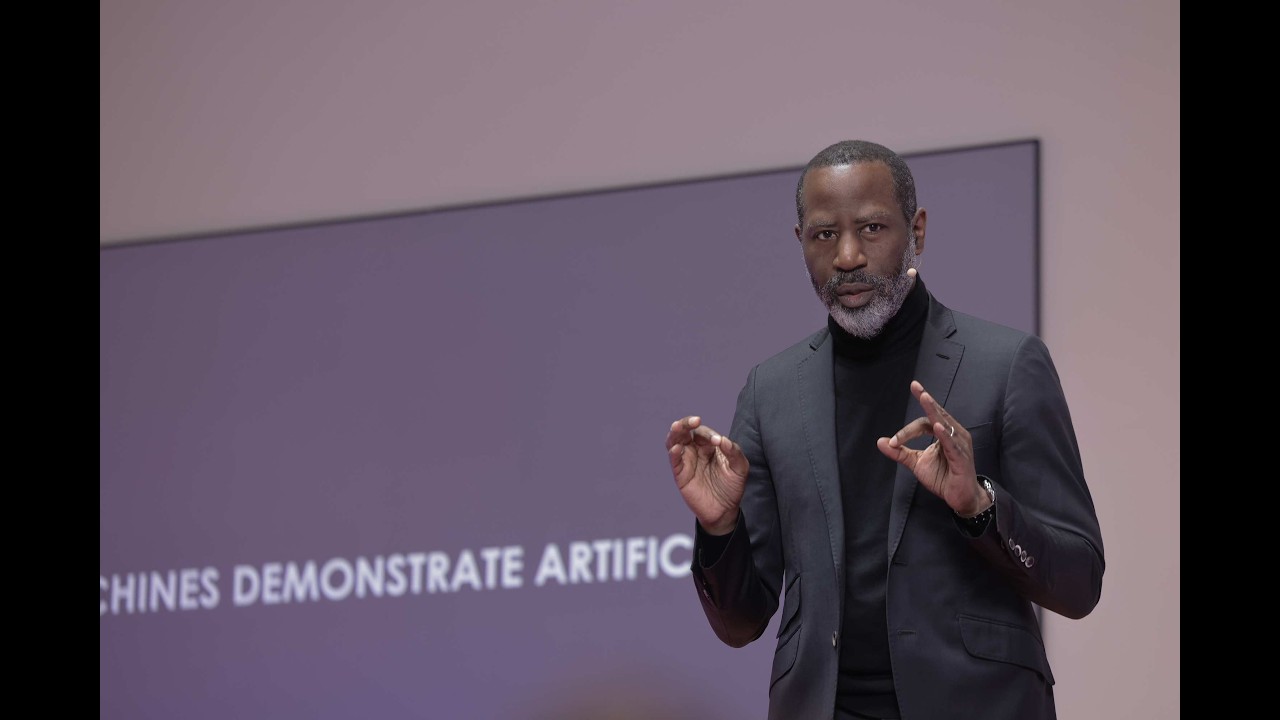
Can Machines demonstrate Artificial Integrity | Hamilton Mann | TEDxBerlin Salon
Keywords
Summary
304 words
Critical Evaluation
Value of the Information & Strength of the Argument
The informational value of the talk lies less in facts than in a conceptual grid. Its most useful contribution is the distinction between intelligence and integrity as separable design objectives, and the observation that optimisation for benchmark performance can be structurally indifferent to moral and social consequences. The nine characteristics, taken together, form a usable checklist for auditing AI systems (cognitive autonomy, addiction and dark patterns, bias disclosure, scope adherence, intellectual property, loophole exploitation, security of vulnerable users, transparency over profit), and this checklist is arguably the most transferable content of the address. The argumentation, however, is almost entirely rhetorical. The central diagnosis is asserted rather than demonstrated: no data is presented on how models actually behave, no benchmark results are cited to support the claim that ethical dimensions are never evaluated, and the causal chain from ‘conformity to pattern’ to societal harm is sketched rather than established. The reasoning proceeds largely by analogy — the Berlin Wall metaphor and the Buffett quotation are persuasive devices, not evidence, and the hypothetical chatbot answer is unfalsifiable by construction. Several claims are stated with sweeping generality (‘all approaches so far’, ’these models are not even crash tested’) without qualification or counter-example, which weakens an otherwise reasonable thesis. The speaker also conflates levels of analysis, moving between model-level properties, deployment practices and societal outcomes without distinguishing which mechanism produces which effect. The result is a coherent and thought-provoking normative framework, but one whose propositions remain hypotheses awaiting operationalisation and empirical test rather than conclusions supported by argument.
Scientific Rigor, Source Quality, Title Accuracy
Scientific rigour is limited. The talk presents no methodology, no data, no experiment and no review of the literature; it is a doctrinal exposition of a concept the speaker himself originated, which by nature requires the audience to accept the framework on the speaker’s authority. The nine characteristics are enumerated without operational definitions, without metrics and without discussion of trade-offs between them — for instance, how scope adherence interacts with transparency, or how bias disclosure would be verified. Source quality is thin in the transcript itself: no study, report or author is cited to substantiate the diagnosis of current AI paradigms, and the only quotation invoked (Warren Buffett on integrity, intelligence and energy) is a popular management aphorism whose exact provenance is not given, applied here by analogy to machines. The one verifiable output, the author’s own book, is a monograph rather than peer-reviewed evidence. The title/content fit is good: the talk addresses exactly the question posed, namely whether machines can demonstrate artificial integrity and what that would require, with no substantive gap between the announced and delivered content. No comments were available for analysis.
454 words
Title / Content Match
The title is well matched to the content: the talk is precisely about whether machines can exhibit 'artificial integrity' and how such systems could be defined. No misleading promise is detected; only the branding of the TEDx subtitle adds framing.
Quality & Reliability
4/10
The talk is delivered by an identifiable author with relevant credentials (AI researcher, visiting scholar, author of a Wiley book on the topic) and the argument is internally coherent and clearly structured. However, it is a normative and rhetorical address rather than an evidence-based presentation: no data, no empirical study, no benchmark results and no explicit citations are given to support the central diagnosis about current AI paradigms, and the nine proposed characteristics of 'artificial integrity systems' are asserted rather than operationalised or tested. The concept is the speaker's own, which makes the talk a statement of doctrine rather than a synthesis of established research.
Key Moments
Markers derived by PSI from the transcript: the creator did not define chapters.
- Framing of the present moment: AI systems are no longer a future possibility but a present reality shaping every aspect of life.
- The claim that AI systems are not just tools but decision-makers, intermediaries and companions — driving cars, approving loans, moderating conversations.
- Statement of the core problem: 'intelligence over integrity' and the reward of conformity to pattern at the expense of reasoning, judgement and intuition.
- Critique of existing ethical frameworks and safety mechanisms as external, peripheral constraints rather than intrinsic verifiable attributes of the model.
- Argument that frontier models are optimised for benchmark performance and never crash-tested against ethical, moral and social criteria.
- Introduction of the 'algorithmic wall' metaphor and the parallel with the fall of the Berlin Wall.
- Hypothetical: what would an AI chatbot trained in the 1970s have answered about whether the Berlin Wall could fall?
- The Warren Buffett quotation on integrity, intelligence and energy, transposed to the hiring of intelligent machines.
- Enumeration of the nine characteristics of an artificial integrity system, from preventing cognitive alienation to optimising for transparency and explainability.
- Closing leadership appeal: before things can change, the belief that things can be different must change.
Cited Sources
- Artificial Integrity: The Paths to Leading AI Toward a Human-Centered Future (Wiley, 2024) — Author's own monograph, cited in the video description as the foundational text for the concept developed in the talk.
- Trias Algorithmica: What Code Rules (Wiley, 2026) — Second book by the speaker, mentioned in the description as forthcoming/companion work to the artificial integrity framework.
- TEDx — official programme page — Link given in the video description to explain the TEDx format and the independently organised local event at which the talk was delivered.
- Warren Buffett — attributed remark on hiring for integrity, intelligence and energy — Quotation invoked mid-talk as an analogy: without integrity, intelligence and energy become dangerous. No primary source given in the video.
Concurring Sources
- Ethics of artificial intelligence — Documents the long-standing debate on whether ethical behaviour in machines should be built in intrinsically or enforced externally, which is the pivot of the talk's argument.
- AI alignment — Supports the claim that optimising capability without aligning systems to human values produces risk, a thesis broadly shared in the technical literature.
- Algorithmic bias — Corroborates the existence of the bias and cultural-nuance problems the speaker lists among his nine characteristics.
- Explainable artificial intelligence — Concords with the demand that systems be optimised for transparency and interpretability rather than for performance alone.
Dissenting Sources
- Artificial Intelligence Act (EU regulation) — The speaker asserts that regulatory and ethical frameworks are uniformly insufficient and purely peripheral. The EU regulation, with its risk-tiered obligations, conformity assessment and documentation duties, is a counter-example of an external constraint designed to be binding rather than cosmetic — a nuance the talk does not engage with.
- AI safety — The claim that frontier models are never evaluated against ethical, moral or social criteria is stronger than the documented state of the art: substantial work exists on evaluating harmful behaviour, red-teaming and social impact. The talk's framing understates this activity, though the speaker's point about benchmark incentivisation retains force.
Contribution & Novelties
The original contribution is terminological and architectural rather than empirical. The speaker proposes ‘artificial integrity’ as a design objective distinct from, and prior to, artificial intelligence, and formalises it as a set of nine named properties an AI system should possess intrinsically rather than being constrained to from outside. This reframing — integrity as an internal, verifiable attribute of the model rather than a compliance layer added afterwards — is a genuine conceptual move that connects AI safety debates to older questions in applied ethics about virtue versus rule-following. The ‘algorithmic wall’ metaphor, and the counterfactual exercise of asking what a model trained on past data would have said about the fall of the Berlin Wall, is an effective illustration of how statistical conformity can entrench the status quo. The talk does not, however, supply the operational definitions, metrics or governance mechanisms that would be needed to turn the nine characteristics into an implementable standard.
Pour aller plus loin :
- Ethics of artificial intelligence — Overview of the field the talk situates itself in, including intrinsic versus extrinsic approaches to machine ethics.
- AI alignment — The research programme closest to the speaker’s argument that capability optimisation without value alignment is hazardous.
- Explainable artificial intelligence — Directly relevant to the ninth characteristic (transparency, interpretability, explainability over profit).
- Dark pattern — Background on the manipulative interface designs the speaker cites when discussing addiction and the hacking of reward systems.
- Algorithmic bias — Context for the bias-disclosure and cultural-nuance characteristics.
- Artificial Intelligence Act (EU regulation) — Named here without URL as the most prominent regulatory attempt to impose integrity-type requirements externally, exactly the approach the speaker judges insufficient.
275 words
Radar Profile
The profile is strongly asymmetric: technical level is low, since the talk offers no model details, no metrics and no engineering content, while the qualitative dimensions sit at a middling level thanks to a well-structured conceptual framework. Information density is moderate because of considerable rhetorical repetition and the extended Berlin Wall metaphor, and overall reliability is capped by the absence of any cited evidence. The shape is that of a persuasive ethics keynote rather than a research presentation.