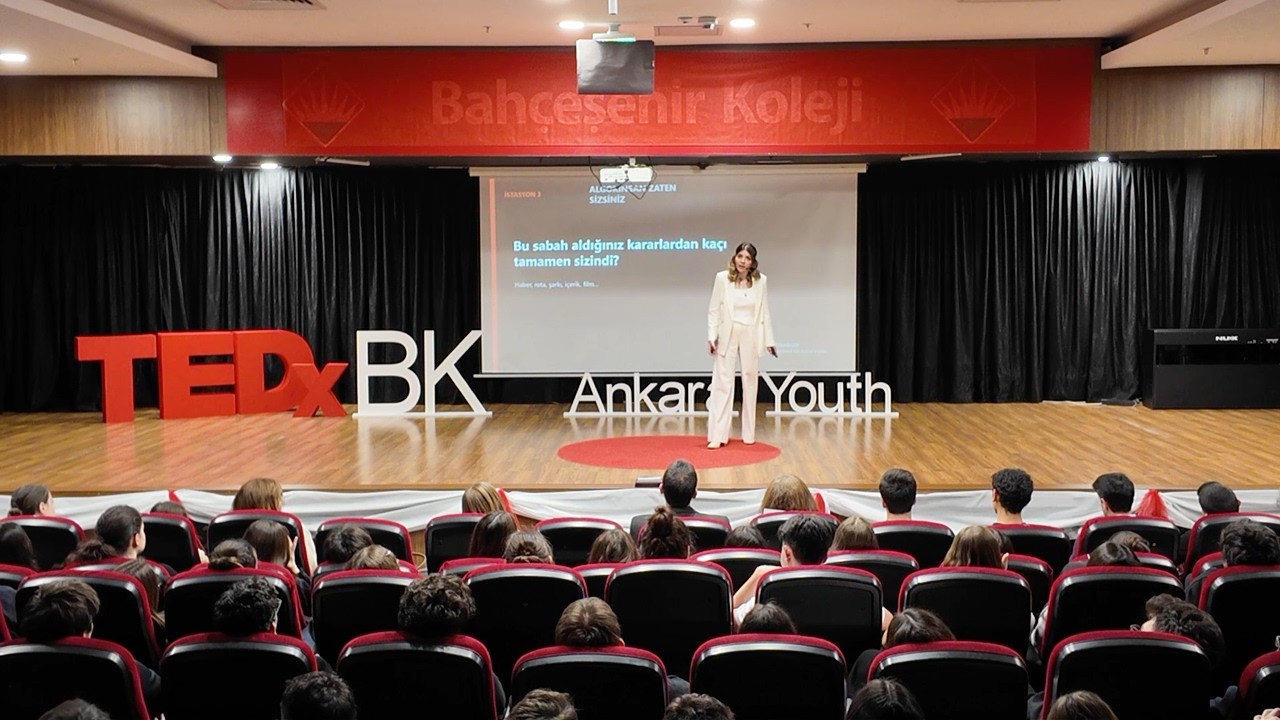
Algorİnsan: Yapay Zeka Çağında Yeni Bir Zihinsel Ortaklık | Mehtap Doğan | TEDxBK Ankara Youth
Algorİnsan: A New Mental Partnership in the Age of Artificial Intelligence | Mehtap Doğan | TEDxBK Ankara Youth
Keywords
Summary
201 words
Critical Evaluation
Value of the Information & Strength of the Argument
The talk provides valuable insights into the cognitive and ethical challenges posed by AI. The argumentation is solid, drawing on well-known philosophical concepts and empirical examples. The speaker clearly explains the extended mind thesis and applies it to modern AI, highlighting the shift from passive tools to active agents. She supports her claims with concrete studies, such as the impact of navigation on hippocampal activity and the healthcare algorithm bias. The reasoning is coherent, moving from a descriptive analysis of the current situation to a prescriptive ethical framework. However, some arguments could benefit from more nuance, such as the distinction between different types of algorithmic influence and the potential for beneficial offloading. Overall, the value lies in raising awareness and offering a thoughtful perspective rather than introducing new empirical data.
Scientific Rigor, Source Quality, Title Accuracy
The scientific rigor is moderate: the speaker references legitimate academic sources (Clark & Chalmers, 1998; studies on cognitive effects) and real-world cases (AlphaGo, healthcare algorithm) without providing detailed citations in the talk itself. The lack of explicit references is typical for TEDx format. The title accurately matches the content, as ‘AlgorHuman’ is defined and explored throughout. The talk is well-structured and delivers a clear message. The sources used are credible, though not exhaustive. No comments were provided for analysis.
224 words
Title / Content Match
The title accurately reflects the content: the concept of 'AlgorHuman' as a new mental partnership is introduced and developed throughout the talk.
Quality & Reliability
7/10
The speaker is a philosophy professor at Ankara Yıldırım Beyazıt University, and she references established academic works (Clark & Chalmers, studies on cognitive effects) and real-world examples (AlphaGo, healthcare algorithm). However, it is an opinion-based talk with limited empirical depth.
Key Moments
Markers derived by PSI from the transcript: the creator did not define chapters.
- Speaker recounts using a chatbot to write the opening, leading to the concept of 'AlgorHuman'.
- Explanation of the extended mind thesis with Otto and Inga example.
- Discussion of AlphaGo vs Lee Sedol and the 'divine move' expanding human imagination.
- Daily use of algorithms and question of how many decisions are truly ours.
- Introduction of three costs: cognitive weakening, bias amplification, evaporation of responsibility.
- Proposal of 'AlgorHuman ethics' with four principles and conclusion.
Cited Sources
- TEDx Talks - Official page — Platform where this talk was given, as referenced in the video description.
Contribution & Novelties
The talk offers an original conceptual framing—‘AlgorHuman’—to describe the hybrid cognitive state emerging from human-AI interaction. It synthesizes existing ideas (extended mind, algorithmic bias) into a coherent ethical call to action. While not entirely novel, the personal narrative and practical principles add a fresh perspective.
Pour aller plus loin :
- Extended Mind Thesis — Foundational concept by Clark & Chalmers.
- Algorithmic Bias — Overview of biased algorithms.
- AlphaGo — Background on the Go-playing AI and its impact.
77 words
Radar Profile
The radar profile shows balanced scores across quantity, quality, and reliability, with a slightly lower technical level, reflecting a philosophical rather than technical talk. The strengths lie in the accessible presentation of concepts and the ethical angle.