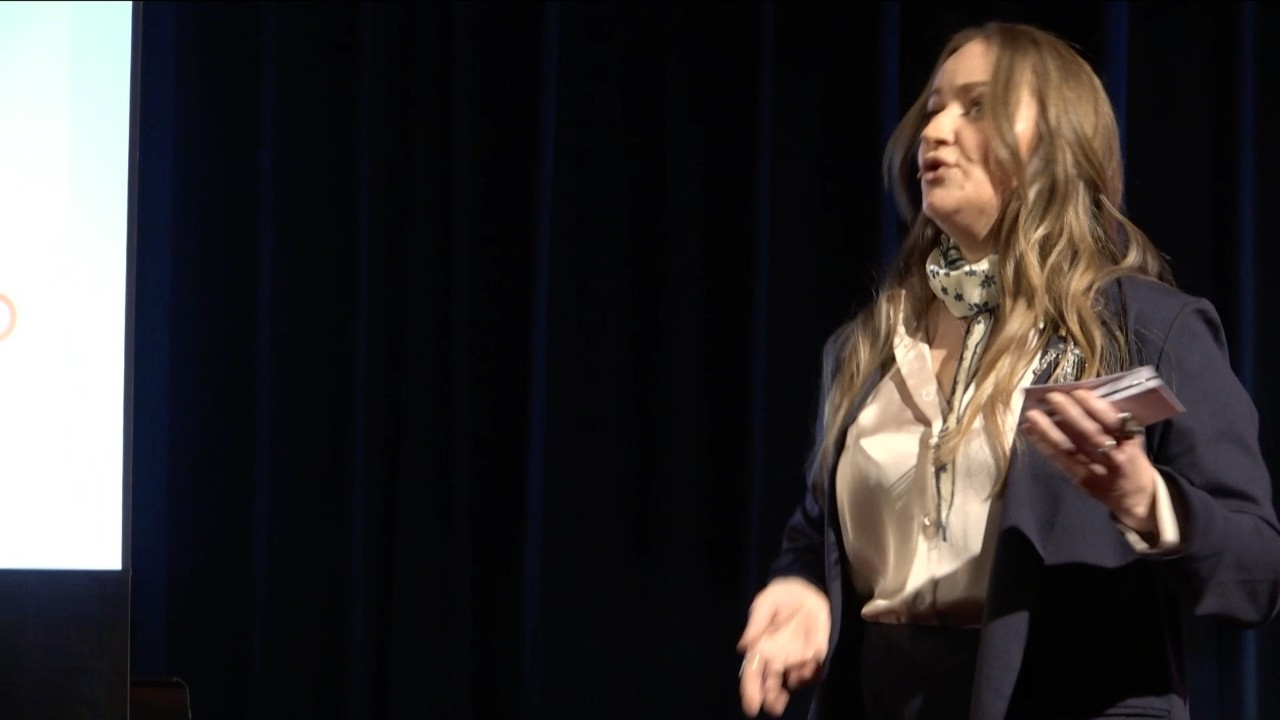
You Can't Build Bridges from Wobbly Ground | Hillary Self | TEDxUCO
Keywords
Summary
247 words
Critical Evaluation
Value of the Information & Strength of the Argument
The informational payload is thin and mostly autobiographical: the talk’s factual content consists of a handful of anecdotes (the Four Corners cannabis boundary, the theatre-to-marketing switch, the phone call during a funeral) plus a set of borrowed conceptual labels. Its value lies less in what it reports than in the framing it proposes: the shift from ‘how do I talk to them?’ to ‘why can’t I hear them?’, and the consequential claim that the obstacle to hearing opposing views is internal rather than external. That is a defensible and generative hypothesis, and the cranberry analogy gives it a compact, usable heuristic — do not legislate another person’s plate, speak up only when someone tries to put the cranberries on yours. The argumentative architecture is clear and disciplined: thesis stated early, metaphor sustained throughout, personal evidence introduced as illustration, conceptual vocabulary supplied midway, call to action at the close.
Its weaknesses are equally clear. The central causal claim — that doing inner work makes a person better at hearing opposing views — is asserted rather than demonstrated, and the supporting evidence is a single first-person narrative with no counterfactual. Several distinct ideas are collapsed under one label: Jungian shadow integration (rejected traits projected outward), Rick Rubin’s remark that rules direct us toward average behaviour, and the speaker’s own ‘borrowed jerseys’ are declared to be ‘different labels, but it’s the same issue’, which is a rhetorical flattening rather than an argument. The talk also equivocates between two very different kinds of rule: the painted centre line that keeps drivers alive and the criminalisation of a substance across a state border, then generalises from the arbitrariness of the second to a suspicion of rules as such. The claim that ‘certainty is where adventure and curiosity go to die’ functions as an aphorism, not a finding. Finally, the piece repeatedly promises an account of a collective divide but resolves it entirely into individual disposition, leaving the structural, institutional and media-economic dimensions it gestures at unexamined.
Scientific Rigor, Source Quality, Title Accuracy
No source is cited in the body of the talk: no study, no book title, no page, no data. The intellectual scaffolding is entirely second-hand and unnamed at the level of publication — Carl Jung’s shadow concept, Joseph Campbell’s hero’s journey, Robert Ray’s account of the official and outlaw hero in American film, a quoted line attributed to Rick Rubin, and a remark attributed to Waylon Jennings. These attributions are broadly consistent with the popular understanding of each author, but they arrive as decorative authority rather than as evidence, and at least one is rendered inconsistently in the transcript (‘Rubin’ later reappearing as ‘Ruben’), which makes precise verification impossible from the video alone. The one checkable factual claim — that recreational cannabis is legal in Colorado and New Mexico while Utah permits it only medically, at the Four Corners marker — is accurate in substance, though it is used illustratively rather than analysed. The description offers only generic TEDx organisational links, including the TEDx content guidelines PDF, which are institutional rather than substantive references.
On title and content: the ‘wobbly ground’ metaphor is announced in the opening minute and recurred to as a refrain, so the title is faithful to the talk’s own imagery. The mismatch is one of scope rather than of accuracy — a title implying collective bridge-building fronts a talk that is predominantly a personal account of shedding inherited beliefs.
No audience comments were supplied with this video, so no analysis of public reception is offered here.
596 words
Title / Content Match
The title's metaphor of 'wobbly ground' is announced early and returned to at regular intervals, so it genuinely structures the talk rather than decorating it. However, the advertised subject is bridge-building between opposed camps while the bulk of the content is an inward-looking personal development narrative, so the framing promises more collective analysis than is delivered.
Quality & Reliability
4/10
The talk is a personal and rhetorical essay rather than a research presentation. It advances a clear thesis and mobilises recognised names (Jung, Campbell, Robert Ray, Rick Rubin, Waylon Jennings), but no citation, bibliographic reference, data set or study is provided, and the conceptual borrowings are simplified and re-labelled. Empirical assertions about media bubbles, attention and polarisation are stated as common sense rather than sourced. It is a coherent and honestly subjective piece of public speaking, not a verifiable scientific exposition.
Key Moments
Markers derived by PSI from the transcript: the creator did not define chapters.
- Opening device: the room as a screen showing 'restricted content, viewer discretion advised', used to frame the talk as an adult conversation.
- Thesis stated: blocking, muting and feed curation atrophy the capacity for disagreement, and 'you can't build bridges from wobbly ground'.
- Four Corners anecdote: identical substance, three state lines, one criminal record — used to separate rules from morality.
- Biographical core: Cordell, Oklahoma upbringing, the Robin Hood story dismissed as fantasy, and the theatre-to-marketing switch made to please parents.
- The turning point: her father's death, the repeated calls from her boss about a celebrity's bottled-water order, and the collapse of her professional identity as consolation.
- Jung's shadow work introduced to explain why disagreement feels personal: rejected traits are projected onto opponents.
- Robert Ray's official hero versus outlaw hero, and the point that the outlaw is not lawless but refuses to outsource his moral compass.
- Waylon Jennings on holding your own, followed by the cranberry analogy: don't legislate another person's plate.
- Campbell's hero's journey and Jungian archetypes reframed as mirrors and tools; the cave you fear holds the treasure.
- Call to action: do the 'woe work', notice when you shut down or scroll, and reach across the divide with curiosity rather than certainty.
Cited Sources
- TEDx content guidelines (TED) — Institutional reference given in the description, defining the format and editorial rules of independently organised TEDx events; it is not a substantive source for the argument.
- TEDx — official programme page — Programme link supplied in the description to situate the talk within the TEDx format; no bearing on the content's claims.
- Carl Jung — shadow work — Named in the talk as the framework for integrating rejected parts of the self and for explaining projection onto opponents; no specific work is cited.
- Robert Ray — the official hero and the outlaw hero — Film scholar invoked for the distinction between the hero who works within the system and the outlaw hero who keeps an internal moral compass; the underlying book is not named.
- Joseph Campbell — the hero's journey — Cited for the departure-initiation-return pattern and for the line that the cave you fear to enter holds the treasure you seek; no edition or title given.
- Rick Rubin — remark on rules and average behaviour — Quoted as 'rules direct us to average behaviours'; the source of the quote is not identified, and the transcript renders the name inconsistently later in the talk.
- Waylon Jennings — on being an outlaw — Interview remark quoted to define outlaw as refusing to simply hang in with what folks have been doing; the interview itself is not referenced.
Concurring Sources
- Shadow (psychology) — Wikipedia — Confirms the substance of the speaker's summary: the shadow as the repository of rejected traits, and projection of those traits onto others.
- Hero's journey — Wikipedia — Corroborates the outline of Campbell's pattern as departure, initiation and return, which the talk presents accurately at the level of generality it uses.
- Four Corners Monument — Wikipedia — Supports the geographical premise of the anecdote: a single marker where four state boundaries meet, which visitors photograph.
Contribution & Novelties
The talk’s original contribution is not conceptual but rhetorical: it relocates the problem of polarisation from the conversational to the intra-personal level, and supplies a memorable vocabulary — ‘wobbly ground’, ‘borrowed jerseys’, ‘outlaw intuition’, ‘woe work’ — for a phenomenon usually described in the dryer language of echo chambers and filter bubbles. The move from ‘how do I talk to them?’ to ‘why can’t I hear them?’ is a genuinely useful reframing, and the cranberry analogy gives it a portable test: hold your own without legislating another person’s plate. The synthesis of Jungian shadow work with the American outlaw-hero tradition is a novel pairing, even if it is asserted rather than argued.
Pour aller plus loin :
- Shadow (psychology) — Overview of the Jungian concept the talk leans on most heavily, useful for judging how far the speaker’s version departs from the original.
- Hero’s journey — Background on Campbell’s monomyth and its critics, which contextualises the claim that the pattern appears in ’every heroic story ever told’.
- Jungian archetypes — For the archetype framing introduced late in the talk and the notion of a collective unconscious.
- Four Corners Monument — Factual backdrop to the cannabis anecdote and to the broader point about arbitrary jurisdictional lines.
- Filter bubble and echo chamber (Eli Pariser; Cass Sunstein) — The empirical literature that directly addresses the talk’s central claim about curated feeds, cited here by concept because the talk itself names no study.
239 words
Radar Profile
The profile is lopsided toward accessibility and rhetorical coherence: technical density and factual quantity sit low, while the talk compensates through sustained metaphor and narrative structure rather than through evidence. Reliability is capped by the near-total absence of citations, so the shape reflects a persuasive essay far more than an informational briefing.