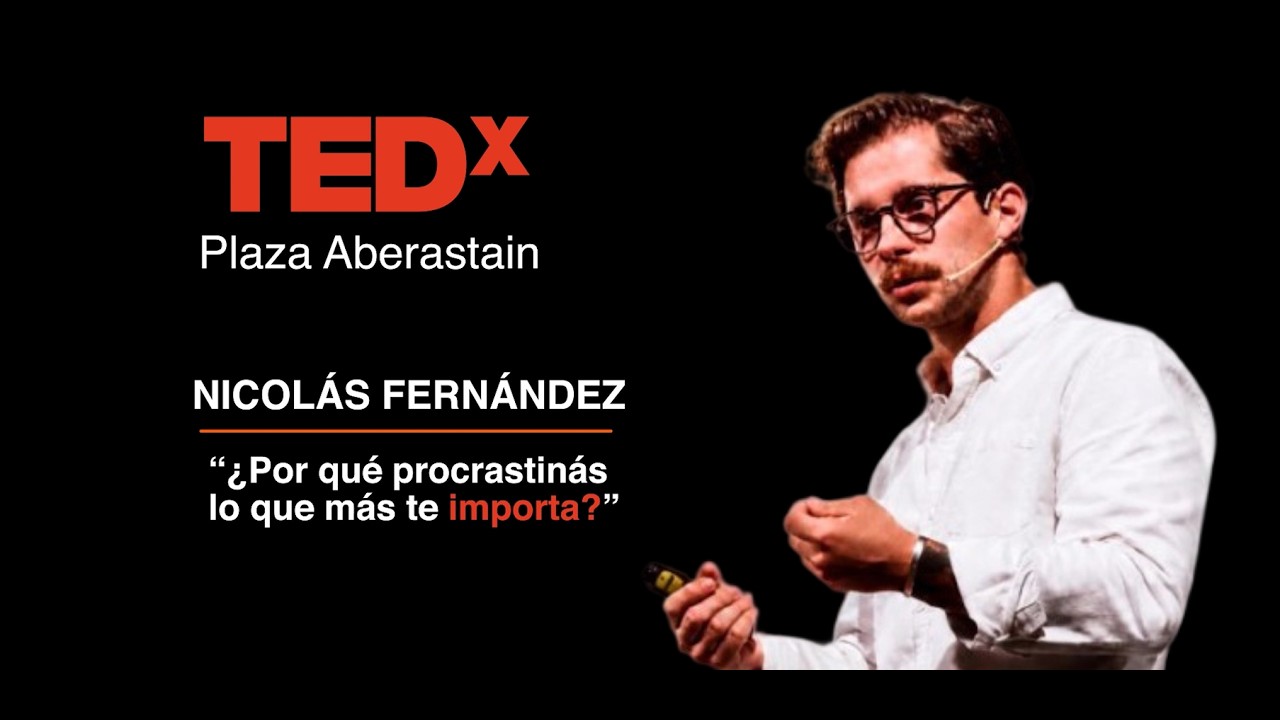
¿Por qué procrastinás lo que más te importa? | Nicolas Fernández Miranda | TEDxPlaza Aberastain
Why do you procrastinate what matters most to you? | Nicolas Fernandez Miranda | TEDxPlaza Aberastain
Keywords
Summary
176 words
Critical Evaluation
Value of the Information & Strength of the Argument
The talk offers practical value by reframing procrastination in terms of design and environment rather than a character flaw, which can reduce self-blame and empower actionable change. The argumentation is coherent, using analogies (fever, domino effect) and citing well-known researchers (Gloria Mark, B.F. Skinner, Stanford Persuasive Technology Lab) to support the case that modern attention hacking undermines intention. The anecdotal evidence and personal examples lend relatability, though the claims about ‘70% increase’ and the unreplicated willpower studies are presented without detailed data. The logical progression from symptoms to causes to practical tools is solid, and the advice is straightforward and actionable, even if not groundbreaking for audiences familiar with productivity research.
Scientific Rigor, Source Quality, Title Accuracy
The scientific rigor is moderate. The speaker cites specific research (Gloria Mark’s attention spans, Skinner’s pigeon experiments, the replication failure of Ego Depletion) but does not provide precise references or methodologies. His characterization of the 2016 replication failure is consistent with known debates in psychology. The talk lacks a clear distinction between correlation and causation, and some numbers (e.g., ‘increase up to 70%’) are mentioned without source. The title is accurate and does not overpromise, though the content is more about practical advice than deep neuroscience. The presentation uses TEDx format, which encourages audience engagement but may oversimplify complex topics. No comments are provided for analysis.
232 words
Title / Content Match
The title accurately reflects the core topic: the talk directly addresses why we postpone important tasks and offers explanations and tools. No mismatch observed.
Quality & Reliability
6/10
The talk references several studies (e.g., Gloria Mark's attention research, the replication failure of willpower depletion studies) but provides no specific citations or quantitative details. The arguments are plausible but simplified, and the scientific claims are not directly verified within the talk. The speaker is a practitioner rather than a dedicated researcher, which limits the depth of scientific rigor.
Key Moments
Markers derived by PSI from the transcript: the creator did not define chapters.
- Introduction: invitation to think about a procrastinated task
- Presentation of procrastination as a symptom and introduction to seven symptoms
- Discussion of willpower research and the 2016 replication failure of ego depletion
- Attention research: Gloria Mark's finding of distraction every 47 seconds, and Skinner's pigeon experiment
- Three practical tools: remove triggers, practice mindful wandering, and structured journaling
- Conclusion: the power of small changes and creating your future
Cited Sources
- TEDx Talks — Official TEDx page providing context about the talk and events.
Contribution & Novelties
The talk’s originality lies in shifting the focus from willpower to design: rather than blaming oneself for lack of self-discipline, it suggests modifying the environment to reduce attention hijacking. It also highlights the modern epidemic of attention fragmentation and connects it to procrastination, making a case for intentional disconnection. The proposed journaling exercises are simple but grounded in implementation intentions.
Pour aller plus loin :
- Ego depletion - Wikipedia — Discusses the theory and its replication failures, directly relevant to the speaker’s claim.
- Attention span - Wikipedia — Provides context on research into attention limits, including Gloria Mark’s work.
- Operant conditioning chamber - Wikipedia — Describes the Skinner box and its role in understanding reinforcement schedules.
- Persuasive technology - Wikipedia — Covers the Stanford Persuasive Technology Lab, which the speaker references in relation to attention-driven design.
136 words
Radar Profile
The radar profile shows mediocre scores on information quantity, quality, and reliability, with a low technical level, reflecting the talk's audience-oriented, practical nature rather than a deep scientific presentation. The strengths lie in clear structure and actionable advice, but the absence of verifiable citations and the simplified treatment of complex research place it as a general-audience talk.