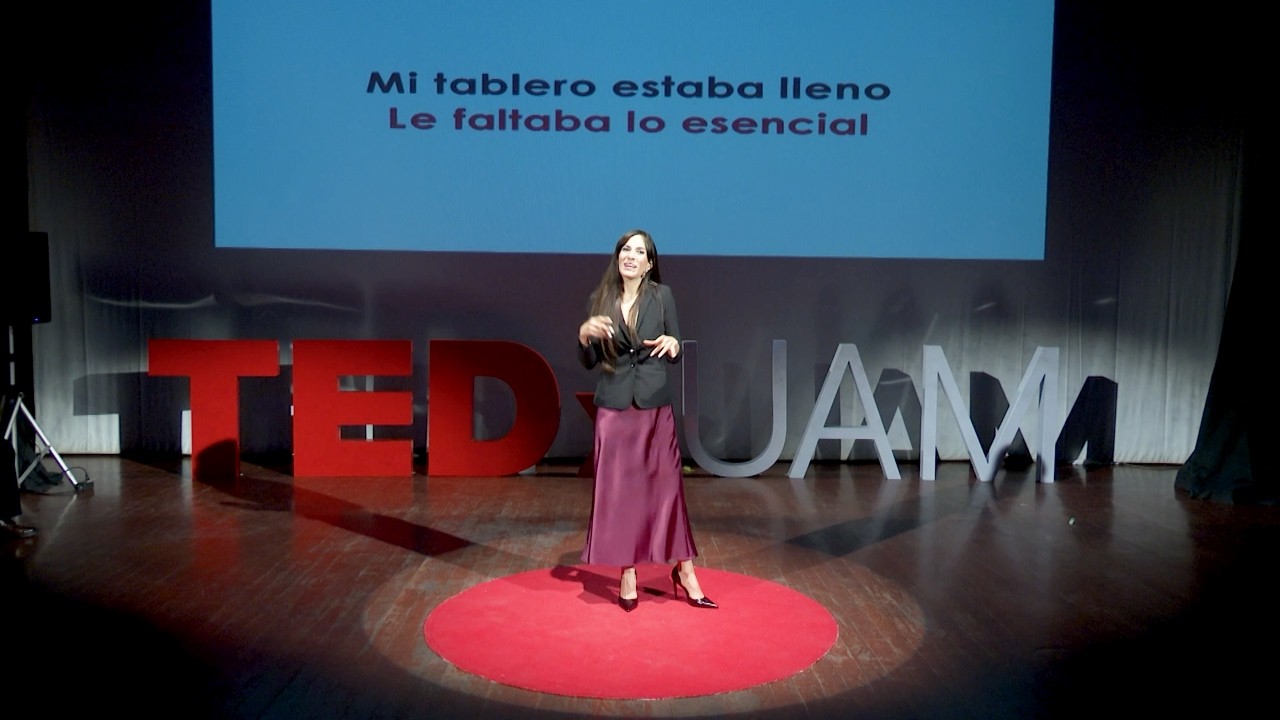
La Molécula de la Felicidad | Sara Avilés | TEDxUAM
The Molecule of Happiness | Sara Avilés | TEDxUAM
Keywords
Summary
304 words
Critical Evaluation
Value of the Information & Strength of the Argument
The informational value lies less in novel facts than in the articulation between three registers that are usually kept apart: a lived experience of achievement-deferred wellbeing, a longitudinal social-science result, and a stress-physiology sketch. The talk is genuinely useful as a map of a common cognitive trap — indexing satisfaction on completed tasks — and it names the trap sharply through the dashboard metaphor and the reach/connection distinction imported from marketing. The argumentative move that carries the most weight is the Wisconsin example, because it isolates the mechanism the speaker cares about: the problem does not disappear, but the body stops processing it as a solitary burden. That is a clean, testable-in-principle claim, and it is what makes the narrative more than a diary entry. What weakens the argumentation is the constant slippage between levels of evidence. A correlation observed in a 1938 male cohort is placed alongside a small experimental protocol on girls and alongside the speaker’s own evening, and these are then treated as converging support for one recommendation, whereas they answer different questions at different scales. The causal grammar also drifts: the Harvard cohort differed in health behaviours, income, education and healthcare access, none of which are separated out, so relationship satisfaction may be a marker as much as a cause. The oxytocin section is honest but compressed to the point of vagueness — ‘part of the complex processes of an integrated system’ is accurate and simultaneously uninformative — and the volume-knob analogy, borrowed from advertising practice, is intuitive but carries no predictive content. The closing recommendation is modest and well-suited to the evidence presented (close the laptop a few minutes earlier), which is a point in its favour: the speaker does not over-promise a protocol. Overall the reasoning is coherent and reflexive within its own limits, with the notable virtue of publicly revising its own premise mid-talk, but it substitutes analogy and personal testimony for the mechanistic detail that would make the claim about social buffering persuasive on scientific rather than rhetorical grounds.
Scientific Rigor, Source Quality, Title Accuracy
Source handling is mixed. The Harvard Study of Adult Development is dated (1938), sized (724 men), geographically located (Boston, partly university students) and followed through to the present, which is more precision than most popular treatments offer; crucially, the speaker immediately flags it as a correlation, notes the homogeneity and historical specificity of the cohort, and refuses to present it as a formula. That single paragraph does more for the talk’s credibility than the rest of the references combined. The Wisconsin work is described only by institution, sample size (sixty girls) and outcome (voice of the mother, cortisol down, oxytocin up), with no author, year, journal or measure named, which makes it unverifiable as stated and leaves the direction of the manipulation-effect link ambiguous in the telling. The World Health Organization figure for 2025 (one in six people experiencing loneliness) is asserted without document, definition or geographic scope, and loneliness prevalence estimates vary substantially depending on instrument and threshold. The description contains no bibliography at all, only the generic TEDx organisational link, so a listener cannot reconstruct any of the three references. On the positive side, there is no fabricated citation, no misattributed quotation, and the talk performs an unusual act of source hygiene by retracting the framing embedded in its own title. The title/content relationship is therefore deliberately ironic: ‘The Molecule of Happiness’ advertises a neurochemical explainer, while the payload is a refutation of that very framing plus a case for relational buffering of stress; the mismatch is thematically justified but still leaves the viewer who came for brain chemistry under-served, and it would be fairer stated as a question about attachment than as a molecule.
629 words
Title / Content Match
The title promises a talk about a 'happiness molecule', but the speaker's central reveal is that this molecule, as usually described, does not exist; the content is really about attachment, stress buffering and social connection, so the title is a deliberate hook rather than a faithful summary.
Quality & Reliability
6/10
The talk rests on a first-person narrative anchored in a few real research landmarks (the Harvard Study of Adult Development launched in 1938, a University of Wisconsin protocol on mother's voice and stress in girls, a WHO 2025 loneliness figure). The speaker shows genuine epistemic caution: she explicitly labels the Harvard finding a correlation rather than a formula, and she dismantles the popular 'happiness molecule' framing of oxytocin. But the sourcing stays thin and imprecise — no author, year or journal for the Wisconsin experiment, no reference for the WHO statistic, and no bibliography in the description beyond the generic TEDx link. The body of the argument is anecdotal and analogical (marketing concepts transposed onto emotional life) rather than evidentiary.
Key Moments
Markers derived by PSI from the transcript: the creator did not define chapters.
- Opening scene: 9:30 pm the night before a deadline, and the admission that she has spent years waiting for an 'and then, finally' before allowing herself to feel calm.
- She turns the pattern back on the audience and asks each listener to name their own postponed 'and then'.
- Her daughters bring an old phone charged all afternoon; a decade-old video of the elder singing into a hairbrush triggers laughter and, unexpectedly, contentment while the work remains unfinished.
- The Harvard Study of Adult Development: 724 Boston men followed since 1938, whose best-known finding links satisfying relationships at fifty to later happiness and health — framed explicitly as a correlation, not a recipe.
- The stress side of the equation: the waiting room before an interview, sweaty palms, racing heart, and cortisol as an alarm that never switches off.
- Oxytocin introduced through the hypothalamus — a structure the size of an almond — and its roles in temperature, sleep, hunger, birth, lactation and early attachment.
- The University of Wisconsin protocol: sixty highly stressed girls whose cortisol dropped markedly on hearing their mother's voice alone.
- The confession that anchors the talk: the 'molecule of happiness' as commonly told does not exist; oxytocin is a volume knob that amplifies context, not a source of joy.
- Reach versus connection: forty weekly conversations versus the twenty minutes she actually remembers, plus a 2025 WHO estimate that one in six people experience loneliness.
- Closing reframing — stop asking when happiness will arrive, ask whether you can recognise it while it is already beside you — and a concrete, modest change: shutting the laptop a few minutes earlier.
Cited Sources
- Harvard Study of Adult Development (launched 1938, 724 participants, Boston) — Presented as the empirical backbone of the talk: men with the most satisfying relationships around age fifty reported greater happiness, wellbeing and health later in life; explicitly described by the speaker as a correlation within a specific historical cohort.
- University of Wisconsin study on maternal voice and stress in girls (60 participants) — Cited as the mechanistic illustration: hearing the mother's voice reportedly lowered cortisol significantly and raised oxytocin in highly stressed girls; no author, year or publication named in the talk.
- World Health Organization, 2025 estimate on loneliness (one in six people) — Used to scale the reach/connection argument; the figure is asserted without a named report, definition or geographic scope.
- TEDx — event format and organisation — The only link supplied in the video description; documents the independently organised TEDx format rather than any scientific reference.
Concurring Sources
- Harvard Study of Adult Development — official study site — The longitudinal study the speaker describes; its published summaries do report an association between relationship quality in midlife and later health and wellbeing, consistent with her account and with her caveat about correlation.
- Grant Study (Wikipedia overview) — Background on the Harvard cohort's origin, its 724 original participants and its known methodological limits, including the homogeneity the speaker herself acknowledges.
- Oxytocin (Wikipedia overview) — Supports the neuroendocrine description given in the talk — hypothalamic synthesis, roles in parturition, lactation, temperature and appetite — and documents the context-dependence that underpins her rejection of the 'happiness molecule' label.
- Cortisol (Wikipedia overview) — Relevant to the stress-alarm passage: cortisol as a glucocorticoid stress hormone, and the distinction between acute mobilisation and chronic dysregulation.
Dissenting Sources
- Oxytocin as a context-dependent and sometimes anxiogenic signal (social salience literature) — Experimental work on intranasal oxytocin shows effects that vary with individual and social context, and in some settings the peptide increases vigilance, defensive aggression or in-group bias rather than calm affiliation. The speaker's volume-knob metaphor gestures at this context-dependence but does not state it, so a listener may still leave with a milder version of the 'bonding hormone' simplification she set out to correct.
- Critiques of the Harvard Study of Adult Development as causal evidence — The cohort is small, male, historically and geographically narrow, and its participants differ on many unmeasured determinants of health; relationship satisfaction may partly reflect pre-existing health, temperament or socioeconomic position rather than cause later outcomes. The speaker flags the correlational nature and the cohort's particularity, which largely pre-empts this objection, but she does not mention confounding by health behaviours or income.
- Heterogeneity of loneliness prevalence estimates — Published prevalence figures vary widely with measurement instrument, threshold and population, so a single 'one in six' figure presented without its source document should be treated as an order of magnitude rather than a measured constant.
Contribution & Novelties
The original contribution is not a discovery but a well-built bridge between two vocabularies that rarely meet in public communication: performance marketing and stress physiology. Transposing ‘reach’ and ‘connection’ onto emotional life gives a compact, memorable diagnostic — many contacts, few bonds — that is more actionable than the usual exhortation to ‘prioritise relationships’. The second distinctive move is structural honesty: a talk titled after the ‘happiness molecule’ spends its middle section dismantling that molecule, reframing oxytocin as a volume knob that amplifies whatever is already present rather than as a source of joy. That self-correction is the most scientifically valuable thirty seconds of the talk, and it is rare in the happiness-advice genre. The third contribution is the reframed question at the close — not when happiness will arrive, but whether one can recognise it while it is already present — which converts an abstract longitudinal finding into a concrete perceptual task. What the talk does not deliver is any mechanistic depth on social buffering, so its novelty is rhetorical and conceptual rather than empirical.
Pour aller plus loin :
- Grant Study / Harvard Study of Adult Development — Background on the cohort the talk leans on, its 724 original participants and the methodological limits the speaker partly acknowledges.
- Oxytocin — Neuroendocrine reference for the hypothalamic synthesis and the context-dependent effects that justify rejecting the ‘happiness molecule’ label.
- Cortisol — Reference for the stress-alarm passage and the difference between acute and chronic activation.
- Social buffering of the stress response (concept, no URL) — The literature on how the presence of a trusted other attenuates HPA-axis reactivity; this is the actual mechanism behind the mother’s-voice result and deserves more space than the talk gives it.
- John Cacioppo and William Patrick, Loneliness: Human Nature and the Need for Social Connection (book, no URL) — The standard treatment of loneliness as a physiological as well as social phenomenon, directly relevant to the WHO figure invoked.
- Robert Waldinger, work on the Harvard study and relationship quality (author, no URL) — Accessible secondary accounts of the same cohort, useful for comparing how far the findings are stretched in popular retellings.
356 words
Radar Profile
The profile is that of a reflective personal essay rather than a technical briefing: information quantity and quality sit mid-scale, technical depth is deliberately low, and overall reliability is lifted above the middle by the speaker's own caveats about correlation and by her explicit retraction of the 'happiness molecule' framing. The gap between technical level and reliability reflects a talk that earns trust through epistemic honesty rather than through density of evidence.