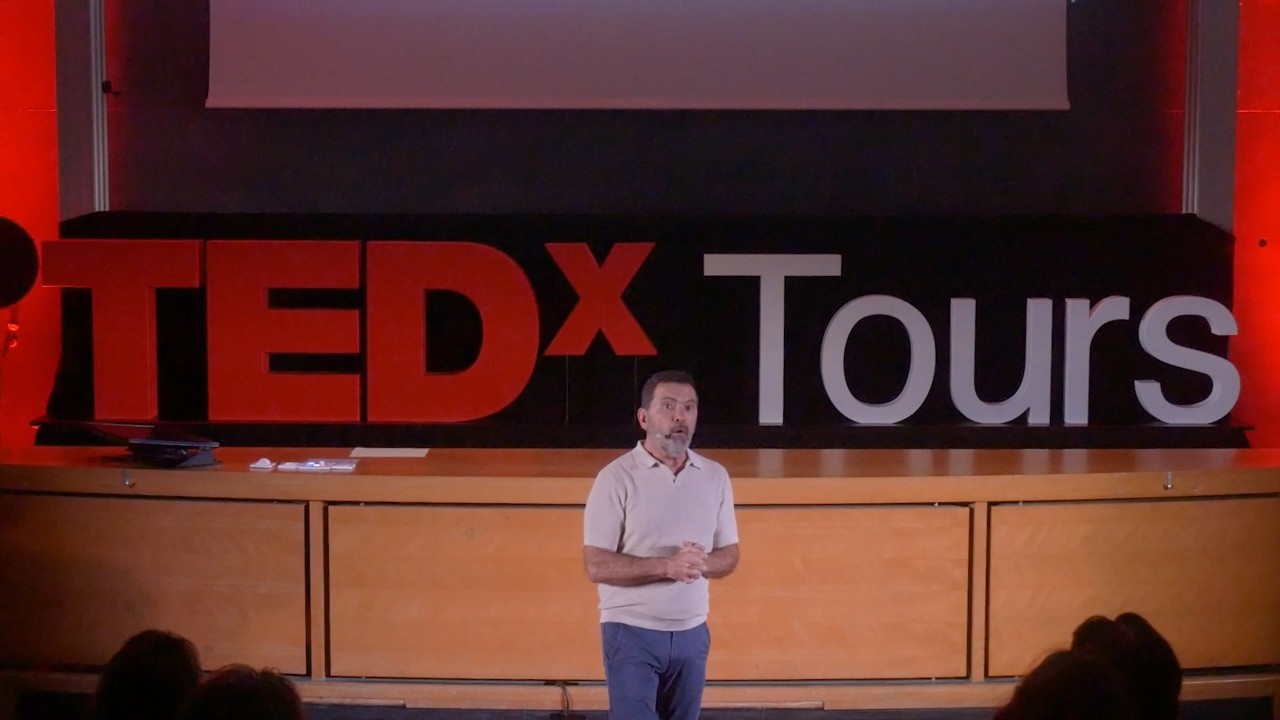
Tester le QI de votre plante verte : science fiction ou réalité ? | Olivier Pichon | TEDxTours Salon
Testing your houseplant's IQ: science fiction or reality? | Olivier Pichon | TEDxTours Salon
Keywords
Summary
362 words
Critical Evaluation
Value of the Information & Strength of the Argument
The informational value lies in the density of concrete, well-chosen illustrations rather than in depth on any single one. The chemical-ecology sequence is the strongest: the move from constitutive and volatile secondary metabolites to the specific case of herbivore-induced volatile release attracting a parasitoid, and from there to priming of neighbouring plants, sketches a coherent signalling system with a clear functional logic. The pharmacological aside (salicylic acid, quinine, morphine) anchors the chemistry in something verifiable by the audience, and the juglone example gives allelopathy a memorable embodiment. The adaptation section is carried by two textbook-grade cases (Ophrys pollination by sexual deception; host mimicry in a climbing vine), and the memory and electrical-signalling sections supply the two elements that most directly challenge the brain-centric intuition. The closing pivot toward applied research is a genuine addition rather than a platitude, because it links the conceptual question to pest management and to climate-stress breeding. The argumentation, however, is definitional rather than demonstrative. The speaker proceeds by conditional moves — ‘if intelligence is the capacity to communicate, to adapt, to memorise, then yes’ — which are logically valid but make the conclusion a consequence of the chosen premises; the alternative reading, that these are sophisticated stimulus-response systems with no need for an intelligence label, is acknowledged only through the intentionally-loaded question about ‘volition’ and the ‘phyto-brainstorming’ image, and is not really weighed. The anti-anthropomorphism warning is intellectually honest and repeated, yet the talk ends by conceding that the audience should reach his own conclusion, which softens the claimed neutrality. There is no quantitative result, no experimental protocol, no order of magnitude for signal speed or memory duration, and no treatment of the strongest counter-evidence — notably the contested status of the chameleon-vine mimicry claims, which would have deserved a sentence of qualification given how frequently they are recycled in popular media. The evolutionary framing is correct and well pitched, and the distinction between genetic adaptation across generations and epigenetic accommodation within an individual is the most rigorous conceptual passage of the talk. Overall: a well-structured, factually sound didactic argument whose persuasive force rests on definitional inclusiveness and vivid example selection rather than on the strength of the evidence marshalled, which is asserted rather than shown.
Scientific Rigor, Source Quality, Title Accuracy
Scientific rigour: the content stays within the consensus of plant physiology and chemical ecology, the technical vocabulary is used correctly (epigenetic marks, volatile organic compounds, intra- and interspecific competition, indirect defence), and the speaker draws a clean line between genetic adaptation over generations and acclimation within an individual’s lifetime. The repeated precaution against anthropomorphism — including the explicit refusal of ‘plant friendship’ or ‘revenge’ — is a mark of disciplinary discipline, and the evolutionary framing invokes Darwin’s mechanism correctly. The weak point is evidential traceability: apart from Darwin and a generic ‘170 years’, not a single researcher, publication, journal or year is named. Findings arrive as ‘it has been shown that’ or ‘studies have shown’, which prevents any listener from checking a claim, and the description offers no reading list to compensate. The most fragile assertion is the ‘chameleon vine’ mimicry, presented as established fact and used as the centrepiece of the adaptation argument, whereas the underlying observations are few and their interpretation contested; a public talk would ideally flag that. Source quality therefore rests entirely on the speaker’s institutional authority (Université de Tours, BBV laboratory, vice-presidency for ecological transition) rather than on cited documents. On title/content adequacy: the ‘IQ test for your houseplant’ hook is a metaphor, openly acknowledged, and the talk genuinely engages the question it announces and answers it explicitly at the end — the match is good and the framing is not misleading.
623 words
Title / Content Match
The title's 'IQ test' framing is metaphorical, but the talk does address the exact question posed and returns to it explicitly at the end. The fit between title and content is strong.
Quality & Reliability
7/10
Speaker is an academic plant biologist (Université de Tours, BBV laboratory) speaking within his field of expertise, and he explicitly warns against anthropomorphism and frames the question in evolutionary terms. The factual content on chemical signalling, indirect defence, volatile organic compounds, epigenetic regulation and electrical signalling is consistent with mainstream plant science. However, no study, author or journal is named: evidence is repeatedly introduced with impersonal formulas ('studies have shown', 'it has been demonstrated'), the headline claim about the 'chameleon vine' is presented without caveat although it remains debated, and the deliberate choice of an inclusive definition of intelligence does much of the argumentative work. Popularisation-level reliability: high on facts, weaker on traceability.
Key Moments
Markers derived by PSI from the transcript: the creator did not define chapters.
- Framing of the paradox: plants have no brain and no peripheral nervous system, yet studies point to a form of plant intelligence; explicit warning against anthropomorphism.
- Plant language is chemical: salicylic acid, quinine and morphine as plant-derived drugs; juglone from walnut roots as a mediator of competition.
- Volatile organic compounds and the species-specific 'green scent', perceptible by animals seeking food.
- Herbivore-induced volatile release attracting a parasitoid wasp, and pre-emptive defence activation in neighbouring unattacked plants — indirect defence.
- Sessile life as a constraint forcing perception of light, gravity, temperature and soil; conversion of signals into biochemical and morphological responses.
- The Ophrys bee orchid: mimicry of a female bee's shape, colour and odour to achieve pollination.
- The South American 'chameleon vine' copying its host's leaves, with different leaf forms on the same plant when it grows on two hosts; hypothesised role of green-scent detection.
- Stress memory: trees retaining a traumatic event for months to years and responding faster and more strongly on a second exposure.
- Information transfer without neurons: puncture-induced electrical signals that propagate through the plant and vary in nature and speed according to the stimulus.
- Reframing through natural selection (Darwin) and, for rapid individual responses, epigenetic marks modulating gene expression rather than mutations.
- Conclusion: parallel evolutionary paths over 500 million years, equally complex but incomparable intelligences; applications in plant immunity and stress-tolerant crop breeding.
Cited Sources
- Charles Darwin — On the Origin of Species (theory of natural selection, cited as formulated ~170 years ago) — Invoked as the explanatory framework for adaptive responses at the population level, contrasted with acclimation within an individual's lifetime.
- Studies on herbivore-induced volatile organic compounds and indirect defence (unnamed in the talk) — Referenced collectively ('it has been shown') for the attraction of parasitoid wasps and the priming of neighbouring plants; no author or journal is given.
- Observations on the 'chameleon vine' (Boquila trifoliolata) host mimicry — Presented as a recent discovery illustrating physical mimicry of the host plant's leaves, shape, colour and vein pattern; no publication cited.
- Ophrys bee orchid pollination by sexual deception — Cited as a classic example of plant mimicry of a female insect's shape, colour and odour.
- TEDx general information page (link from the video description) — Organisational reference supplied in the description to explain the TEDx format; not a scientific source.
Concurring Sources
- Green leaf volatiles — Wikipedia — Confirms the core chemistry of the talk's signalling examples: herbivore-induced volatile release and its role in attracting predators of herbivores.
- Juglone — Wikipedia — Corroborates the claim that walnut roots release a compound inhibiting the growth of other plants.
- Plant perception (physiology) — Wikipedia — Supports the general framing: plants sense light, gravity, temperature, mechanical stimulation and chemical signals and convert them into physiological responses without a nervous system.
- Epigenetics — Wikipedia — Consistent with the talk's explanation of rapid, within-lifetime responses via chemical marks modifying gene expression rather than mutations.
Dissenting Sources
- Plant neurobiology critique — Alpi et al., 'Plant neurobiology: no brain, no gain?', Trends in Plant Science (2007) — A structured rebuttal arguing that plant signalling, however sophisticated, does not warrant the vocabulary of intelligence and neurobiology, and that the anthropomorphic framing misleads. The talk acknowledges the risk of anthropomorphism but does not engage this literature.
- Critical reassessments of Boquila trifoliolata mimicry claims — The 'chameleon vine' is presented in the talk as a recent, established discovery; published commentary has questioned the experimental basis and proposed alternative explanations (including coincidence and herbivory patterns). The talk offers no caveat on this point, which it uses as its strongest adaptation example.
Contribution & Novelties
The talk’s distinctive contribution is not new data but a compact pedagogical architecture: it converts the diffuse notion of ‘plant intelligence’ into three testable functional criteria — communication, adaptation, memory — plus a fourth, information transfer, that specifically targets the brain-centred objection, and it then supplies one vivid case per criterion. It also does something that much popular plant-intelligence content omits: it separates the timescales. Population-level adaptation through mutation and selection is explicitly distinguished from within-lifetime acclimation via epigenetic modification of gene expression, which is the correct conceptual hinge for avoiding both anthropomorphism and naive genetic determinism, and which also explains why the more spectacular claims (the mimicry vine, tree memory) are not evidence of planning. The early, insistent refusal of sentimental metaphors about plants is another point of value, since the field is unusually exposed to that drift. The closing section linking the conceptual debate to concrete research agendas — plant immunity and the prospect of immunising crops to reduce chemical control, and selection for heat- and drought-tolerant varieties — gives the subject an applied stake rather than leaving it as a curiosity.
Pour aller plus loin :
- Boquila — The genus of the ‘chameleon vine’ discussed in the talk; useful starting point for checking the actual state of the mimicry evidence, which is far more limited than the talk suggests.
- Green leaf volatiles — Background on the volatile blend at the heart of the herbivore-induced signalling and plant-to-plant priming examples.
- Juglone — The walnut-root compound used as the talk’s allelopathy example, with its mechanism and ecological role.
- Epigenetics — Conceptual complement to the talk’s distinction between genetic adaptation and epigenetic acclimation.
- Plant perception (physiology) — Overview of the sensory and signalling capacities the talk surveys, with pointers to the primary literature the speaker leaves unnamed.
- On the Origin of Species — The Darwinian framework invoked for the evolutionary reading of plant responses.
- Plant neurobiology controversy (Alpi et al., ‘Plant neurobiology: no brain, no gain?’, Trends in Plant Science, 2007) — The critical counter-position the talk does not really confront; cited by name only, as the exact address is not certain.
352 words
Radar Profile
The profile is that of a solid science-communication talk: high on information density, on reliability of the underlying biology and on conceptual clarity, moderate on technical depth because results are described qualitatively and without numbers, and slightly lower on the evidential traceability axis since no study is ever named. The shape reflects deliberate pedagogical choices rather than ignorance — breadth of examples traded against citation depth. It rewards a viewer seeking a structured map of the field, not one seeking verifiable references.