Inside the Moment You Think, You Decide: Exploring Free Will | Kia Bahari | TEDxUBC
Keywords
Summary
196 words
Critical Evaluation
Value of the Information & Strength of the Argument
The talk provides a clear and engaging overview of key experiments that question the existence of free will. The argumentation is logical and progresses from simple examples to more complex neuroscientific evidence. The speaker effectively uses audience interaction and relatable scenarios to make the abstract concept of free will tangible. However, the presentation relies heavily on anecdotal and summarized studies without delving into methodological nuances, and the speaker’s own conclusions lean toward a deterministic view without thoroughly exploring counterarguments. The value lies in its ability to stimulate curiosity and provide a starting point for deeper exploration.
Scientific Rigor, Source Quality, Title Accuracy
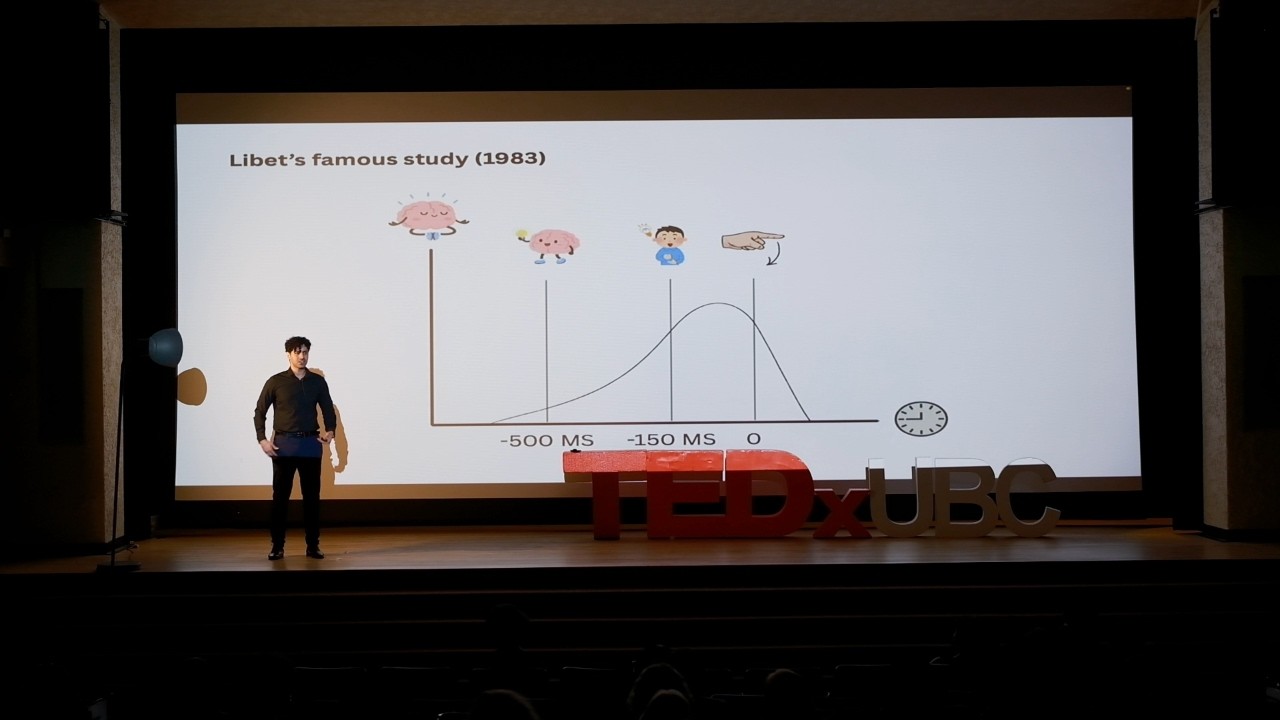
The speaker references several scientific studies, including the well-known Libet experiment and a bungee jumping study, though specific citations are not provided. The only external link in the description is to the TEDx program, which is not a scientific source. The talk’s rigor is moderate: it correctly identifies the core findings but omits critical details and potential criticisms of these studies (e.g., the ongoing debate about Libet’s interpretation). The title matches the content well, and the talk’s message aligns with contemporary neuroscience literature, but the lack of direct references and minor inaccuracies lower its overall scientific rigor.
208 words
Title / Content Match
The title accurately reflects the content: the talk explores the moment of decision and the neuroscience behind free will, matching the described theme.
Quality & Reliability
7/10
The talk presents well-known neuroscience experiments (e.g., Libet) with reasonable accuracy, but simplifies complex findings and includes a few factual inaccuracies (e.g., misattributing the 1965 date to Libet's experiment, which was actually conducted in the 1980s). The speaker acknowledges limitations and cites no peer-reviewed sources directly, but the overall message aligns with mainstream scientific discourse on free will.
Key Moments
Markers derived by PSI from the transcript: the creator did not define chapters.
- Introduction: personal story about observing a brain during surgery
- Audience thought experiment: choosing an animal
- Definition of free will and initial discussion
- Description of Libet experiment (1965) and its findings
- Bungee jumping study and neuron explanation
- Surgical study with TV show neurons
- Implications for justice and final quote from Daniel Dennett
Cited Sources
- TEDx Program — Official TEDx page, indicated in the video description as the platform for the talk.
Contribution & Novelties
The talk offers a concise synthesis of classic neuroscience experiments on free will, making them accessible to a general audience. Its originality lies in the personal narrative and the use of interactive questions to engage listeners. The speaker bridges neuroscience and philosophy, highlighting implications for responsibility without diving into deep philosophical analysis.
Pour aller plus loin :
- Free will — Overview of the philosophical concept and its debate.
- Benjamin Libet — Page on the neuropsychologist who conducted the pioneering experiment on readiness potentials.
- Neuroscience of free will — Summary of research on neural processes behind decision-making.
- Determinism — Philosophical position that all events are determined by prior causes, relevant to the talk’s implications.
113 words
Radar Profile
The radar profile shows moderate scores across information quality and technical depth, with higher marks in quality of information and lower in technical level, indicating an accessible but scientifically accurate presentation. The low view and like counts do not affect the assessment.