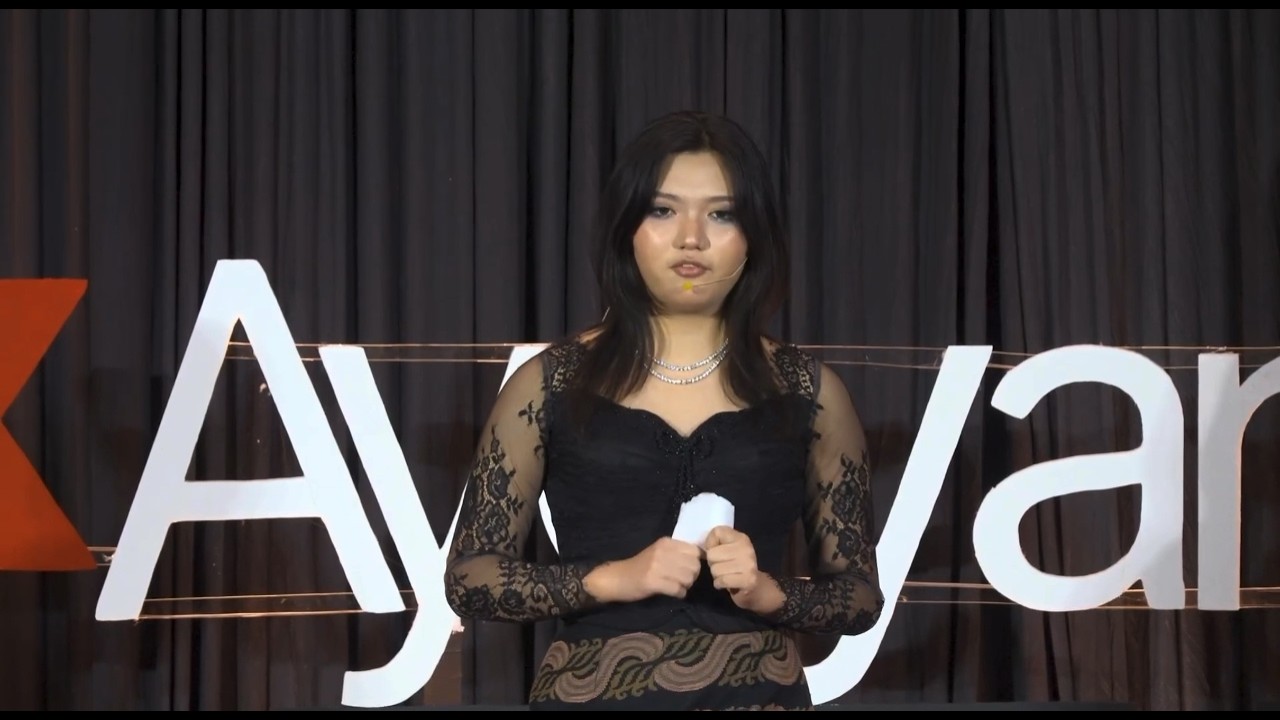
We Are the Editors of Tradition | Shin Thant La Wunn | TEDxAyeyarwaddy International School
Keywords
Summary
162 words
Critical Evaluation
Value of the Information & Strength of the Argument
The value of the information lies in its accessible integration of personal narrative with broader social critique. The speaker effectively uses her earthquake experience as a powerful metaphor for vulnerability and resilience, linking it to the need for cultural adaptation. She references neuroplasticity to argue for the plasticity of culture, but simplifies complex scientific concepts. The argumentation is persuasive and emotionally resonant, but relies on anecdotal evidence and a limited set of statistics without deep verification. The feminist perspective is nuanced, advocating for internal reform rather than outright rejection of tradition. However, the causal link between neuroscience and cultural change is underdeveloped, and the mention of ‘quantum consciousness’ introduces pseudoscientific language that weakens the argumentative rigor.
Scientific Rigor, Source Quality, Title Accuracy
The talk lacks explicit citations for most claims; statistics seem based on general reports but are not referenced during the presentation. The only provided link is the generic TEDx page. The title accurately captures the central theme of editing tradition. The scientific references (neuroplasticity) are accurate but presented superficially, while ‘quantum consciousness’ is a debatable concept. There is no evidence of deliberate misinformation, but the lack of source transparency lowers the overall scientific rigor. The anecdotal angle is transparently personal, which adds authenticity but not verifiable reliability.
218 words
Title / Content Match
The title accurately reflects the central thesis of reinterpreting and reshaping tradition rather than discarding it.
Quality & Reliability
4/10
The talk presents a personal narrative and cultural critique, drawing on statistical claims (e.g., gender parity timeline, parliamentary representation) without explicit sourcing. It references neuroplasticity and quantum consciousness, the latter being a fringe concept, which slightly undermines scientific reliability. The overall argument is coherent but relies on anecdotal and ideologically motivated reasoning.
Key Moments
Markers derived by PSI from the transcript: the creator did not define chapters.
- Introduction and hook about the earthquake story.
- Story of the 2025 Mandalay earthquake and her spontaneous prayer.
- Reflection on growing up in Mandalay, restrictions on women, and cultural dissonance.
- Introduction of scientific concepts: quantum consciousness and neuroplasticity.
- Presentation of gender inequality statistics and the call for cultural rewiring.
- Argument that feminism is not discarding faith but separating it from patriarchy.
- Call to action: become editors of tradition and rewrite one's own code.
- Personal revelation that she is the girl from the story, now reclaiming her identity.
Cited Sources
- TEDx Program — The talk was given at a TEDx event, and this is the official TEDx link provided in the description.
Contribution & Novelties
The talk offers a fresh perspective by linking neuroplasticity to cultural change, proposing that traditions can be ‘rewired’ like neural pathways. It frames feminism not as rejection of tradition but as a process of editing inherited beliefs. The personal earthquake narrative adds emotional depth and authenticity. While not ground-breaking scientifically, it creatively juxtaposes neuroscience with cultural critique.
Pour aller plus loin :
- Neuroplasticity (Wikipedia) — Directly supports the key scientific analogy used in the talk.
- Global Gender Gap Report (World Economic Forum) — Source for the 131-year estimate and gender parity statistics mentioned.
- Quantum mind (Wikipedia) — Discusses the concept referenced by the speaker, though scientifically controversial.
107 words
Radar Profile
The radar profile shows moderate scores in information quantity and quality, a slightly lower technical level, and a notably low reliability score. This indicates a talk that is engaging and provides some statistical and conceptual information but lacks rigorous sourcing and scientific depth, making it more suitable as a starting point for discussion than as a reference.