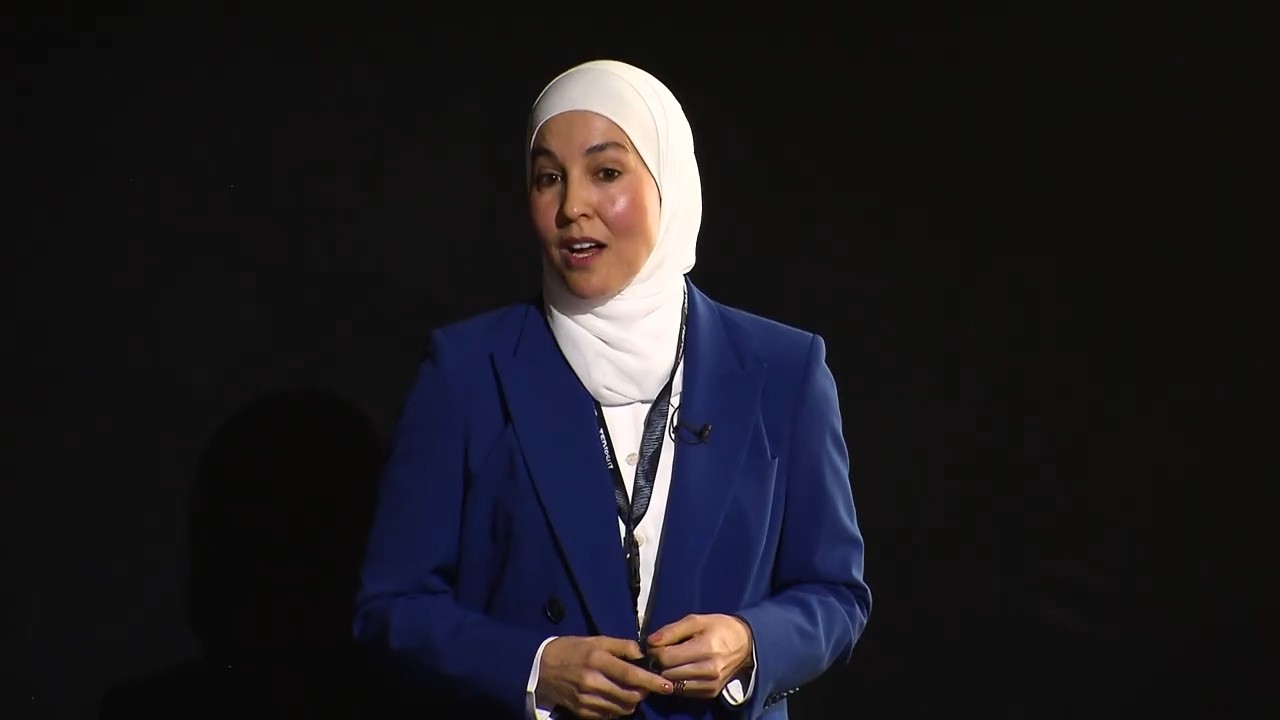
An Unwavering Heart In The Storms Of Life | Sinamis Bayouq | TEDxPSUT
Keywords
Summary
328 words
Critical Evaluation
Value of the Information & Strength of the Argument
The informational value of this talk lies less in new knowledge than in the transferable structure it gives to a common experience: a high-achieving graduate discovers that effort does not mechanically convert into outcomes. Two elements carry genuine practical weight. The first is the operational distinction between a considered response and a reflex reaction, which she uses to explain why the same person handled two comparable crises very differently. The second is the emergency fund she describes in concrete terms — a monthly envelope, untouched, treated as non-negotiable — which is presented as the material condition that made an emotional posture of flexibility possible; this link between financial buffer and psychological margin is the most useful and least common observation in the talk. The four-stage transition model, taught through the card game Shaddeh, is a competent piece of pedagogy: the mapping of shuffling, dealing, playing and the end of the round onto beginnings, execution, uneven results and closure makes an abstract framework memorable, and her addition that setbacks inside the ‘play’ phase require pausing to re-plan rather than pushing harder is sound.
The argumentation, however, is testimonial rather than evidential. Every general claim is established by returning to a single case, her own, so the reasoning amounts to ’this happened to me, therefore it holds’. That structure is vulnerable to survivorship bias: the account ends in success, and no case is examined in which the same mindset and the same emergency fund failed to produce a recovery. Causal attribution is also loose. When she states that her mental health during the income-loss period was much better than during her first unemployment, she attributes the difference entirely to emotional intelligence, although the two episodes differ in many other respects — age, family support, professional identity, a financial reserve, a defined programme of study. The order of events is itself reconstructed retrospectively, and the narrator now has a professional interest in the framework she is promoting. Similarly, the assertion that a strong emotional vocabulary would have changed her first crisis is counterfactual and untestable. What remains robust is the descriptive part: the account of suppressing feeling in public while depleted in private, and of decision paralysis under a demand for certainty that no decision can supply, will be recognisable to many and is stated with unusual candour. The talk is therefore valuable as structured experience and as a set of practical prompts, not as a demonstration of how emotional intelligence produces the outcomes claimed for it.
Scientific Rigor, Source Quality, Title Accuracy
The sourcing is thin and entirely second-hand. Four authorities are named: Daniel Goleman for the definition of emotional intelligence, Harvard Business Review for the claim that what separates a good leader from a great one is emotional rather than technical skill and that 58% of job performance is attributable to emotional intelligence, a LinkedIn survey reporting that 71% of employers weight emotional intelligence above IQ in interviews, and Bruce D Schneider together with iPEC for the four-stage transition model. None is accompanied by a title, an author, a publication year, a sample size or a locatable reference, and the only link made available with the talk is the generic TEDx programme page. The two percentages are delivered as bare figures, which is precisely the form in which such corporate-survey statistics circulate most loosely; the 58% claim in particular has no identifiable primary study behind it in the talk. The change model is attributed jointly to a named individual and a coaching organisation, a pairing that reflects its commercial origin rather than peer-reviewed validation. Nothing in the talk is fabricated or misattributed in an obvious way — Goleman’s definition is a fair paraphrase, and the model is credited to its promoter rather than presented as established science — but the audience is given no means of verifying any of it, and the rhetorical weight placed on the numbers exceeds what such citations can bear.
On fit between title and content, the mismatch is moderate and mostly a matter of framing rather than substance: the title promises a testimony about endurance, which the talk delivers, while the event description promises a session on emotional intelligence and resilience as leadership traits, which it addresses only in its middle section before returning to autobiography. The result is a talk that is honest about what it is — one person’s account of three turning points — but sold as something broader.
745 words
Title / Content Match
The title's imagery of an 'unwavering heart in the storms of life' matches the talk's core narrative of repeated career and financial shocks absorbed through emotional skills. The gap is with the promotional description, which advertises a session on leadership and emotional intelligence, whereas the delivered content is mainly an autobiographical account of one career transition.
Quality & Reliability
4/10
A coherent first-person testimonial framed by a recognised coaching vocabulary, but built almost entirely on personal anecdote and unnamed secondary statistics. Three bodies of work are invoked (Goleman, Harvard Business Review, a LinkedIn survey) plus one change-management model, none with a title, year, sample or link, so nothing can be traced or checked. The reasoning is internally consistent and the practical advice is sensible, but the evidence base is asserted rather than demonstrated.
Key Moments
Markers derived by PSI from the transcript: the creator did not define chapters.
- Opening challenge to the inherited formula: study, strive, be first, and the world will roll out roses — and what happens when the roses turn out not to be yours.
- Show of hands on personal goals and on plans to work immediately after graduation, used to set up the story that follows.
- The high-achieving student chooses an IT degree against the advice around her, following the prevailing trend; strong grades, projects and activities follow.
- Graduation and its aftermath: classmates hired, doors closed, and the exhausting gap between public composure and private depletion.
- Goleman's definition of emotional intelligence — understanding and regulating one's own emotions and empathising with others — and why conscious responses beat reflex reactions.
- The cited figures: a Harvard Business Review claim that 58% of job performance is attributable to emotional intelligence, and a LinkedIn survey putting employer preference at 71%.
- Reveal that the protagonist is the speaker herself, followed by six unhappy years in programming and systems analysis, decision paralysis and fear of failure.
- Resignation to pursue a master's and an intensive coaching programme, and the loss of the household's sole income for more than a year; the monthly emergency fund that absorbed the shock.
- The four-stage transition model attributed to Bruce D Schneider and iPEC — beginnings, deal, play, endings — taught through the card game Shaddeh.
- Closing injunction: plan, accept that goals and plans shift, and refuse to play a supporting role in someone else's plan.
Cited Sources
- TEDx — official programme page — The only link supplied with the talk; a general reference for the independently organised TEDx format and not a substantive source for any of its claims.
- Daniel Goleman — definition of emotional intelligence — Paraphrased near the middle of the talk as the ability to understand and manage one's own emotions and to recognise and empathise with those of others. No book, article or year is named.
- Harvard Business Review — studies on emotional intelligence and leadership — Invoked to support the claims that the difference between a good and a great leader lies in emotional skills rather than technical ability, and that 58% of job performance is attributable to emotional intelligence. No specific article, author or date is given.
- LinkedIn survey on employers' valuation of emotional intelligence — Cited as showing that 71% of employers place more importance on emotional intelligence than on IQ during job interviews. No date, sample or report title is provided.
- Bruce D Schneider / iPEC — four-stage change model — Framework used to structure the last third of the talk around beginnings, deal, play and endings. Attributed jointly to a named author and a coaching institute; no publication is referenced.
Concurring Sources
- Emotional intelligence — Wikipedia — Confirms that the definition given in the talk closely tracks the standard ability-and-trait framing of the construct and summarises the academic debate over its incremental predictive value.
- Psychological resilience — Wikipedia — Supports the talk's central claim that accepting and articulating emotion is associated with better adaptation to adversity than suppression.
- Daniel Goleman, Emotional Intelligence (1995) — The origin of the definition paraphrased in the talk; cited by name only, as no edition or page is referenced in the video.
Dissenting Sources
- Critiques of the '58% of job performance' emotional intelligence statistic — The figure quoted for the share of job performance attributable to emotional intelligence is a widely repeated secondary claim with no identifiable primary study presented in the talk; researchers have long noted that such percentages cannot be traced to a peer-reviewed source and that effect sizes for emotional intelligence on performance are considerably more modest once cognitive ability and personality are controlled for.
- Methodological caveat on self-reported crisis outcomes — The comparison between the speaker's two crises as evidence for the effect of emotional intelligence is confounded by several concurrent differences — age, family support, a defined study programme and, crucially, the emergency fund — so the improvement cannot be attributed to emotional skills alone; no comparative or longitudinal evidence is offered.
Contribution & Novelties
The talk’s originality is not conceptual — emotional intelligence, resilience and stage models of transition are all well-trodden ground — but rhetorical and structural. It refuses the standard motivational arc in which effort is rewarded, and instead builds its argument on a failure of that arc: the diligent student who does everything right and is still left without a door. That refusal gives the later material credibility, because the framework is presented as something the speaker arrived at after the model she had been given broke down, rather than as a doctrine offered in advance. The most genuinely distinctive contribution is the explicit coupling of a financial mechanism (a monthly, ring-fenced emergency fund) with an emotional capacity (flexibility under pressure), arguing that the second is difficult to sustain without the first — a point rarely made in personal-development talks, which tend to treat mindset as self-sufficient. The use of a familiar card game to teach a four-stage transition model is also an effective translation device: the shift from shuffling and negotiating partners to dealing with uneven results gives the audience a concrete handle on an abstract sequence, including the underrated observation that resistance intensifies at the closing stage even when the ending is a good one.
Pour aller plus loin :
- Emotional intelligence — Wikipedia — Background on the construct the talk builds on, including the longstanding debate about how much of it is measurable independently of personality and IQ.
- Daniel Goleman — Wikipedia — Context for the author whose definition is paraphrased, and for the popularisation that produced the performance statistics quoted here.
- Psychological resilience — Wikipedia — Overview of the research literature on resilience, useful for distinguishing the trait as studied empirically from the coaching usage in the talk.
- William Bridges’ transition model (endings, neutral zone, new beginnings) — the most widely used stage model of personal transition and the natural comparison point for the four-stage framework presented here; worth reading alongside it to see what each model adds.
- Bruce D Schneider and the iPEC ‘Energy Leadership’ corpus — the primary source of the four-stage model used in the final section, best consulted directly to see the evidence claims behind it.
363 words
Radar Profile
The profile is that of a testimonial-driven talk: information quantity and quality sit in the middle band, technical depth is deliberately low, and overall reliability is held back by untraceable statistics rather than by factual error. High scores on personal coherence and practical applicability are not represented in this radar, which measures evidential density rather than usefulness.