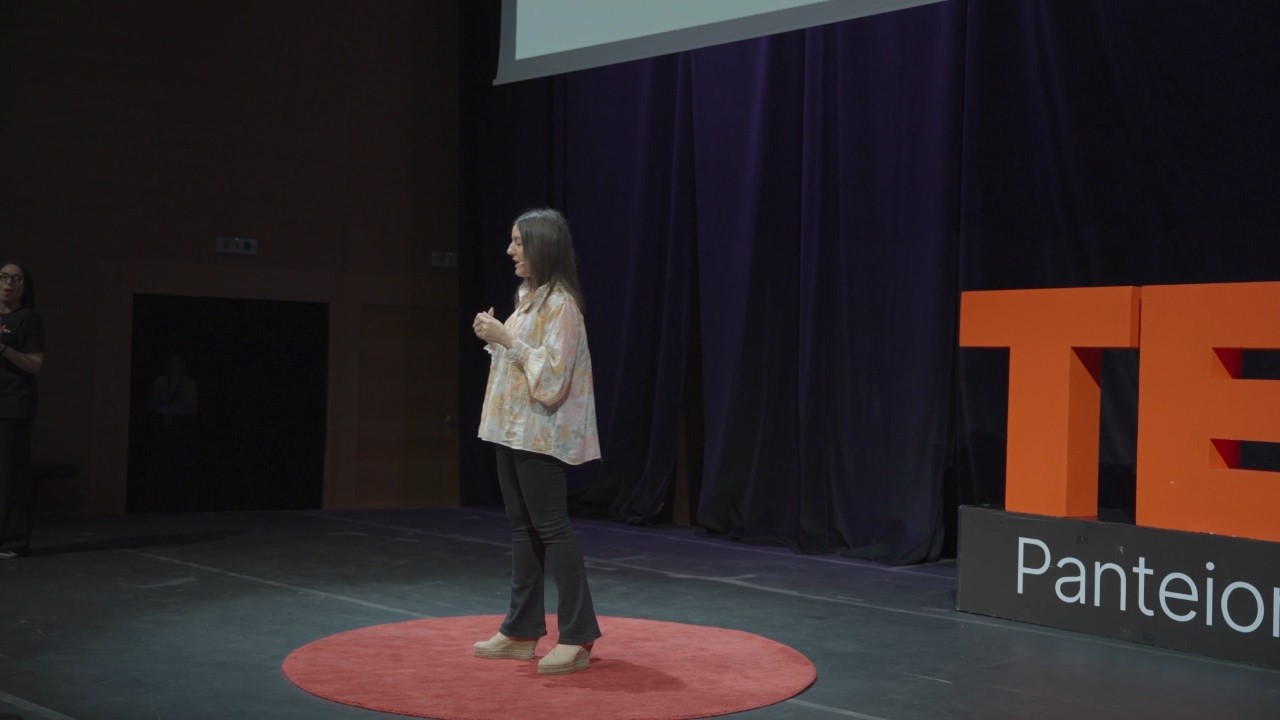
How the Brain Directs Our World | Angeliki Tsapanou | TEDxPanteion University
Keywords
Summary
236 words
Critical Evaluation
Value of the Information & Strength of the Argument
The informational value lies in the breadth of phenomena gathered under a single organising concept. Within roughly thirteen minutes the speaker touches on multisensory integration, proprioceptive loss, sensory deprivation, sleep paralysis, synesthesia, hyperosmia and hyperacusis, mirror neurons, neuroplasticity and the free-will debate. This makes the talk a useful conceptual map for a non-specialist audience and a decent entry point into embodied and predictive views of perception. The argumentative spine is clear and consistently followed: if the world we experience is a construction, then disrupting the sensory input should disrupt the construction, and the clinical and experimental examples supplied are chosen precisely to make that point. The rhetorical device of imagined scenarios (waking unable to distinguish seeing from hearing; a young man who must watch his own legs to walk; a student paralysed at night perceiving a presence) is effective and didactically well calibrated.
The weakness is argumentative depth. Every phenomenon is introduced, illustrated and abandoned before any mechanism, evidence or magnitude is given. The mirror-neuron passage illustrates the pattern: a three-condition monkey description is offered as a demonstration, then immediately extended to action understanding, social perception and emotional empathy, an inferential leap that the described experiment does not license. The Libet passage has the same shape — a single classic result is used to suggest that consciousness is merely a control system, without mentioning the substantial methodological debate around readiness potentials or the alternative interpretations that have been proposed since. Counter-arguments are never raised: the talk does not consider that constructionist accounts of perception differ among themselves, nor that the ‘we create reality’ framing can slide into claims considerably stronger than the evidence supports. The final movement from neuroscience to a philosophical conclusion about co-creation is rhetorically satisfying but is asserted rather than argued. Nothing quantitative is provided anywhere — no effect sizes, no prevalence figures, no experimental designs beyond the anecdotal level.
Scientific Rigor, Source Quality, Title Accuracy
Sourcing is the weakest dimension. Two researchers are named — Giacomo Rizzolatti for mirror neurons and Benjamin Libet for the free-will experiment — and both attributions are correct, but no publication, year, journal or dataset is cited, and the single link supplied in the video description is the generic TEDx organisational page rather than any scientific reference. The clinical claims (delirium, dementia, Alzheimer’s disease, sleep deprivation as conditions in which the sensorium is disturbed) are stated without qualification and without pointing to any clinical literature. The sensory-deprivation experiment is described in the vaguest possible terms (‘students entered a room without light and without sound’), with no indication of the study, its protocol or its date, which makes it unverifiable as presented. Sleep paralysis is defined correctly in its broad outline — a mixed wake/REM state with atonia — but the neurophysiological account is simplified to the point of caricature.
On the positive side, the talk does not fabricate data, does not misattribute discoveries, and its general claims sit within mainstream neuroscience. The problem is not accuracy of attribution but absence of evidentiary traceability: a viewer cannot check anything that is said. Concerning title and content, the fit is genuinely good: the presentation delivers on the promise of explaining how the brain ‘directs’ experience, and the sensorium concept announced at the start is the one actually developed throughout. No significant divergence between promotion and delivery was observed.
564 words
Title / Content Match
The title matches the content closely: the talk is organised around the claim that the brain actively constructs and directs experience rather than merely recording it. The subtitle framing around 'sensorium' corresponds to the actual thread of the presentation.
Quality & Reliability
5/10
The content is broadly consistent with mainstream cognitive neuroscience, but the talk offers no bibliography, no data and no methodological detail. Named references (Rizzolatti on mirror neurons, Libet on free will) are correct attributions yet are presented without nuance, and contested findings are stated as settled. The scientific framing is sound; the evidentiary apparatus is essentially absent.
Key Moments
Markers derived by PSI from the transcript: the creator did not define chapters.
- Opening definition of the 'sensorium' as the set of sensory inputs the brain processes to build the experience of reality.
- The sensorium as an active filter rather than a recording device: the brain interprets, organises and gives meaning.
- What happens when the system is disrupted: delirium, dementia, Alzheimer's disease, sensory isolation, sleep deprivation.
- Case of lost proprioception: a man who must look at his legs to walk and falls when he closes his eyes.
- Sensory deprivation experiment: students in a dark, silent room begin to see and hear things that are not there.
- Sleep paralysis described as a mixed wake/REM state, leading to the claim that sleep resets the sensorium.
- Synesthesia: one sensory pathway triggering another, illustrated by hearing musical notes as colours.
- Mirror neurons discovered by Giacomo Rizzolatti in the 1990s, presented as a bridge between perception and action.
- Neuroplasticity: the brain changes throughout life and can reorganise after stroke or traumatic brain injury.
- The Libet experiment and free will: decision-related brain activity precedes conscious awareness by about half a second.
Cited Sources
- TEDx — official organisational page — The only link provided in the video description; it documents the TEDx format and does not point to any scientific reference.
- Giacomo Rizzolatti — discovery of mirror neurons (1990s) — Named in the talk as the discoverer of mirror neurons; no publication or year is cited by the speaker.
- Benjamin Libet — readiness potential experiment — Named in the talk for the demonstration that brain activity precedes the conscious decision by roughly half a second; no reference given.
Concurring Sources
- Mirror neuron — Wikipedia — Confirms the attribution of mirror-neuron discovery to Rizzolatti's group in the early 1990s and summarises the response properties described in the talk.
- Neuroscience of free will — Wikipedia — Documents the Libet paradigm and the roughly 500 ms gap between readiness potential and reported conscious intention.
- Neuroplasticity — Wikipedia — Supports the talk's claim that the brain reorganises throughout life and during rehabilitation after injury.
- Synesthesia — Wikipedia — Confirms the definition used in the talk: stimulation of one sensory or cognitive pathway eliciting an automatic experience in another.
Dissenting Sources
- Debate on the functional role of mirror neurons — The talk presents mirror neurons as underpinning action understanding, social perception and emotional empathy. This strong reading is contested in the literature, where the evidence for a causal role in social cognition (as opposed to a correlational or motor-simulation role) remains debated.
- Reappraisal of the Libet experiment — The conclusion that consciousness is merely a control system is stronger than the evidence supports; alternative accounts of the readiness potential (for instance as stochastic accumulation of noise rather than a decision) have been proposed and are not acknowledged in the talk.
Contribution & Novelties
The talk’s contribution is pedagogical rather than empirical. It offers no new data, but it does useful integrative work by grouping phenomena that are usually treated separately — multisensory integration, proprioceptive loss, sensory deprivation, sleep paralysis, synesthesia, sensory hypersensitivity, mirror neurons, neuroplasticity and the free-will question — under the single umbrella of a ‘sensorium’ that constructs rather than records reality. For a general audience this is a coherent entry point into embodied and constructionist views of perception, and the clinical examples (delirium, dementia, sleep deprivation, proprioceptive loss) usefully remind the viewer that altered perception is a neurological event and not a matter of imagination. The framing of sleep as a nightly reset of the sensorium, and of neuroplasticity as the optimistic counterpart to these vulnerabilities, is a memorable rhetorical pairing. What the talk does not supply is any original result, any quantitative evidence, or any discussion of the ongoing debates within the field.
Pour aller plus loin :
- Mirror neuron — Wikipedia — Background on Rizzolatti’s discovery and on the contested scope of mirror-neuron function in social cognition.
- Neuroscience of free will — Wikipedia — Details the Libet paradigm, the readiness potential and the methodological critiques the talk omits.
- Neuroplasticity — Wikipedia — Mechanisms of cortical reorganisation, including post-stroke rehabilitation referred to in the final section.
- Synesthesia — Wikipedia — Definitions, prevalence and the debate over grapheme-colour versus tone-colour variants evoked in the talk.
- Predictive processing and the ‘brain as inference engine’ framework (Andy Clark, Karl Friston) — the theoretical tradition closest to the talk’s thesis that perception is construction, mentioned by name without a URL to avoid citing an unverified address.
- Proprioception and deafferentation literature — clinical background to the case of lost position sense described in the talk; to be searched by keyword rather than through a guessed link.
301 words
Radar Profile
The profile is broad and accessible: a relatively high volume of concepts covered for a short format, paired with a low-to-moderate technical depth and moderate reliability. Information quantity exceeds quality, which reflects a talk that surveys many phenomena without documenting any of them. The low technical score is by design for the format, not a defect of the speaker's expertise.