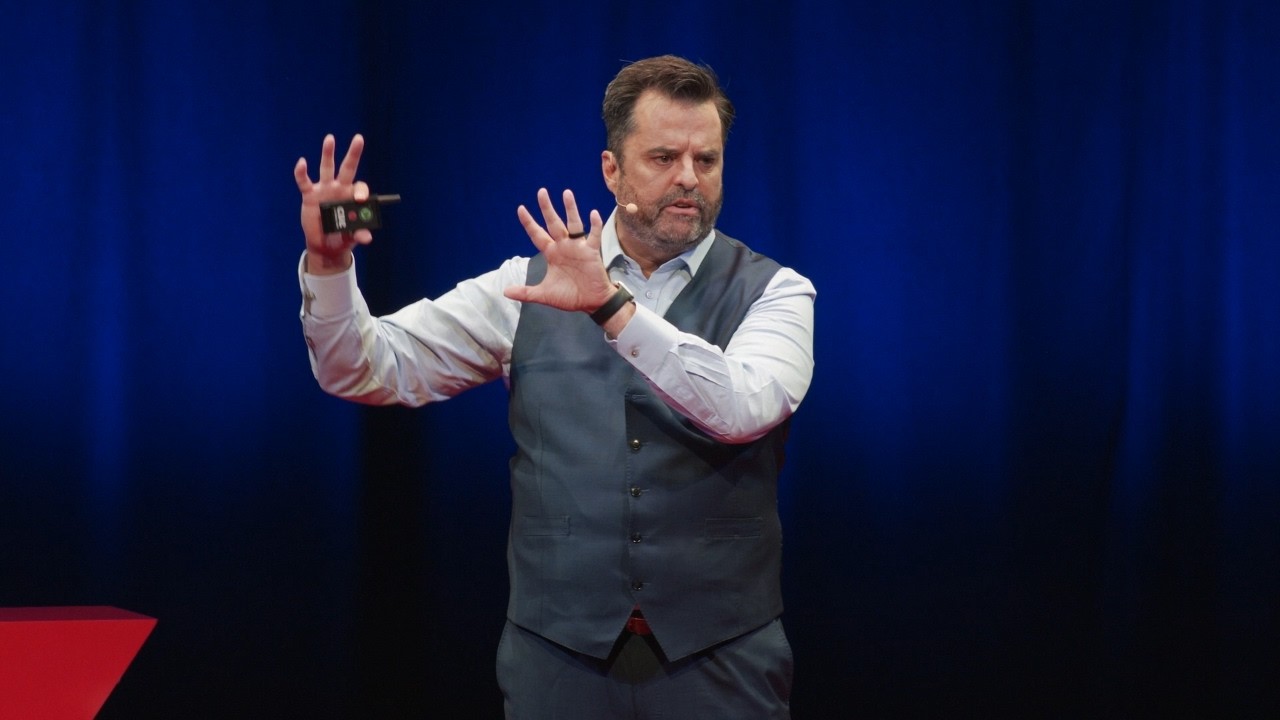
AI Is Changing the Rules. Who Gets to Benefit? | Tim Kapp | TEDxSaltLakeCity
Keywords
Summary
267 words
Critical Evaluation
Value of the Information & Strength of the Argument
The informational value lies less in data than in framing. Kapp offers a compact, well-organised typology that gives names to phenomena many observers sense but rarely separate: the hollowing out of entry-level knowledge work, the migration of economic value toward accountability and signature risk, and the prospect of machine-to-machine transactions forming a parallel layer of the economy. The three-pattern structure is genuinely useful as an analytical grid, and the work-spectrum device (judgment / in-person / screen-based) is a sharper instrument than the usual blue-collar-versus-white-collar dichotomy, because it explains who is exposed and why. The talk is also honest about the limits of its own output: the model, he says, shows futures that could happen but cannot decide what should happen, and the fourth scenario is explicitly a choice rather than a forecast.
The argumentation, however, is rhetorical rather than demonstrative. Its skeleton is a classical persuasion structure: a founding thought experiment, an order-of-magnitude shock, a debunked comforting narrative, a taxonomy, a moral pivot, and a personal closing anecdote. Each quantitative step is asserted without provenance — the productivity gains of 30 to 60%, the claim that a team of fifty will need five, the share of jobs in the screen-based middle, the implied gender distribution of displacement. Several moves compress complex causal questions into single sentences: the shift from a ‘pyramid’ to a ‘diamond’ org chart is a vivid metaphor but not a demonstrated labour-market mechanism, and the assertion that women will bear a disproportionate share follows from the sectoral composition of the middle rather than from evidence about actual displacement. The leap from description to prescription is made deliberately but without engaging counter-arguments: no discussion of how quickly the transition occurs, of wage effects versus headcount effects, of historical elasticities of demand for cognitive labour, or of the possibility that new categories of accountability-bearing work emerge. The atomic-bomb anecdote is emotionally effective and thematically apt, yet it substitutes moral weight for evidential support. The overall reasoning is coherent, original in its assembly, and intellectually honest about its normative turn, but it is a thesis defended by conviction and analogy, not by traceable evidence.
Scientific Rigor, Source Quality, Title Accuracy
Sourcing is the weakest dimension. The talk cites exactly two identifiable references: John Rawls’ 1971 veil of ignorance, correctly attributed and correctly summarised, and a body of research from ’eight major organizations’ that are never named and never separately characterised, so the reader cannot tell whether the aggregation is consistent in scope, currency or definitions. The central empirical claim rests on an in-house simulation whose design, assumptions, variable set, country selection and validation are not disclosed, and which appears unpublished in any accessible form, making replication or even assessment impossible from the talk alone. The production values reinforce the impression of evidence without supplying it: precise-sounding percentages and multipliers are delivered with confidence and zero on-screen attribution. The talk’s institutional framing is legitimate — the speaker’s profile (BYU teaching, UN AI for Good Innovation Factory, US National AI & Cybersecurity ISAO) is verifiable through the talk description — but credentials are used as a proxy for cited evidence rather than as a complement to it. The only external link provided in the description is the generic TEDx programme page, which offers no supporting material.
On title-content adequacy, the title poses the question the talk actually addresses and the body answers it in normative terms; there is no bait-and-switch, though a viewer expecting quantified distributional analysis will receive a moral framework instead. No viewer comments were supplied with this material, so no public-reception trend is characterised here.
605 words
Title / Content Match
The title's question — who benefits from AI — is exactly the question the talk builds toward, and the content delivers a framework plus a moral call rather than a quantified answer.
Quality & Reliability
5/10
The speaker is a credentialed practitioner (AI builder, economist, professor, former chair of a UN AI for Good programme) and the talk rests on a real modelling effort, but the evidence is presented entirely in rhetorical form: no study is named, no figures are sourced on screen, the 'eight major organizations' whose research is aggregated are never identified, and the simulation (5,000+ worker groups, six countries, thousands of runs) is neither published nor described methodologically. Quantitative claims such as 30–60% productivity gains, the 'one third to nearly 50% of jobs' figure, or 'by 2040 AI could create more value in a year than the US and China produce today combined' are asserted as settled. The argument is coherent and internally consistent, but it functions as an informed thesis rather than a verifiable presentation of evidence. No advertising break appears in the transcript.
Key Moments
Markers derived by PSI from the transcript: the creator did not define chapters.
- Opening thought experiment: John Rawls' 1971 'veil of ignorance' and the case for rules designed to protect the person at the bottom.
- Order-of-magnitude framing: AI presented as more economically significant than the steam engine, electricity or the internet, with a claim that by 2040 it could create more value in one year than the US and China produce today combined.
- The 'technology always creates new jobs' narrative is challenged — fields, factories, then 'knowledge work' — with the argument that thinking was always humanity's original advantage.
- Work mapped on a spectrum: judgment/accountability roles (about 60% male, older) versus in-person roles versus the screen-based middle, a third to nearly half of all jobs, two-thirds held by women.
- Presentation of the simulation (5,000+ worker groups, six countries, thousands of runs) and the first pattern, the 'middle-quake': 30–60% productivity gains shrink teams and hollow out junior entry points.
- Second and third patterns: the 'assurance economy', where value pools in accountability and the name on the line, and the 'synthetic economy', where AI agents with budgets transact among themselves.
- Pivot from description to prescription: markets reward scarcity, AI makes intelligence abundant, and the social contract must therefore be rethought — AI is described as built on an inherited pool of human knowledge.
- Personal coda: the speaker's grandfather, a scientist on the atomic bomb, and the question his grandchildren will one day ask him.
- Closing call: everyone stands behind a new veil of ignorance, so the rules should be chosen now — 'What rules will you choose?'
Cited Sources
- John Rawls — A Theory of Justice (1971), veil of ignorance — The talk's founding reference: Rawls' device for choosing fair rules without knowing one's own position in society, applied here to AI-driven redistribution.
- TEDx programme page — The only link given in the video description; documents the TEDx format and does not provide any supporting data for the talk's claims.
Concurring Sources
- Technological unemployment — Wikipedia — Documents the long-running debate on whether automation destroys more work than it creates, which the talk reframes specifically around cognitive labour.
- The Second Machine Age — Wikipedia — Brynjolfsson and McAfee argue that digital technologies reshape labour demand and may polarise it; convergent with the productivity-shock and hollowing-out claims made here.
- Universal basic income — Wikipedia — The redistribution instrument most frequently discussed in the 'intelligence becomes abundant' scenario the talk invokes without naming.
- Agent-based model — Wikipedia — Methodological context for the described simulation of thousands of worker groups across several countries.
Dissenting Sources
- Lump of labour fallacy — Wikipedia — The standard economic objection to displacement-heavy narratives: the quantity of work is not fixed, and productivity gains can expand demand for labour in ways the talk's spectrum model does not incorporate. The talk acknowledges growth but does not engage this counter-mechanism.
Contribution & Novelties
The genuine contribution is taxonomic and normative rather than empirical. Kapp assembles three named patterns — middle-quake, assurance economy, synthetic economy — that reframe the AI-and-work debate away from the binary ‘jobs destroyed versus jobs created’ toward a question of where value relocates and who holds the entry points. The work-spectrum model (judgment / in-person / screen-based) is a more discriminating exposure map than occupational averages, and the observation that AI compresses the bottom of the org chart rather than eliminating the middle wholesale is a sharper hypothesis than the usual pyramid-to-hourglass metaphor. The explicit staging of a ‘fourth future’ as a choice rather than a forecast is also a useful rhetorical move for policy discussion. What is missing is novelty at the evidential level: the simulation is not disclosed, the aggregate research is unattributed, and the normative conclusion — that a new social contract is necessary and that everyone should share in AI-generated prosperity — is a restatement of long-standing distributive-justice positions applied to a new productivity shock.
Further reading:
- Veil of ignorance — The Rawlsian device the talk builds on; useful for testing whether the argument’s fairness premises hold.
- A Theory of Justice — Rawls’ 1971 book, the direct source of the opening thought experiment.
- Technological unemployment — Historical and theoretical background for the displacement-versus-creation question the talk reframes.
- The Second Machine Age — Brynjolfsson and McAfee’s account of digital technologies and labour demand, a close relative of the ‘middle-quake’ thesis.
- Universal basic income — The redistribution mechanism most often attached to the ‘abundant intelligence’ scenario, though the talk deliberately stops short of naming instruments.
- Agent-based model — The class of simulation implied by the ’thousands of runs, 5,000 worker groups’ description; relevant for judging what such models can and cannot establish.
294 words
Radar Profile
The profile is characteristic of a well-constructed persuasive talk: high density of framing and moderate conceptual complexity, but weaker on verifiability and on technical depth, since no method, dataset or statistical reasoning is exposed. Information quantity moderately exceeds information quality, and overall reliability sits at the midpoint — a credible, credentialed synthesis whose empirical backbone remains unshown.