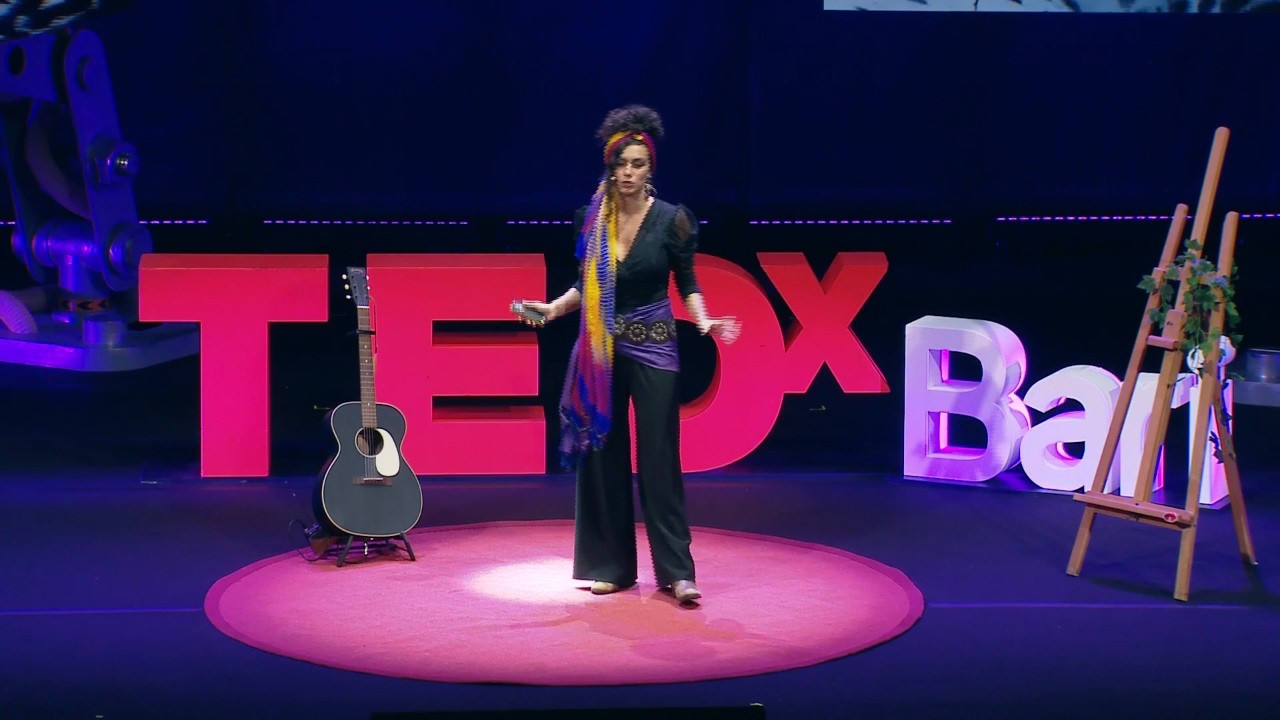
Il potere curativo della voce e il coraggio di sbagliare dal vivo | Gaia Daria Miolla GEA | TEDxBari
The healing power of the voice and the courage to make mistakes live | Gaia Daria Miolla GEA | TEDxBari
Keywords
Summary
238 words
Critical Evaluation
Value of the Information & Strength of the Argument
The informational value of the talk is limited in density but real in kind: it delivers a small set of concepts — the voice as a total instrument, ‘musicomedicine’, co-creation with an audience, the productive role of error, the ‘window of tolerance’ — each sketched in a few sentences rather than developed. These are working notions of an artist reflecting on her own practice, not analytical categories backed by definitions, measurements or comparisons. The argumentation proceeds essentially by example and metaphor: the versatility of the voice is illustrated by the claim that it contains percussive and melodic instruments; the healing function is supported by a generic evocation of Native American practices and by the observation that some contemporary music ‘almost makes us ill’; the value of error is argued through the parallel between stream of consciousness and what she calls high cognitive potential. None of these links is established, and several are stated as self-evident when they are in fact contestable — in particular the causal attribution of therapeutic effects to frequencies and vibrations, and the assimilation between improvisational freedom and neurodivergence. What does give the argument some empirical weight is the demonstration itself: the instant composition built from words supplied in advance by the audience is a verifiable performance, and the choral sequence shows in real time that a room of strangers can coordinate vocally under minimal direction. The claim that collective singing produces cohesion is thus illustrated, if not proven. The overall reasoning is internally coherent and often striking as rhetoric, but it relies on the speaker’s charisma and on the emotional effect of the performance rather than on evidence, and it repeatedly substitutes injunction (‘keep making mistakes’, ’never stop imagining’) for demonstration.
Scientific Rigor, Source Quality, Title Accuracy
No source is cited anywhere in the talk: there is no study, no author, no institution and no bibliographic pointer, and the only external reference in the description is the generic TEDx format link. The term ‘musicomedicine’ is introduced without attribution, even though a body of literature on music therapy and on sound-based practices exists and could easily have been named; the appeal to Native American uses of voice and instruments remains at the level of a general evocation without nation, period or ethnographic reference. The assertion that polyhedricity is valued abroad but treated as a problem in Italian institutions is likewise presented as personal observation without any supporting comparison. The link drawn between improvisation, error and neurodivergence is suggestive but never grounded, and the closing reflection on the ‘window of tolerance’ uses a technical-sounding phrase from clinical psychology without defining or situating it. The result is a talk whose scientific surface is thin and whose claims stand or fall with the speaker’s authority as a performer. On the title/content relation, the fit is genuine: the healing power of the voice and the courage to err on stage are precisely what the intervention stages, with the improvised pieces functioning as the argument rather than as decoration.
506 words
Title / Content Match
The title is faithful: the talk does address the voice as a healing/emancipatory tool and the acceptance of error in live performance, both of which structure the intervention. The 'healing' dimension is however evoked more than it is argued.
Quality & Reliability
3/10
The talk is a personal and artistic testimony rather than a documented exposition: no study, data, bibliography or named reference is provided. The notion of 'musicomedicine' and the healing role of frequencies are asserted rather than demonstrated, and the appeal to Native American practice remains generic. The value of the content lies mainly in the live demonstration of instant composition and in the coherence of the speaker's own artistic approach, not in verifiable evidentiary support.
Key Moments
Markers derived by PSI from the transcript: the creator did not define chapters.
- Opening: an improvised song about love, sung a cappella as an immediate demonstration of the method.
- Introduction of 'musicomedicine' and the Native American use of voice and instruments as a healing practice based on frequencies and vibrations.
- Definition of improvisation as the permission to err and to follow a stream of consciousness, linked to the discovery of oneself.
- Statement of the central thesis: perfection does not exist in art, and one must keep making mistakes until something is created.
- Participatory experiment: the audience is split into left and right vocal groups and led in a repeated rhythmic call-and-response.
- After the applause, theoretical framing of co-creation as a 'madness' that turns the artist into a receptacle for other people's ideas.
- A volunteer brings the canvas covered with words written by the audience; the words are read aloud for the first time.
- Start of the instant composition built from the audience's words (magic, revolution, limit, memory, neurodiversity, censorship, accessibility).
- Final verses on appearances, blindness to surfaces, artificial intelligence and the place of the artist's body in performance.
- Closing message around the 'window of tolerance' and the injunction to keep creating what does not yet exist.
Cited Sources
- TEDx — official programme page — Only external link given in the description; it documents the TEDx format under which the talk was given, not any scientific reference.
Concurring Sources
- Music therapy — Confirms that structured use of music and voice has documented applications in care and wellbeing, which broadly supports the speaker's intuition about the voice as a therapeutic medium, while framing it as a clinical discipline rather than as an ancestral frequency practice.
Dissenting Sources
- Sound healing — The documented literature on sound and frequency-based healing reports weak or inconclusive evidence for curative effects, which tempers the talk's assertion that frequencies and vibrations can 'heal others' and that this capacity has simply been forgotten.
Contribution & Novelties
The originality of the intervention lies less in its ideas — the therapeutic uses of song, the value of improvisation, the critique of perfectionism — than in the way it makes the argument: the talk performs what it claims. The instant composition built from words collected in advance from the audience, and the choral sequence conducted with the room divided in two, turn the audience into co-authors and provide a live, checkable demonstration of the speaker’s central assertion that a work can be produced without a score and without the possibility of correction. The personal framing of multi-disciplinarity and neurodivergence as assets rather than deficits, delivered by a performer who explicitly refuses the demand to present herself under a single label, gives the talk a distinctive voice within the genre of artist testimonials. The weakness is that the conceptual vocabulary introduced (‘musicomedicine’, ‘co-creation’, ‘window of tolerance’) is left at the level of evocative naming, so the talk opens lines of inquiry without equipping the listener to pursue any of them.
Pour aller plus loin :
- Music therapy — Overview of the clinical field closest to what the speaker calls ‘musicomedicine’, with the distinction between evidence-based practice and broader sound-based wellbeing claims.
- Sound healing — Useful counterpoint on the claims regarding frequencies and vibrations, summarising the state of evidence behind them.
- Musical improvisation — Contextualises the practice of instant composition and the role of error in improvised performance.
- Neurodiversity — Conceptual background for the speaker’s assimilation of improvisational freedom and neurodivergence.
- Window of tolerance (concept developed by Dan Siegel) — The clinical notion invoked in the closing lines, cited here by name only as its exact reference is not given in the talk.
282 words
Radar Profile
The profile is dominated by a very low technical and reliability score combined with a similarly modest information density: the talk carries almost no transferable technical content or verifiable claim. Its strength lies elsewhere, in the performative and human dimension, which the radar does not capture. The overall shape is that of an artistic testimony rather than a knowledge-bearing exposition.