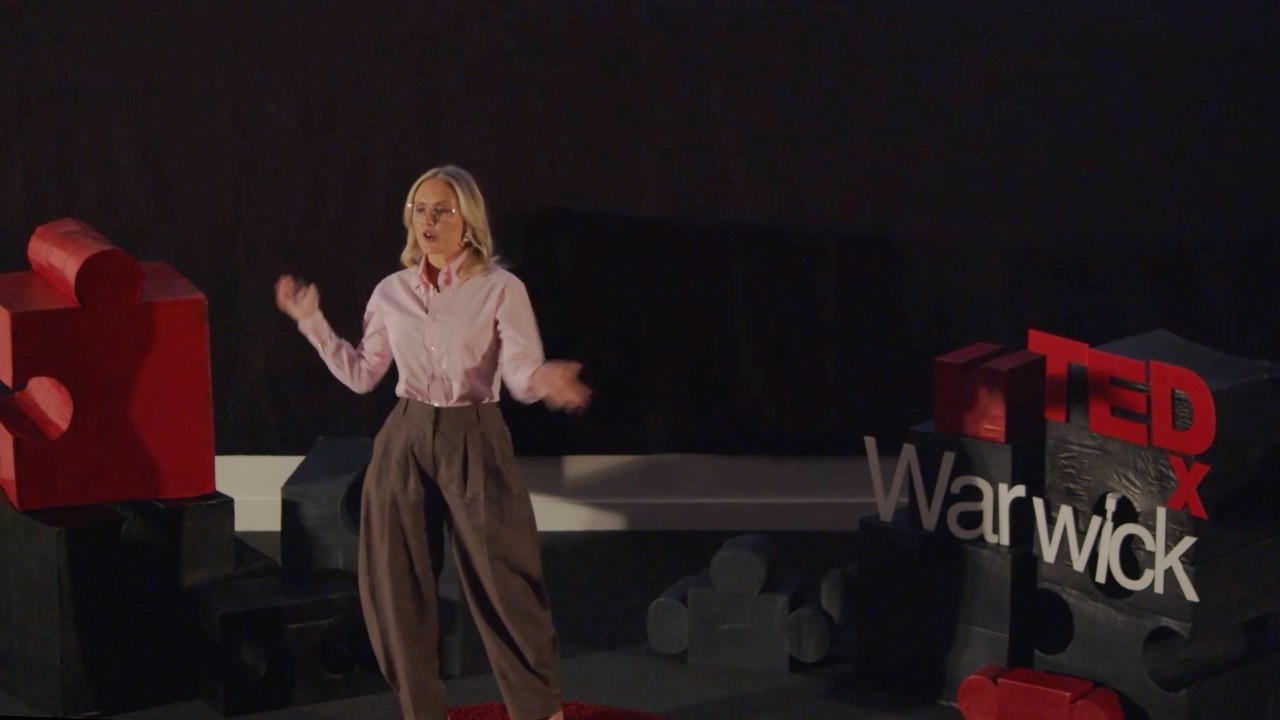
The Mother Tongue Of Science Is Man | Faye Bate | TEDxWarwick Salon
Keywords
Summary
232 words
Critical Evaluation
Value of the Information & Strength of the Argument
The talk offers significant value by translating complex medical research biases into an accessible narrative that resonates with a broad audience. Bate’s argument is persuasive, built on a clear logical progression from historical exclusion to modern-day consequences, reinforced by statistical evidence and personal anecdotes. Her framing of the issue as a language barrier is innovative and memorable, making the problem tangible and actionable. The strength of her argumentation lies in her ability to connect systemic issues with individual experiences, culminating in a simple, pragmatic challenge (28-day learning) that empowers listeners. However, some claims lack detailed citation, weakening the scholarly rigor, and the talk occasionally relies on emotional persuasion rather than systematic evidence, though the core message remains well-supported.
Scientific Rigor, Source Quality, Title Accuracy
The scientific rigor is moderate; Bate references specific studies (e.g., the meta-analysis of female rat variability, a UK survey on dismissal, an analysis of clinical notes) but does not provide exact citations or publication details, which would strengthen the talk’s credibility. The sources mentioned are credible in context, but the lack of direct referencing prevents full verification. The title is highly appropriate, capturing the central metaphor and thesis succinctly. It aligns with the content, which repeatedly underscores how science’s default ‘mother tongue’ is male, and the talk fulfills this promise. No specific external sources are linked in the description other than the generic TEDx page, so viewers cannot easily access the cited research, limiting transparency.
248 words
Title / Content Match
The title effectively captures the core metaphor that science has been male-centric, and the talk elaborates on this with evidence and personal anecdotes.
Quality & Reliability
7/10
The talk is by a medical doctor and presents well-known issues in medical research, but lacks direct citations for the studies referenced. It is persuasive but would benefit from more precise sourcing.
Key Moments
Markers derived by PSI from the transcript: the creator did not define chapters.
- Speaker introduces her 'plus 50' tattoo and its connection to Mexico.
- Spanish lesson analogy; English as mother tongue, science's mother tongue is man.
- History of excluding female rats from research in 1922.
- Meta-analysis of 263 studies showing male rats are more variable.
- Education gap: statistics on menstrual health education in UK schools.
- Dismissal gap: survey on women ignored by doctors, quotation mark analysis.
- Misinformation gap: social media as Google Translate for women's bodies.
- Proposes 28-day challenge with three rules to build body literacy.
Cited Sources
- TEDx Talks — The video is a TEDx talk; this link provides general information about TEDx events and the TED conference format.
Contribution & Novelties
This talk adds a fresh perspective by framing the historical neglect of female biology in medical research as a ’language barrier’ and offering a concrete, low-effort solution for individuals to become ‘bilingual’. It synthesizes existing research on sex/gender bias into an actionable framework that empowers women and men alike. The novelty lies not in the underlying facts but in the analogy and the practical 28-day challenge that democratizes health knowledge.
Pour aller plus loin :
- Women’s health — Overview of the historical and current gaps in women’s health research.
- Sex and gender differences in research — Discusses how biological and sociocultural differences are often overlooked in scientific studies.
- Health literacy — The ability to obtain and understand health information, directly relevant to the speaker’s call for body literacy.
128 words
Radar Profile
The radar profile shows high 'quantite_information' and moderate 'qualite_information' and 'fiabilite_globale', indicating a talk that is informative and accessible but with room for more rigorous sourcing. 'Niveau_technique' is low, reflecting the non-technical audience, while the overall note is solid, aligning with a compelling science communication piece.