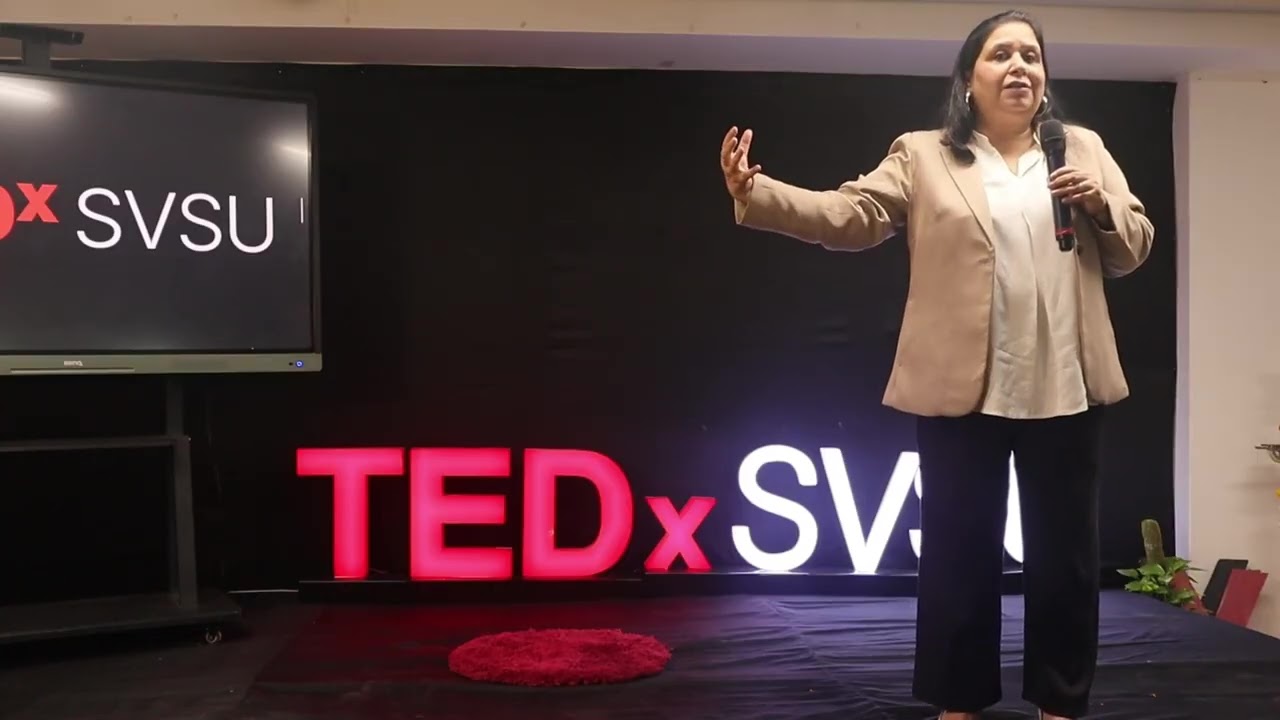
Are We Raising the Next Generation or Shaping Its Problems? | SVSU | Neera Paritosh | TEDxSVSU
Title history
- Are We Raising the Next Generation or Shaping Its Problems? | SVSU | Neera Paritosh | TEDxSVSU (PSI archive)
- Are We Raising the Next Generation or Shaping Its Problems? | SVSU | Neera Paritosh | TEDxSVSU — observed on 20261119-1828 UTC (YouTube)
Keywords
Summary
154 words
Critical Evaluation
Value of the Information & Strength of the Argument
The core value lies in drawing attention to the often-unrecognized influence of parental behavior on children’s development, utilizing relatable scenarios to illustrate the gap between what parents preach and practice. The argumentation, however, is built entirely on anecdotal narratives rather than data or research, making it persuasive only at an emotional level. The speaker’s reasoning is straightforward but oversimplified, attributing complex generational issues to a single root cause (parental modeling) without considering broader societal, economic, or genetic factors. The suggestions offered (subordination of individual interest, motivation, sensitization) are generic and lack actionable depth. Overall, the talk provides a thought-provoking perspective but lacks the rigor needed for a scientifically grounded argument.
Scientific Rigor, Source Quality, Title Accuracy
The talk demonstrates minimal scientific rigor: no studies, statistics, or expert references are cited, and the four incidents are presented as hypothetical or anecdotal without any verification. The only source provided in the description is the generic TEDx page, which is not directly related to the content’s claims. The title ‘Are We Raising the Next Generation or Shaping Its Problems?’ is well-matched, as the talk directly addresses how parents shape their children’s problems through their own actions. The presentation style is engaging but relies on emotional storytelling rather than factual evidence, which weakens its reliability. No comments were provided for analysis.
226 words
Title / Content Match
The title accurately reflects the content, which argues that parents unconsciously shape their children's problematic behaviors.
Quality & Reliability
3/10
The talk relies on personal anecdotes and subjective observations rather than empirical evidence, and no scientific sources are cited. The reasoning is simplistic and lacks rigorous analysis.
Key Moments
Markers derived by PSI from the transcript: the creator did not define chapters.
- Introduction of the campaign 'Parenting the Parent' and the hypothetical society of 50 people.
- First scenario: car accident where young adults use abusive language toward an older driver.
- Second scenario: job interview failures due to lack of qualification and personality traits.
- Third scenario: flashback of a father routinely drinking wine and dismissing education.
- Fourth scenario: party where parents criticize the youth while themselves drinking and smoking.
- Conclusion: parents blame their own children for mistakes they have taught them.
- Suggestions: subordination of individual interest, motivation, sensitization, and leading by example.
- Closing call for parents to change themselves for the betterment of the next generation.
Cited Sources
- TEDx Talks — Official TEDx page describing the event format and context.
Contribution & Novelties
The talk’s original contribution is the conceptualization of ‘Parenting the Parent,’ a campaign that reframes the responsibility for generational problems onto parents and society at large. It uses accessible, everyday scenarios to highlight the discrepancy between parental criticism and parental behavior. However, the ideas are not novel, as they echo well-established principles of social learning and role modeling. The talk lacks empirical grounding and mostly reiterates common wisdom.
Pour aller plus loin :
- Social learning theory — Bandura’s theory on how children learn behaviors through observation and modeling, directly relevant to the talk’s premise.
- Role model — Concept of individuals who influence others’ behavior and aspirations, central to the speaker’s advice.
- Intergenerational transmission of trauma — Research on how behaviors and attitudes can be passed across generations, offering a more rigorous perspective on similar themes.
135 words
Radar Profile
The radar profile shows low scores across all dimensions, particularly in fiabilite_globale (2) and niveau_technique (2), reflecting the talk's anecdotal nature and lack of scientific depth. Quantite_information is moderate (5) as the speaker provides multiple scenarios, but qualite_information remains weak due to subjective storytelling.