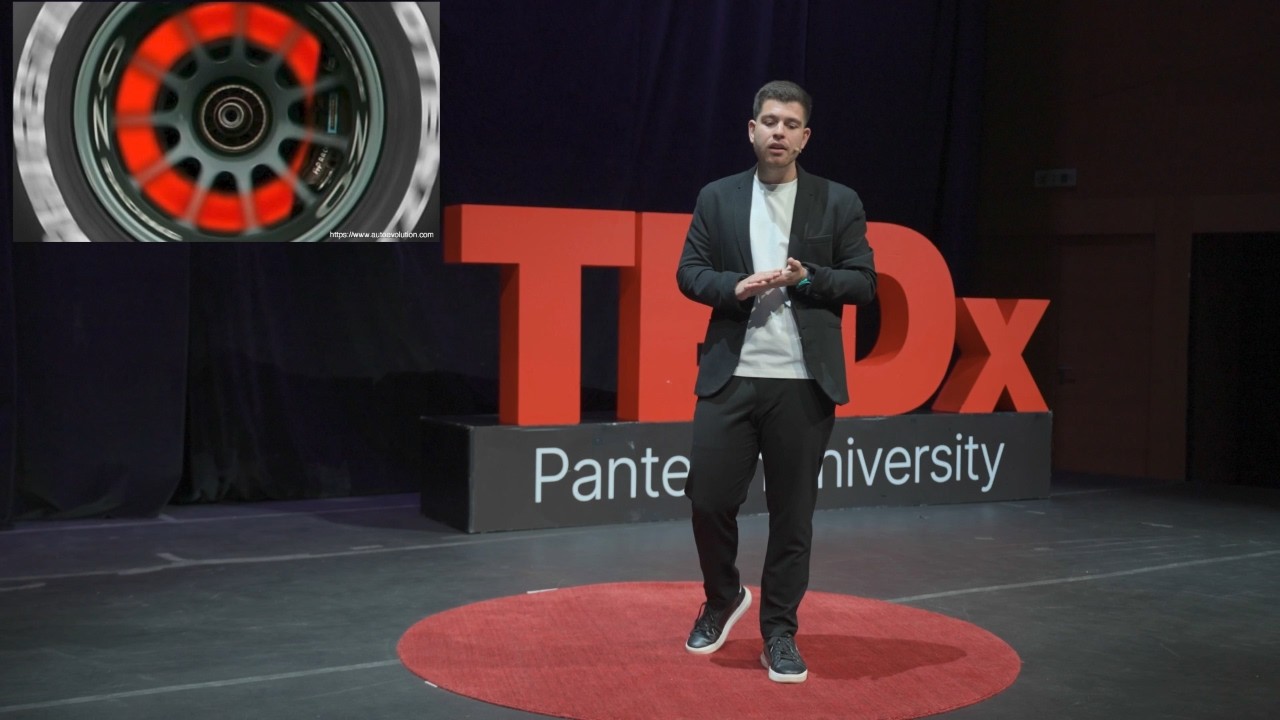
Beyond Human Senses: The Sensorium of Formula 1 | Kyriakos Theofanidis | TEDxPanteion University
Keywords
Summary
389 words
Critical Evaluation
Value of the Information & Strength of the Argument
The informational value lies in the insider framing rather than in data. The talk supplies a small number of concrete anchors (rev ceilings, power output, top speed, combustion temperatures, cornering loads, the role of the dynamometer as the primary engine-development tool) and one genuinely instructive micro-explanation, the description of normal spark-ignited combustion and of the abnormal auto-ignition that occurs at very high speed and temperature and that engineers deliberately approach without crossing. The most transferable idea is that raw measurements are worthless without an interpretive layer: thermal cameras produce numbers, but the engineer’s contribution is turning them into predicted consequences and pre-emptive fixes, which he labels a complex, multi-factor perception. The energy section adds a useful conceptual point, namely that engineers reason about transformations rather than about energy itself, so that a glowing brake disc is read as kinetic energy becoming heat rather than as an object. The argumentation, however, is essentially testimonial and metaphorical. The central claim, that the ordinary senses are insufficient, is never tested: it is framed as a rhetorical question deferred to the audience, and no example is given of a diagnosis that instruments missed and a human sense caught, which is precisely the evidence that would make the case. The assertion that perception can be deliberately extended is supported only by personal anecdote. The treatment of stress is a plausible practitioner’s dichotomy with no criterion for distinguishing the productive from the burdensome form, no threshold, and no evidence beyond the speaker’s own experience; the appeal to leadership is asserted rather than argued. The passion section functions as motivation and autobiography rather than as analysis, and the closing sequence on the emotional blankness after a crash is evocative but non-falsifiable. The technical simplification also weakens precision: spontaneous ignition without a spark at high load is described under the label of knock, whereas the two phenomena are distinct in engine literature. Overall the reasoning is coherent and pedagogically well sequenced, moving from scale, to biography, to perception, to enablers, to affect, but it argues by analogy and conviction where measurement and cases would have been available.
Scientific Rigor, Source Quality, Title Accuracy
No source is cited anywhere in the talk: no regulation text, no technical paper, no manufacturer data, no measurement campaign, no reference to published work on combustion, thermal sensing or human factors. Every quantitative element is delivered from memory and without attribution, which is acceptable for a personal account but leaves the audience unable to check anything. The only link supplied with the video is the generic TEDx platform address, which is an organisational pointer and not a documentary reference; the school competition and the company employing the speaker are named but not sourced. The technical statements that can be checked are broadly accurate and appropriately hedged, and the speaker explicitly notes that Formula 1 is no longer the dangerous sport it was decades ago, which is a correct and honest correction of a common perception. The main reservation concerns the treatment of abnormal combustion, where spontaneous ignition and knock are conflated, and the general absence of any distinction between what is measured in the sport and what is his own reconstruction of it. On title and content: the announced subject, perceiving the invisible in Formula 1, is genuinely addressed in the middle third of the talk, but a substantial share of the runtime is devoted to a general presentation of the sport and to career autobiography, so the billing is somewhat broader than the delivered argument.
591 words
Title / Content Match
The title is broadly honoured: the talk does build a case for engineers extending perception beyond sight, hearing and touch. It nonetheless oversells the conceptual content, since roughly the first half is a personal career narrative and a general presentation of the sport before the 'sensorium' idea is developed.
Quality & Reliability
5/10
First-person testimonial from a practising Formula 1 powertrain engineer. The technical anchors given (engine speeds above 15,000 rpm, roughly 1,000 hp, top speeds above 350 km/h, combustion temperatures above 1,000 °C, cornering loads around 6G) are consistent with public knowledge of the sport, and the basic physics invoked (energy conservation, kinetic-to-thermal conversion under braking) is correct. However, no source, dataset, regulation text or measurement is ever cited, the 'sensorium' framework is a personal metaphor rather than a demonstrated construct, and the explanation of abnormal combustion blends knock with spontaneous pre-ignition without distinguishing them. Reliable as an insider's account of engineering practice, not as a technical reference.
Key Moments
Markers derived by PSI from the transcript: the creator did not define chapters.
- Opening: the speaker introduces himself as a 25-year-old mechanical engineer working for Red Bull Powertrains in Formula 1, with a brief self-description for accessibility.
- Scale comparison with everyday driving: over 15,000 rpm, roughly 1,000 hp, more than 350 km/h and combustion temperatures above 1,000 °C, against 6,000-7,000 rpm and about 150 hp for a city car.
- Personal trajectory: childhood around his racing-driver father's cars, then the F1 in Schools / STEM Racing competition, a national title and the world finals in Austin, Texas, in 2016.
- Engineering studies in the United Kingdom, Formula Student experience, and the transition to professional Formula 1 engine design.
- Dynamometer footage as the pivot of the talk: what a spectator sees, hears and infers, versus what the engineer reads in the same sequence.
- First extended sense, heat: an engine as a thermal machine, the impossibility of approaching live components, and infrared imaging as a route to interpreting thermal stress and predicting failures.
- Second extended sense, energy: energy is transformed rather than created, and the glowing brake disc is read as kinetic energy converted to heat, a reading that can separate a win from a loss.
- Third extended sense, communication: drivers' expressions, sounds and gestures, a motorcycle-racing clip, and the explanation of normal combustion versus the abnormal ignition engineers approach deliberately.
- Time and stress: fixed race calendars, the wish for unlimited time, and the split between a productive stress that sharpens perception and a burdensome one that requires good leadership.
- Passion as the ultimate driver, followed by the inverse state: the seconds of emotional blankness after a crash, the switch back to problem-solving, and the Vettel image as the reward of engineering.
Cited Sources
- TEDx official platform page — The only link supplied with the video; a general organisational reference for the TEDx format, not a documentary source for any of the technical claims made in the talk. No technical or academic reference is cited on screen or in the description.
Concurring Sources
- Wikipedia — Formula One engines — Provides context on the regulation-imposed rev ceiling of 15,000 rpm, hybrid power-unit architecture and thermal efficiency figures, consistent with the scale comparison given in the talk.
- Wikipedia — Engine knocking — Documents abnormal combustion phenomena and the distinction between knock and pre-ignition, which helps situate the speaker's account of ignition occurring without a spark at high speed and temperature.
- Wikipedia — F1 in Schools — Background on the school competition (now STEM Racing) in which the speaker won a national title and the world final in Austin in 2016.
Contribution & Novelties
The distinctive contribution is not technical disclosure but a reframing of engineering work as perceptual work. Instead of presenting Formula 1 engineering as a catalogue of hardware, the talk describes three constructed senses (reading heat, reading energy transformations, and a shared non-verbal language with the driver) and then names three conditions that sustain them (time pressure, a productive form of stress, and passion). The idea that the interpretive layer, not the sensor, is where engineering value is created is a genuinely useful framing for anyone working with instrumentation, and it is stated more explicitly here than in most popular accounts of the sport. The complementary observation, that perception collapses for a few seconds after a crash before switching to intense problem-solving, is an unusual and honest description of the emotional regulation required in high-reliability environments. The content is, however, experiential and would need to be connected to existing work on expertise, human-machine interaction and combustion diagnostics before being treated as an analytical framework.
Pour aller plus loin :
- Wikipedia — Formula One engines — Reference point for the regulation-imposed 15,000 rpm ceiling, hybrid power-unit layout and thermal-efficiency context behind the talk’s opening comparison.
- Wikipedia — Engine knocking — Clarifies the distinction between knock and pre-ignition that the talk’s description of spontaneous ignition blurs.
- Wikipedia — F1 in Schools — Background on the school engineering competition and its world finals, the pivot of the speaker’s own trajectory.
- Wikipedia — Heat transfer — The physical basis for reading thermal stress, expansion and cooling in a running engine rather than measuring temperature alone.
- Wikipedia — Kinetic energy recovery system — Illustrates the energy-transformation reasoning the speaker describes when a brake disc glows, with the recovery side made explicit.
- Wikipedia — Sensorium — The concept the talk borrows and extends; useful for separating the physiological notion from the professional-perception metaphor used on stage.
- Tacit knowledge and expert intuition in engineering practice (concept, no URL given) — Relevant literature for testing the claim that experienced engineers detect faults that instruments alone miss.
337 words
Radar Profile
The profile is balanced around the middle: moderate informational density, moderate technical level and moderate reliability, with no axis standing out as a strength or as a clear weakness. The relatively low quantity score reflects a talk built on one practitioner's experience rather than on data, while the technical level is held up by a handful of precise physical anchors and one worked explanation of combustion. The overall shape is that of a well-structured personal testimonial rather than a technical briefing.