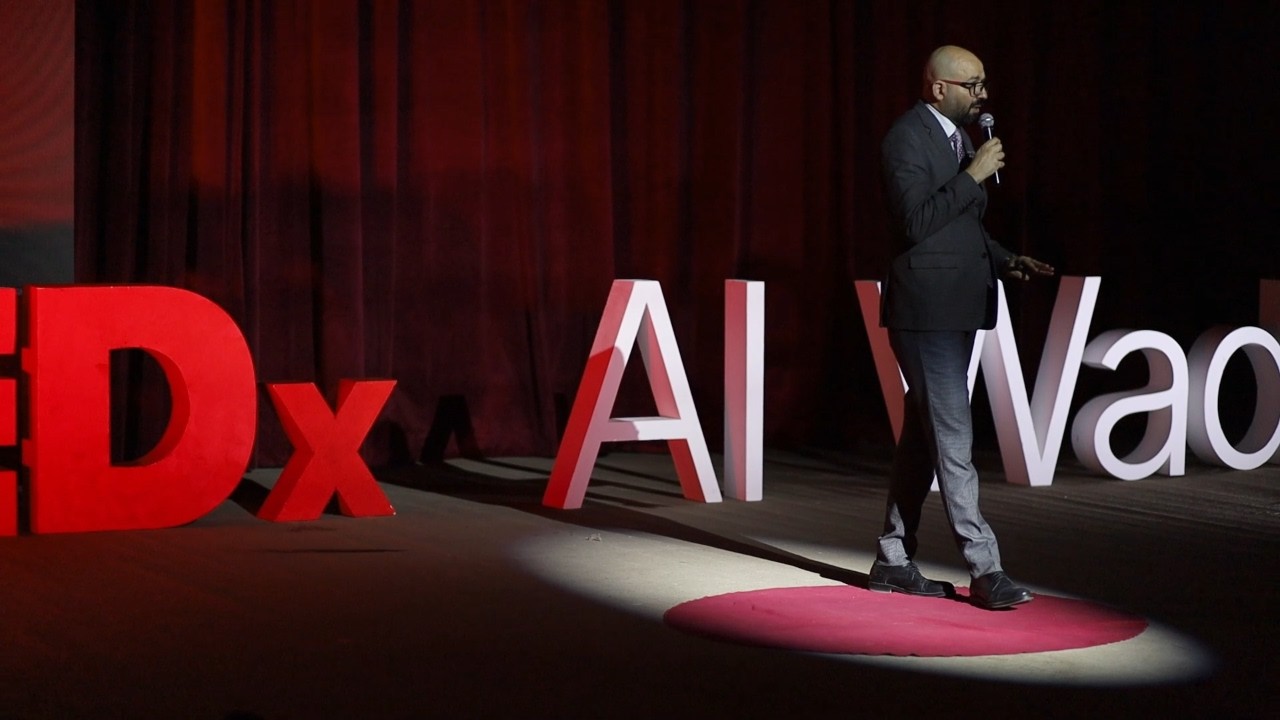
شيفرة الحمض النووي للتسويق:لماذا نسأل لماذا | هيثم قطرنجي | TEDxAl Wady
The Marketing DNA Code: Why We Ask Why | Haitham Katranji | TEDxAl Wady
Keywords
Summary
203 words
Critical Evaluation
Value of the Information & Strength of the Argument
The value of this talk lies in its accessible synthesis of existing marketing psychology (Simon Sinek’s Golden Circle) into an intuitive, memorable metaphor called ‘DNA Marketing’ (Data, Need, Presentation). The argumentation is built on relatable metaphors—twins, job interviews, product packaging—which effectively illustrate the relative weight of presentation versus content. However, the logical chain is primarily anecdotal. The claim that presentation can systematically outweigh information is supported by a single personal story, not a systematic study. The speaker’s terminology (‘DNA’, ‘golden circle’) is borrowed without deep academic precision, and the ‘DNA Marketing’ framework is presented as a novel theory but lacks critical evaluation of its boundary conditions or counterexamples. The rhetorical structure is persuasive, especially the final call-to-action, but the argumentative rigor remains at an introductory, motivational level rather than an advanced scientific level.
Scientific Rigor, Source Quality, Title Accuracy
The video explicitly cites the work of Simon Sinek (author and researcher) and his book ‘Start with Why’ as the primary theoretical anchor, which is accurate and easily verifiable TED talks. However, beyond this single reference to popular management literature, no other academic or empirical sources are mentioned. The talk is a work of ’expert opinion’ rather than a review of literature, which aligns with the TEDx format but does not satisfy high scientific rigor. The title’s promise to explore the ‘DNA code of marketing’ is well matched as the speaker explicitly defines his three-part model within the first half of the talk. The adequacy between the title and content is high. However, the reliance on personal professional anecdotes without citing specific data sets or verifiable case studies weakens the overall source quality.
281 words
Title / Content Match
The title accurately reflects the content, which introduces a marketing DNA framework and explores the 'Why' question central to the speaker's model. The title is a faithful representation of the talk's theme.
Quality & Reliability
5/10
The talk presents a personalized marketing framework ('DNA Marketing') derived from anecdotal experience and Simon Sinek's Golden Circle theory. While engaging and structurally coherent, it lacks empirical data, peer-reviewed references, or statistical evidence, relying entirely on the speaker's authority and personal narrative.
Key Moments
Markers derived by PSI from the transcript: the creator did not define chapters.
- Introduction with the twins analogy, illustrating natural human marketing from birth.
- Speaker recounts an award ceremony anecdote where a better presentation beat superior information.
- Introduces Simon Sinek's Golden Circle theory (What, How, Why).
- Proposes the 'DNA Marketing' model with three foundational pillars: Data, Need, and Presentation.
- Interactive tests with paracetamol packaging and a hypothetical job interview to demonstrate the model.
- Discussion on how a beautiful 'package' (presentation) does not guarantee good content.
- Key methodological integration: three questions to correspond with the Golden Circle and DNA Marketing.
- Concluding advice: 'Do not chase opportunities, be the opportunity' followed by thanks.
Cited Sources
- TEDx Program — The official platform hosting this independent TEDx event.
- Simon Sinek - Start with Why — Book and theory (Golden Circle) referenced in the video as the theoretical foundation.
Concurring Sources
- Simon Sinek - Golden Circle — The video's core theoretical concept is directly derived from this model, which is uncritically accepted and reformulated by the speaker.
Contribution & Novelties
The primary new contribution is the creative repackaging of Simon Sinek’s Golden Circle into a memorable and measurable framework called ‘DNA Marketing’, where the three pillars (Data, Need, Presentation) are treated as a genetic code for personal or product success. The talk’s originality lies in its pedagogical approach—using simple everyday tests (twins, job interviews) to make abstract marketing principles tangible. It does not introduce new empirical scientific data but offers an accessible heuristic model for practitioners.
Pour aller plus loin :
- Start with Why (Wikipedia) — The foundational book and theory that the speaker builds upon.
- Unique Selling Proposition (Wikipedia) — Related concept for identifying the core unique value (Data/Need) in marketing.
- Personal Branding (Wikipedia) — Closely tied to the speaker’s premise of self-marketing and managing one’s presentation and reputation.
130 words
Radar Profile
The radar profile is relatively balanced, with moderate peaks in information quantity and quality and slightly lower scores in technical level and reliability. This reflects a talk that is conceptually rich and audience-friendly but grounded in personal insight rather than rigorous scientific methodology.