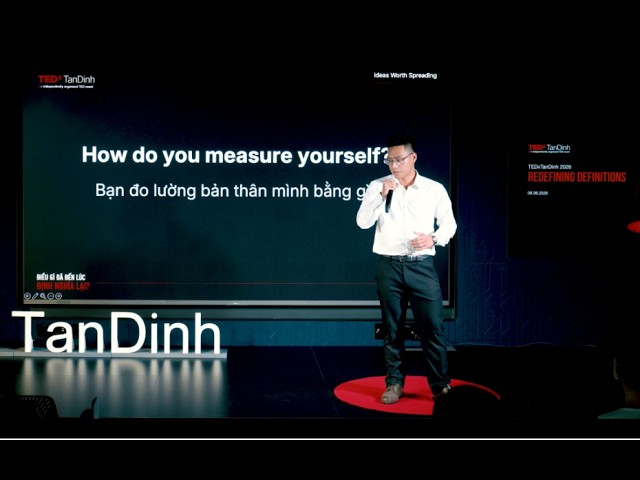
How Do You Measure Yourself? | Tiến Đạt Nguyễn | TEDxTan Dinh
Keywords
Summary
131 words
Critical Evaluation
Value of the Information & Strength of the Argument
The talk offers a valuable personal insight into the psychological pitfalls of tying self-worth to achievements. The speaker’s argument is built on a clear narrative arc, contrasting his early mindset with his later awakening. He effectively uses concrete episodes (winning the medal, the empty Podium, the casual swim in Singapore) to support his shift in perspective. The reasoning is coherent and emotionally resonant, though it relies solely on anecdotal evidence. The argument is further strengthened by his honest admission of struggle and the practical advice to view measurements as feedback rather than verdicts.
Scientific Rigor, Source Quality, Title Accuracy
As a TEDx talk, the rigour is based on personal testimony rather than scientific citations. No external sources are referenced in the description beyond the generic TEDx page. The speaker’s claims about human motivation are consistent with established psychological research, but no explicit links are provided. The title accurately matches the content, and the talk stays on topic throughout, offering a coherent and introspective narrative. Given it is a personal story, the lack of academic references is acceptable, but the information should be considered subjective.
193 words
Title / Content Match
The title perfectly reflects the core question of the talk, which the speaker revisits throughout and answers in the conclusion.
Quality & Reliability
6/10
Personal narrative with no empirical evidence, but the message aligns with established psychological concepts like intrinsic vs extrinsic motivation. The speaker's first-hand experience provides a unique perspective, though the lack of external data limits objective reliability.
Key Moments
Markers derived by PSI from the transcript: the creator did not define chapters.
- Opening question: How do you measure yourself?
- Introduction of the gold medal chase and belief that it would bring self-worth
- Describing the moment of winning and the subsequent emptiness
- Struggling after the victory, losing motivation, and quitting swimming
- Reconnecting with swimming in Singapore and rediscovering joy
- Training for the world championship with a new mindset
- Placing sixth and feeling fulfilled, concluding with his new approach to measurement
Cited Sources
- TEDx Talks — The talk was given at a TEDx event, and the link is provided in the description as a general reference to the organization.
Contribution & Novelties
The talk brings a fresh personal perspective on the common human struggle to define self-worth through external achievements. It offers a practical reframing of measurements as indicators of progress rather than value indicators, which could help listeners reassess their own motivations.
Pour aller plus loin :
- Intrinsic motivation — Core concept underlying the speaker’s shift from external rewards to internal fulfillment.
- Self-determination theory — A formal framework that explains the importance of autonomy, competence, and relatedness in achieving lasting well-being.
- Overjustification effect — A phenomenon where external rewards can undermine intrinsic interest, relevant to the speaker’s early loss of joy.
- Identity achievement — Relates to the speaker’s journey to define himself beyond achievements.
113 words
Radar Profile
The radar profile shows moderate scores across the board, with higher quality of information and lower quantity of technical detail. This indicates a thought-provoking but not data-dense talk, emphasizing emotional and reflective content over factual depth.