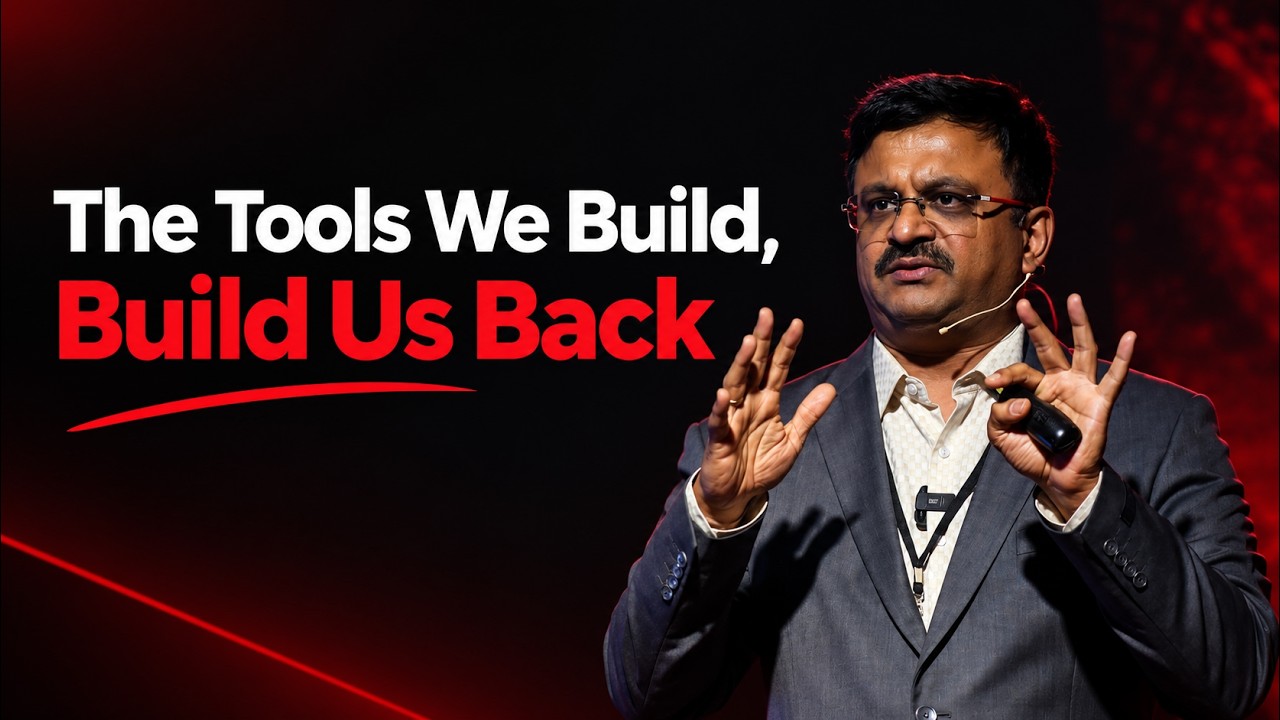
The Tools We Build,Build Us Back | Venkatarangan Thirumalai | TEDxThiagarajar College of Engineering
Keywords
Summary
223 words
Critical Evaluation
Value of the Information & Strength of the Argument
The talk’s value lies in its coherent philosophical narrative linking ancient tool use to modern AI, illustrating a shift in the human-tool relationship. The argument is personal and anecdotal, with clear structure: from passive tools (hammer, book, software) to active AI that decides and influences. The speaker uses storytelling (Jane Goodall, the Coke bottle movie, his own experiments) to make abstract concepts accessible. The argument is logically sound, though it lacks empirical data or rigorous citation. It raises important ethical and practical questions about human agency and responsibility in the age of AI.
Scientific Rigor, Source Quality, Title Accuracy
Scientific rigor is moderate: the speaker references historical facts (stone tools in Kenya, Jane Goodall’s studies) but does not provide sources. The description includes only a link to TEDx, which is generic. The title accurately captures the central thesis: tools now ‘build us back’. There are no comments to gauge public reception.
160 words
Title / Content Match
The title accurately reflects the core theme: tools, especially AI, are now actively shaping their creators.
Quality & Reliability
7/10
The talk provides a personal and philosophical perspective on tools and AI, drawing on historical examples and personal anecdotes. While not rigorously sourced, it offers coherent reasoning and references to well-known events and concepts. The speaker's expertise as a software entrepreneur adds credibility, but the content is largely subjective and lacks empirical evidence.
Key Moments
Markers derived by PSI from the transcript: the creator did not define chapters.
- Jane Goodall's observation of a chimpanzee using a stick as a tool
- Discovery of 3.3-million-year-old stone tools in Kenya, showing early toolmaking predates Homo sapiens
- The 'The Gods Must Be Crazy' story: a Coke bottle as a tool that triggers conflict and reinterpretation
- AI as a 'genie' that can both help and mess up; the speaker's book revision experience
- Advice to students: be toolmakers, own your tools, and build something meaningful with AI
Cited Sources
- Jane Goodall's research on chimpanzees — Early tool use observed in chimpanzees
- Stone tools from Lomekwi, Kenya — Archaeological discovery of 3.3 million-year-old tools
- TEDx program — This talk was given at a TEDx event
Concurring Sources
- TEDx Talks — Official TEDx platform where the talk is hosted
Contribution & Novelties
The talk offers a fresh perspective on AI by framing it as the first tool that actively shapes its creators, contrasting with the historical passivity of tools. It synthesizes examples from primatology, archaeology, and personal experience to illustrate a cognitive shift. The speaker’s concept of ’toolmaker pride’ and his advice to not let AI erase failure stories provides a novel ethical stance.
Pour aller plus loin :
- Tool use by animals — Relevant to the early examples of tool use.
- Lomekwi stone tools — Context on the 3.3-million-year-old tools.
- Generative artificial intelligence — Background on AI capabilities and implications.
99 words
Radar Profile
The radar profile shows moderate scores across the board, reflecting a talk that is informative and coherent but lacks strong technical depth and empirical grounding. The highest score is in information quality, indicating a valuable narrative, while technical niveau is lower due to its non-specialist approach.