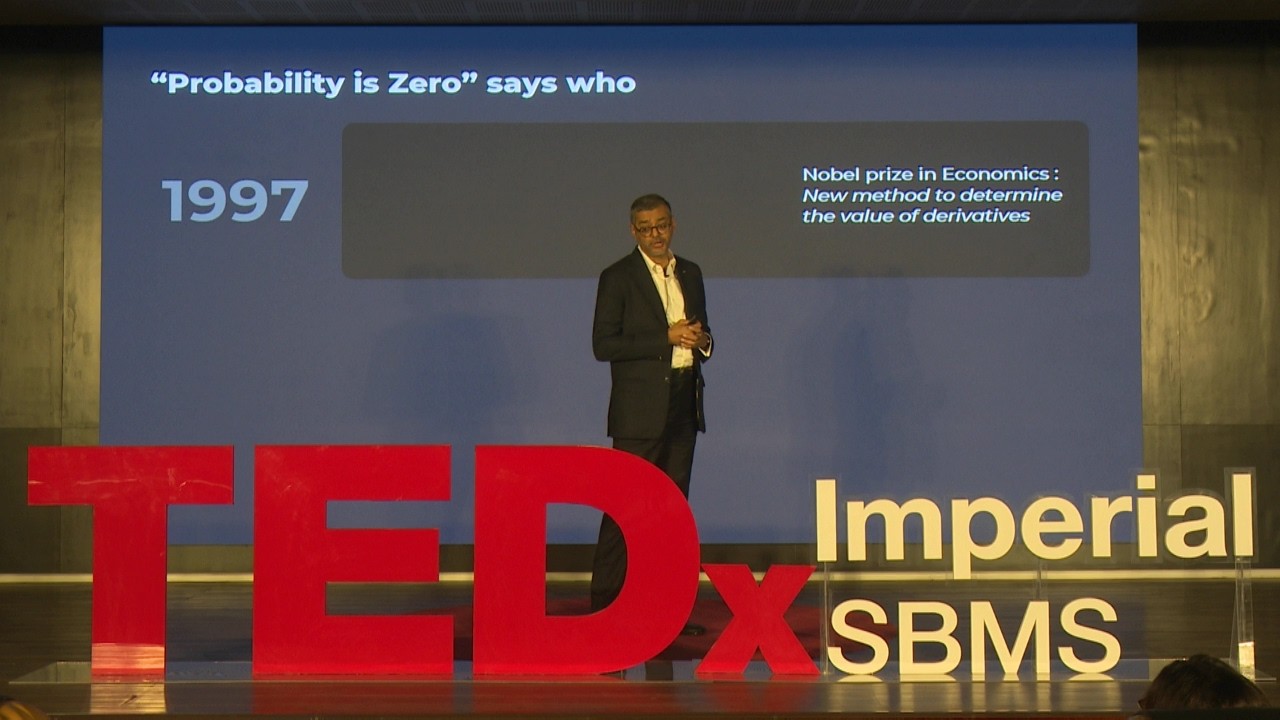
You Have to Be Wrong to Be Right | Rajosik Banerjee | TEDxImperial SBMS
Keywords
Summary
361 words
Critical Evaluation
Value of the Information & Strength of the Argument
The informational value lies less in new facts than in the articulation of a coherent decision-making posture, assembled from heterogeneous material: a personal anecdote, a public-administration taxonomy, a classical Indian philosophical parable, two well-known finance failures and a contemporary fraud case. The talk supplies a usable vocabulary (unknown unknowns, effectively-zero probability, antifragility, pre-mortem, tenth man) and two immediately actionable procedures, which is its real practical yield for a professional audience. The argumentation is built almost entirely by analogy, and the analogies are handled with some sophistication: Banerjee does not merely repeat the rope/snake story, he reverses it — in 2008 the industry saw a snake and manufactured the appearance of a rope, and in 2024 the rope itself has learned to look like a snake. That inversion is the strongest conceptual move of the talk and gives it a genuine analytical spine rather than a collection of anecdotes. The weaknesses are equally clear. Each example is asserted rather than evidenced: no figures are given for the 2008 exposures, no distinction is drawn between model risk, governance failure and incentive failure, and the causal story remains at the level of metaphor. The Rumsfeld framework is presented as a risk-management tool without discussion of its limits, notably that unknown unknowns are by definition not enumerable in advance, so a matrix can only sensitise rather than specify. The antifragility section is the thinnest: the gym analogy and the Indian payments example are suggestive but do not establish that controlled shocks reliably build institutional robustness, and the boundary between a ‘measured’ shock and a destabilising one is never drawn. The two prescribed tools, pre-mortem and red teaming, are sound and well documented in the decision-science literature, but their known failure modes — dissent being captured by hierarchy, pre-mortems becoming ritual — are not addressed. The talk is therefore strong as provocation and as a practitioner’s checklist, and weak as demonstration: it persuades by recognition rather than by proof, and the audience is invited to assent rather than to verify.
Scientific Rigor, Source Quality, Title Accuracy
Scientific rigour is low in the formal sense. No study, dataset, report or author is cited at any point; the only external anchors are named entities (Rumsfeld, Merton and Scholes, Long-Term Capital Management, Taleb’s turkey and Antifragile, the Hong Kong deepfake case, India’s share of global real-time payments) invoked from memory without references. Several of these are nonetheless checkable and roughly correct: the 1997 Nobel Memorial Prize in Economic Sciences awarded to Merton and Scholes, the 1998 collapse of LTCM, Rumsfeld’s February 2002 formulation, and the 2024 Hong Kong case in which an employee was deceived by a fabricated video conference. One formulation deserves qualification: the LTCM rescue is described as a ‘US Fed bailout of $3.6 billion’, whereas the $3.6 billion recapitalisation was provided by a consortium of private banks, orchestrated under the Federal Reserve’s convening role rather than as a direct central-bank outlay — a nuance that does not undermine the point but shows the level of precision on offer. The quantitative claim that India accounts for almost 50% of global real-time payments is stated without a source or a reference period. The source base of the talk is consequently experiential and bibliographic in the loose sense (one book explicitly recommended, Antifragile) rather than evidentiary. On the title/content relationship, the fit is close: the title’s paradox is exactly the thesis developed and restated in the closing formula, with no promotional drift. The talk also contains no advertising sequence.
590 words
Title / Content Match
The title is faithful to the content: the whole talk argues that accepting the possibility of being wrong is a precondition for being right, and ends on the injunction to be 'wrong early, small, often, inexpensive and on purpose'.
Quality & Reliability
5/10
Anecdotal and rhetorical TEDx talk delivered by a senior risk-advisory practitioner. The factual anchors it invokes (Rumsfeld's 2002 'known unknowns' formulation, the 1997 Nobel Prize of Merton and Scholes, the 1998 Long-Term Capital Management collapse, the 2024 Hong Kong deepfake transfer, India's share of global real-time payments) are broadly accurate and publicly documented, but no source, dataset, study or reference is cited on screen or in the description. The reasoning is built on analogies (rope/snake, turkey, gym, lantern) rather than on evidence, and the quantitative claims are given without figures, periods or methodology. It is therefore credible as professional testimony and pedagogically effective, but not verifiable as a scientific or data-backed exposition.
Key Moments
Markers derived by PSI from the transcript: the creator did not define chapters.
- The 2009 night-time road trip in Rajasthan: a navigation app confidently announces the route, the couple ends up in open country, and a policeman points them to the right junction — 'the app knew the map, the policeman knew the road'.
- The stated lesson: 'we were not wrong because we were careless, we were wrong because we doubted something more certain', followed by the observation that schools, bosses and spreadsheets all reward being right.
- Introduction of Rumsfeld's 2002 framework — known knowns, known unknowns, unknown unknowns — reframed as a risk-management device for mapping the possibility of being wrong, with attention to the third box.
- The Rajju-Sarpa parable from Advaita Vedanta and Adi Shankaracharya's commentary: a traveller mistakes a rope for a snake at dusk, and a lantern reveals the rope — the perception was false but the fear was real.
- Application to the 2008 credit crisis: the industry saw the snake and made it look like the rope — unsuitable borrowers, thin cushions, 'too big to fail' — with confidence, tidy reports and reassuring dashboards as the real darkness.
- The bag stolen in central Paris in broad daylight illustrates 'effectively zero' probability as a personal, not statistical, confidence; a travel app logging ~50 trips a year is used as the calibration of that confidence.
- Merton and Scholes win the 1997 Nobel Prize and, one year later, the fund they ran — Long-Term Capital Management — collapses under high leverage, requiring a $3.6 billion rescue.
- Taleb's turkey is fed for a thousand days, each feeding reinforcing its confidence, until day 1001 brings Thanksgiving — a parable of a stationary sample and of fragility built by success.
- Antifragility introduced via the gym and via the surge in Indian real-time payments during demonetisation and COVID: controlled, measured, small shocks in pieces rather than shock avoidance.
- Two prescribed practices: the pre-mortem (writing the programme's obituary on day one) and the 'tenth man' / red-teaming dissent that punches holes in a plan before reality does.
- The 2024 Hong Kong video-conference fraud, in which $25 million was wired after a fabricated CFO and board appeared on screen — 'the rope has learned how to be the snake' through voice cloning and deepfakes, closing on the question 'what if I'm wrong?'.
Cited Sources
- TEDx — official programme page — The only external link given in the video description; it documents the TEDx format and states that the talk was given at an independently organised local TEDx event (TEDxImperial SBMS). No documentary reference, report or study is linked.
Concurring Sources
- Long-Term Capital Management (Wikipedia) — Corroborates the account of the 1998 collapse of the fund associated with Merton and Scholes and of the roughly $3.6 billion private-sector recapitalisation, while documenting the Federal Reserve's convening role rather than a direct outlay.
- Black swan theory (Wikipedia) — Provides the conceptual background to the talk's treatment of 'effectively zero' probabilities, of models calibrated on calm historical data, and of Taleb's turkey as the archetype of inductive confidence.
- Antifragile (Wikipedia) — The book explicitly recommended by the speaker; documents the notion that some systems gain from volatility and stress, which underlies the gym analogy and the proposed small, controlled shocks.
- Unknown unknown (Wikipedia) — Traces the Rumsfeld formulation of February 2002 and its later uptake in risk management, matching the use the speaker makes of the third box of the matrix.
- Deepfake (Wikipedia) — Documents the class of synthetic voice and video fraud to which the speaker attributes the 2024 Hong Kong video-conference transfer of $25 million, supporting the claim that the deception surface has shifted.
Dissenting Sources
- Long-Term Capital Management (Wikipedia) — The talk describes the episode as a '$3.6 billion US Fed bailout'. The public record shows a recapitalisation of about $3.6 billion subscribed by a consortium of major banks, convened and supervised by the Federal Reserve Bank of New York; the distinction matters for how systemic risk resolution is characterised, though the illustrative point survives it.
- Pre-mortem and red teaming in the decision-science literature — The two prescribed tools are well supported in principle, but the talk presents them as reliably producing robustness without mentioning documented failure modes — ritualisation of the exercise, and dissent being neutralised by hierarchy or by the very consensus it is meant to challenge.
Radar Profile
The profile is that of a persuasive practitioner talk: moderate information density carried by narrative rather than data, low technical depth as regards modelling or statistics, and middling reliability because nothing is sourced. The high conceptual interest relative to the modest technical level reflects a synthesis built from metaphor and experience rather than from evidence.