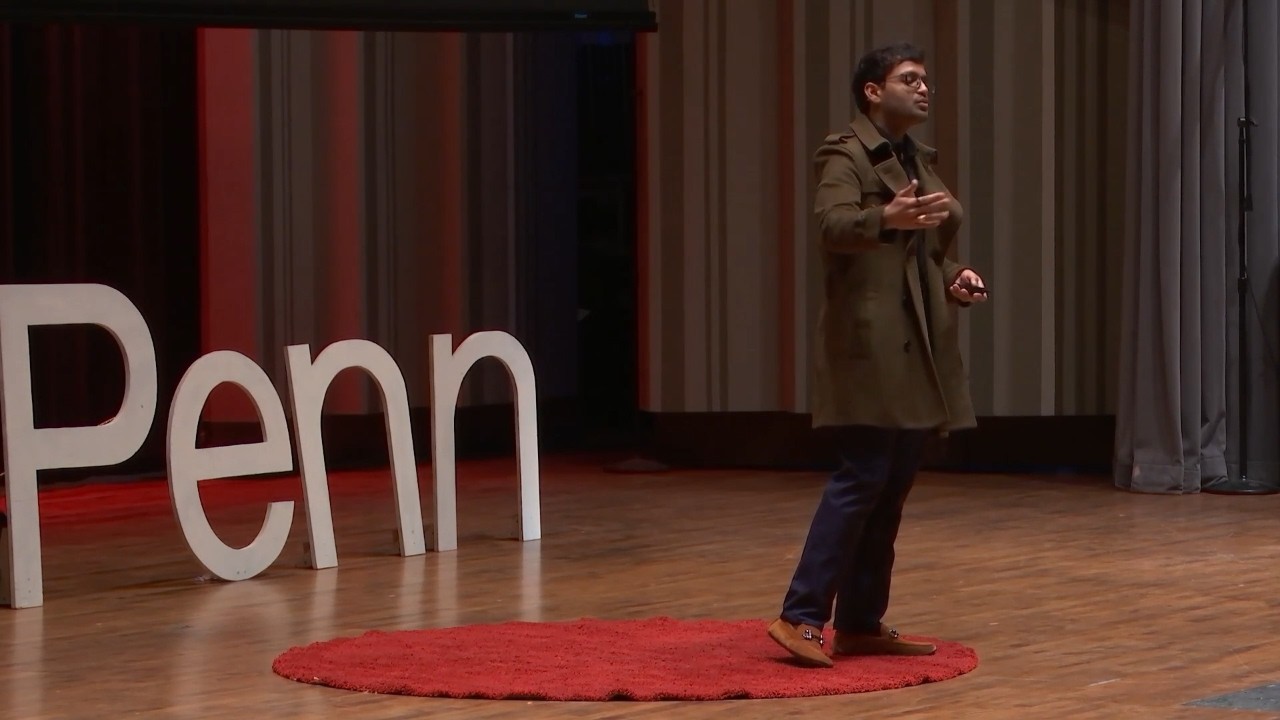
Can robots teach you how to live? | Lakshay Sharma | TEDxPenn
Keywords
Summary
110 words
Critical Evaluation
Value of the Information & Strength of the Argument
The value of the information lies in its accessible synthesis of engineering concepts and their application to personal development. The argumentation is structured around personal anecdotes and analogies, which are effective for engagement but lack empirical evidence. The speaker’s credibility from his background adds weight, but the reasoning is largely narrative rather than systematically proven.
Scientific Rigor, Source Quality, Title Accuracy
The scientific rigor is moderate; the talk references real projects (Planet Nine, DARPA, NASA) but does not cite specific papers or data. The only source provided is the generic TEDx link. The title is accurate as it directly addresses the thesis. The content is coherent and the title matches the message without exaggeration.
123 words
Title / Content Match
The title accurately reflects the content, as the talk argues that robotics principles can offer life guidance.
Quality & Reliability
6/10
The talk presents personal insights from the speaker's engineering experiences, but lacks rigorous citations or verifiable scientific data. The reasoning is anecdotal but logically coherent.
Key Moments
Markers derived by PSI from the transcript: the creator did not define chapters.
- Introduction of cost function as a necessity for robots.
- Search for Planet Nine and dealing with false positives.
- Building and launching rockets, committing to the unknown.
- DARPA off-road robots and trade-offs between safety and speed.
- NASA research on astronaut cognition and 'space fog'.
- Robotics as a mirror: environment as training data.
- Exploration vs exploitation and the value of both.
- Conclusion: what building robots teaches us about life.
Cited Sources
- TEDx Program — General source mentioned in the video description for TEDx events.
Contribution & Novelties
The talk’s original contribution is framing robotics as a mirror for human decision-making, using concepts like cost functions and exploration-exploitation as metaphors for life choices. It personalizes complex engineering ideas to offer practical advice.
Pour aller plus loin :
- Exploration–exploitation — Fundamental trade-off in decision-making, relevant to the speaker’s discussion.
- Cost function — Mathematical optimization concept central to the talk’s analogy.
- Algorithmic bias — Relates to the claim that biased training data leads to biased systems, applicable to human environments.
80 words
Radar Profile
The profile shows medium information quantity and quality, low technical depth, and moderate reliability, reflecting a talk that is engaging but not deeply technical or heavily sourced.