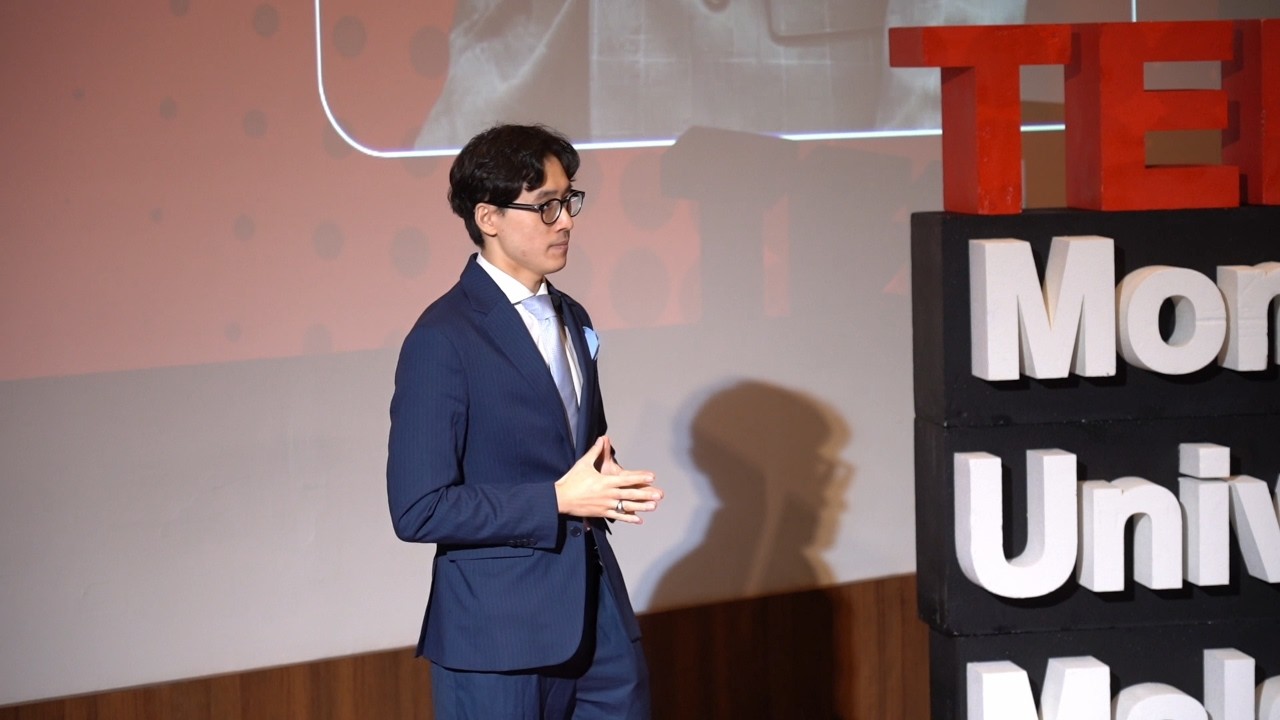
You Do Not Exist: And Why That Might Save You | Melvin Poh | TEDxMonash University Malaysia
Keywords
Summary
182 words
Critical Evaluation
Value of the Information & Strength of the Argument
The talk offers a valuable challenge to common assumptions about identity, making complex philosophical and neuroscientific concepts accessible. The argument is structured logically: it starts with direct experience, moves to historical and scientific evidence, and then draws social and personal implications. The use of interactive introspection effectively engages the audience and supports the central claim. However, the argumentation sometimes conflates different concepts (e.g., ‘self’ as a process vs. ’no-self’) and oversimplifies certain philosophical positions, yet overall it is persuasive and well-reasoned.
Scientific Rigor, Source Quality, Title Accuracy
The talk references well-known thinkers (Hume, Descartes, Confucius, Buddha) and general neuroscience findings, but does not cite specific studies or provide direct sources. The quality of sources is therefore moderate: it relies on established ideas but lacks precise references. The title-content fit is strong: the provocative title is directly supported by the talk’s thesis and conclusion. The talk is a philosophical opinion piece rather than a rigorous scientific review, which is appropriate for a TEDx format.
172 words
Title / Content Match
The title accurately captures the central thesis: the nonexistence of an independent self and the liberating potential of this realization.
Quality & Reliability
6/10
The talk presents a coherent argument blending philosophical and neuroscientific insights, but relies on general references without specific citations. The reasoning is logical and aligns with established concepts, yet lacks rigorous sourcing and empirical verification.
Key Moments
Markers derived by PSI from the transcript: the creator did not define chapters.
- Introduction: the universal belief that we exist.
- Exercise: trying to find the observer reveals only observations.
- David Hume's bundle theory and neuroscience's failure to locate a self.
- Descartes' 'I think therefore I am' and the cultural construction of the separate self.
- Consequences of a separate self: loneliness, ego, and performance.
- The self as relational and impermanent: Confucius, Buddha, and neuroscience converge.
- Conclusion: look outward, you are never alone; the self is everything and nothing.
Cited Sources
- TEDx Official Site — The talk is a TEDx event; this link provides general information about TEDx and its independent organization.
Contribution & Novelties
The talk synthesizes Eastern and Western philosophical traditions with modern neuroscience to argue for a relational, fluid concept of the self. It offers a fresh perspective by connecting the ’no-self’ idea to practical issues of loneliness and ego, suggesting that releasing the illusion of separation can be psychologically liberating. This integration is both thought-provoking and accessible.
Pour aller plus loin :
- Bundle theory — The philosophical idea that the self is a collection of perceptions, directly relevant to Hume’s argument.
- Anatta — The Buddhist doctrine of non-self, central to the talk’s critique of a permanent self.
- Split-brain — Neuroscientific research on patients with severed corpus callosum, supporting the idea of a constructed narrative self.
- Cogito, ergo sum — Descartes’ foundational statement, which the talk contrasts with Eastern perspectives.
128 words
Radar Profile
The scores indicate a talk that is strong in information quality but moderate in quantity and technical depth, making it accessible yet not deeply rigorous. The overall reliability is moderate, reflecting the opinion-based nature and lack of explicit citations.