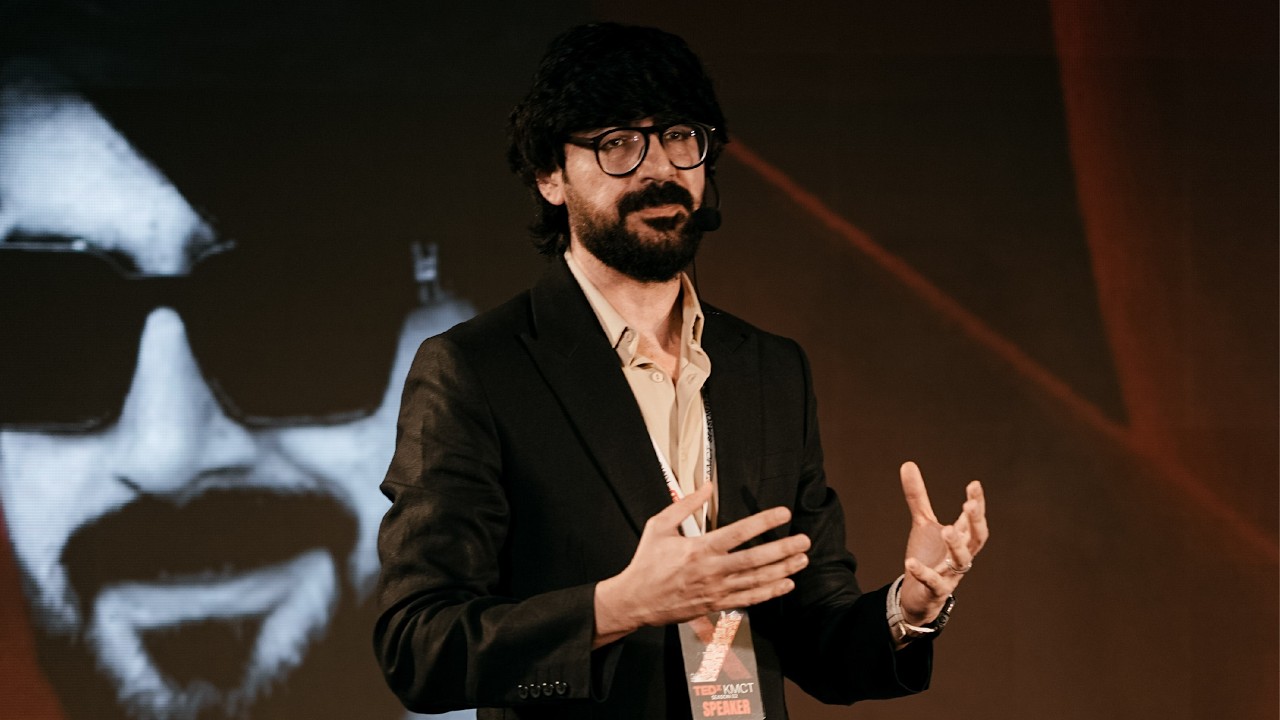
Frequencies That Broke Frontiers | Arfaz Iqbal | TEDxKMCT
Keywords
Summary
Arfaz Iqbal, a Dubai-based radio presenter with more than twenty years on air, opens with a childhood memory: convinced that tiny people lived inside his grandfather’s set, he built a wall of slippers and cushions around it and eventually unscrewed the casing, only to find wires, a speaker and springs. From that disappointment he draws the talk’s thesis — the people were never inside the radio, the people were the radio.
He then reconstructs the social history of the medium in Kerala, where listening was a collective act organised around teashops: independence, the end of wars and the 1983 cricket victory were all learned by men gathered around a set. He notes that Kozhikode, where the state’s first FM station launched, symbolises this culture.
Moving to the Gulf, he contrasts a modest and apparently declining listening habit in Kerala with the centrality of radio in the United Arab Emirates, where, by his own account, close to nine hours a week of listening are recorded among his station’s audience — commuters spending two hours in traffic finding relief in a familiar human voice.
The core of the talk is a series of campaigns run by his station: paying a listener’s rent, school fees, EMI and grocery bills, helping a family build a house on five cents of land in Kerala, and a long-running recruitment programme that has placed listeners in jobs. He describes the ‘Five Mom’ campaign, which brings mothers from Kerala villages to Dubai for a week, including the woman who refused to sleep on a five-star bed sheet and the widow taken to her husband’s grave nearly thirty years after his death in the Emirates.
He closes with a hotline call from a listener in distress, handled live and redirected to an ambulance, and with the observation that cassettes, CDs, MP3 players, podcasts and streaming have succeeded one another without displacing the medium.
314 words
Critical Evaluation
Value of the Information & Strength of the Argument
The informational value of this talk lies almost entirely in a register that academic literature on broadcasting rarely captures well: the felt texture of radio as a daily companion. Iqbal documents, from the inside of a station, a set of practices that are genuinely informative for anyone studying diaspora media — the teashop as a collective listening room in Kerala, the commute as a captive listening slot in the UAE, the station as an informal welfare desk that pays rents and school fees, matches job seekers with employers, and relays emergency calls to an ambulance. The ‘Five Mom’ campaign and the widow’s visit to her husband’s grave are striking ethnographic material on how a broadcaster can act as a broker of emotional and logistical ties between a sending region and its migrant population. The closing formula, that the people were the radio, is a neat compression of the idea that a medium’s social efficacy resides in the community that inhabits it rather than in the apparatus. The argument, however, is built exclusively by accumulation of anecdotes and by an implicit contrast between a nostalgic Kerala and a radio-saturated Gulf. No mechanism is proposed for why the same technology thrives in one place and fades in the other, other than the suggestive pairing of loneliness and commuting time. There is no engagement with the obvious alternative explanations — in-car listening, language of the available stations, licence and regulatory environments, advertising economics, the demographics of a population that is 88% expatriate. Nor is any counter-evidence considered: falling advertising revenue, the migration of young listeners to streaming, the difference between a captive audience and an attentive one. The reasoning is inductive and rhetorical, relying on emotional escalation rather than on comparison or control, and the evidentiary weight rests on the speaker’s personal authority as a witness. As testimony it is valuable and often moving; as demonstration it does not attempt to be one.
Scientific Rigor, Source Quality, Title Accuracy
No source is cited at any point. The single quantitative claim — that under a survey covering 2017-2018, roughly three in ten people listen to radio in Kerala — is introduced without naming the survey, the institute, the sample or the question asked, which makes it unverifiable and difficult even to interpret (reach? daily listening? household ownership?). The UAE figure of about nine hours per week is presented as an internal station or industry metric without attribution, and is described loosely as ‘a working day plus a lunch break plus phone browsing time’, which mixes measurement with metaphor. Historical assertions are likewise offered without reference: that Kozhikode hosted Kerala’s first FM station, that radio is roughly a hundred years old, that the station has run its recruitment campaign for ten to fifteen seasons. The campaigns themselves are recounted as personal memory, which is legitimate but cannot be checked. The single link in the description points to the generic TEDx page rather than to any documentation. There is no bibliography, no data table, no external corroboration: the talk stands as oral testimony, and should be read as such. On the relation between title and content, the mismatch is real but not disqualifying: ‘frequencies that broke frontiers’ announces a technological or geopolitical narrative that never arrives, while the actual subject is attachment, migration and belonging; the word ‘frontiers’ survives only as a metaphor for distance.
568 words
Title / Content Match
The title promises 'frequencies that broke frontiers', suggesting a technical or geopolitical account of broadcasting, whereas the talk never discusses spectrum, propagation or regulation and is in fact a personal and emotional tribute to radio as a companion medium for Malayali listeners in Kerala and the Gulf. The metaphorical reading of 'frontiers' (distance, migration, loneliness) rescues the title only partially.
Quality & Reliability
4/10
First-person testimony from a practitioner with two decades of radio experience: the lived material is authentic and internally coherent, but nothing is documented. No study, report, broadcaster or date is named; the only quantitative element ('a survey from 2017-2018', roughly one listener in three) is delivered without an identifiable source, and the audience figures for the UAE are given as an approximate internal estimate. The talk is a memoir and a plea, not a documented analysis, so its reliability rests on the speaker's professional credibility alone.
Key Moments
Markers derived by PSI from the transcript: the creator did not define chapters.
- Opening memory: as a five- or six-year-old, the speaker is convinced that small people live inside his grandfather's radio and work there day and night.
- He builds a barrier of slippers, cushions and pillows around the set so the invisible workers cannot escape, then unscrews the casing and finds only wires, a speaker and springs.
- Radio as collective listening in Kerala: teashops where people gathered to hear independence, the end of wars and the 1983 cricket victory.
- Kozhikode and the launch of Kerala's first FM station; the medium described as roughly a century old.
- Dubai commuting: two hours in traffic, and the relief brought by a human voice and a song.
- Comparison of listening habits: a 2017-2018 survey cited for Kerala against an estimated nine hours a week of listening in the UAE.
- Nostalgia as a driver: school, college, slang, films and songs replayed on air recreate a shared Malayali world.
- Station campaigns: paying a listener's rent, school fees, EMI and grocery bills, and helping a family build a house in Kerala.
- The recruitment campaign that has connected listeners with employers over ten to fifteen seasons.
- The 'Five Mom' campaign: mothers brought from Kerala villages to Dubai, including the woman who would not sleep on the hotel bed sheet and the widow taken to her husband's grave after nearly thirty years.
Cited Sources
- TEDx — official programme page — The only link provided in the video description; it documents the TEDx format and the independently organised local event (TEDxKMCT) at which the talk was given, but contains no reference supporting the talk's factual claims.
Concurring Sources
- Radio — General reference on the medium's century-long history, consistent with the talk's dating of radio technology and with its account of successive formats (cassette, CD, MP3, streaming) not displacing broadcast radio.
- All India Radio — Confirms the long-standing place of broadcast radio in Indian public life, which supports the description of collective listening in Kerala's teashops.
- Malayali diaspora — Corroborates the scale of Kerala's emigration to the Gulf, the demographic base of the station's UAE audience and of the family-separation situations described.
Contribution & Novelties
The talk’s originality is not analytical but documentary and affective: it gives an insider’s account of what a regional-language radio station actually does in the Gulf, well beyond music programming. The description of the station as an informal welfare and matchmaking institution — settling rents, school fees and loan instalments, circulating job offers, relaying a distress call to an ambulance — is a concrete and rarely articulated picture of broadcasting as social infrastructure. The ‘Five Mom’ campaign and the widow’s visit to her husband’s grave are particularly valuable as testimony on the emotional economy of migration between Kerala and the Emirates, and on the broadcaster as a trusted intermediary standing in for absent kin. The closing inversion — the people were the radio — reframes the medium as a community rather than a device, which is a useful counterpoint to narratives of technological supersession.
Pour aller plus loin :
- All India Radio — Background on India’s public broadcaster, the institutional frame within which the teashop listening culture described in the talk developed.
- The medium is the message — McLuhan’s formulation, useful for situating the speaker’s claim that the social effect of radio resides in the community that inhabits it rather than in the apparatus.
- Global village — McLuhan’s concept of electronically retribalised audiences, directly relevant to the idea of a dispersed Malayali public sharing one voice.
- Malayali diaspora — Context on the Kerala–Gulf migration system that underpins the station’s audience and its remittance-and-welfare campaigns.
- Uses and gratifications theory — media-studies framework (companionship, personal identity, surveillance) that would give the speaker’s observations a testable structure, cited here by name only.
269 words
Radar Profile
The profile is dominated by a very low technical score and a moderate information score, reflecting a talk built on narrative and emotion rather than on data or mechanism. Quantity and quality of information sit at mid-range: the anecdotes are substantive and specific, but unsourced. Overall reliability is the weakest axis, pulled down by the absence of any identifiable reference behind the figures cited.