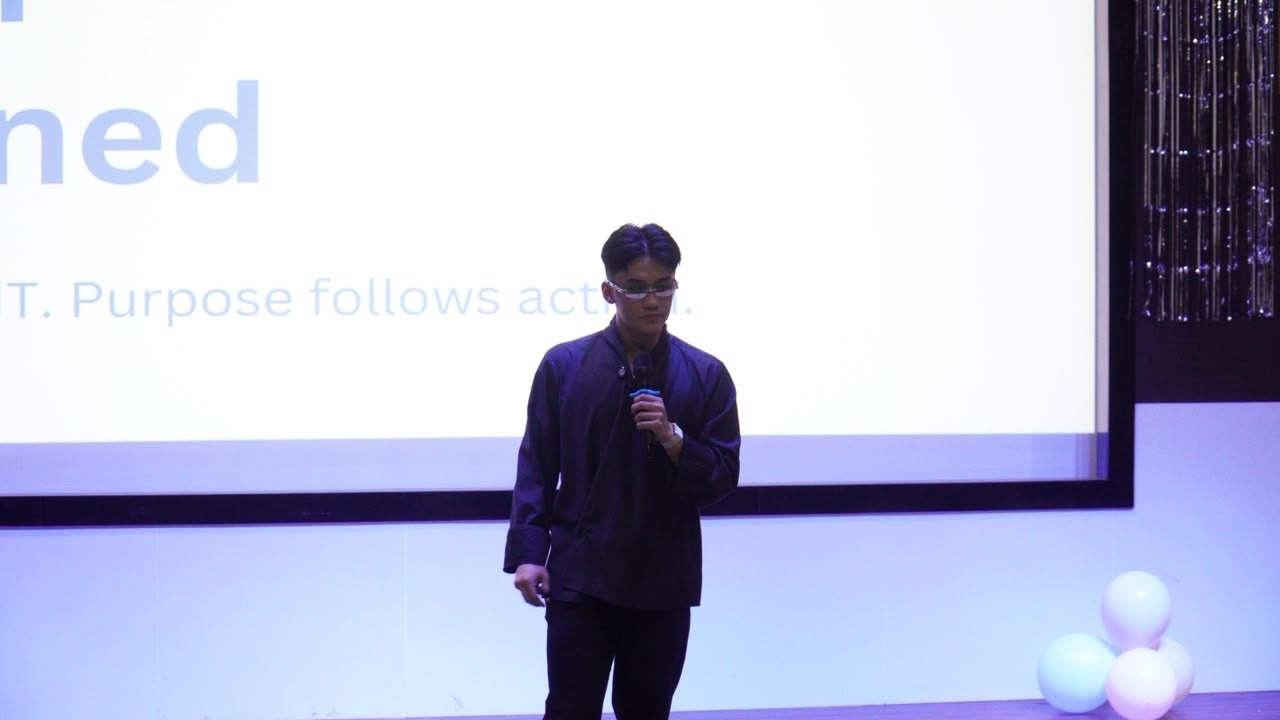
Purpose Beyond Profit: Building What Matters | Bryant Kandani | TEDxTrisakti School of Management
Title history
- Purpose Beyond Profit: Building What Matters | Bryant Kandani | TEDxTrisakti School of Management — observed on 20261119-1754 UTC (YouTube)
Keywords
Summary
130 words
Critical Evaluation
Value of the Information & Strength of the Argument
The talk provides a coherent set of motivational principles centered on purpose-driven entrepreneurship. The argumentation is largely experiential, anchored in the speaker’s own achievements at a young age, which lends authenticity but not empirical weight. The principles are presented as universal truths, yet they are supported only by anecdote and analogy (e.g., the steakhouse example to explain that purpose is earned). There is no reference to research or data, and the logic is sometimes circular (e.g., ‘success is a collection of failures’). Nevertheless, the talk offers practical reframing, such as focusing on capacity building and feedback loops, which can resonate with audiences seeking actionable mindset shifts. The value lies more in motivation and mindset than in rigorous advice.
Scientific Rigor, Source Quality, Title Accuracy
The talk has no scientific rigor: no citations, no references to studies, and no verifiable data. The only source mentioned is the TEDx platform itself (https://www.ted.com/tedx ), which provides general context but not specific evidence. The title is apt and directly reflects the content, which repeatedly contrasts purpose with profit. No comments were provided for analysis; thus no audience trends can be inferred. The lack of sources weakens the credibility of the claims, but the speaker’s personal experiences are presented transparently as the basis of his advice.
220 words
Title / Content Match
The title accurately reflects the core message: prioritizing purpose over profit.
Quality & Reliability
4/10
The talk is authentic personal testimony but lacks verifiable data or external sources; it relies on anecdote and motivational rhetoric rather than evidence-based argument.
Key Moments
Markers derived by PSI from the transcript: the creator did not define chapters.
- Opening statement: 'Many rich people are very poor, they only have money.'
- Principle 1: Win the identity game - focus on becoming the person you want to be before chasing results.
- Principle 2: Operate like an athlete - obsession beats talent; consistency and discipline in business and sport.
- Principle 3: Own it - 'If you don't own your challenge, your challenge owns you.'
- Principle 4: Quit chasing money - focus on providing value, and money will follow.
- Principle 5: Stop comparing clocks - run your own race; compare only with your past self.
- Principle 6: Failure is your friend - embrace failure as a step toward success; success is just the order of failures.
Cited Sources
- TEDx program — General context: the talk was given at a TEDx event, independently organized by a local community.
Contribution & Novelties
The talk’s original contribution is the synthesis of personal success principles into a practical framework centered on purpose. It reinforces common themes in self-development literature, but does so through the lens of a young entrepreneur and athlete, which may appeal to a similar demographic. The ‘capacity issue’ concept and the emphasis on building a feedback loop are pragmatic takeaways. No academic foundations are offered, but the motivational packaging is coherent.
Pour aller plus loin :
- Purpose-driven company — Relevant to the core idea of building a business around purpose beyond profit.
- Grit (personality trait) — Connects to the speaker’s emphasis on perseverance and obsession.
- Growth mindset — Related to the idea of viewing failures as learning steps.
117 words
Radar Profile
The radar profile shows moderate information quantity but low technical depth and reliability, reflecting the motivational and anecdotal nature of the talk. The high enthusiasm is tempered by the lack of evidence-based support, resulting in a balanced but not rigorous presentation.