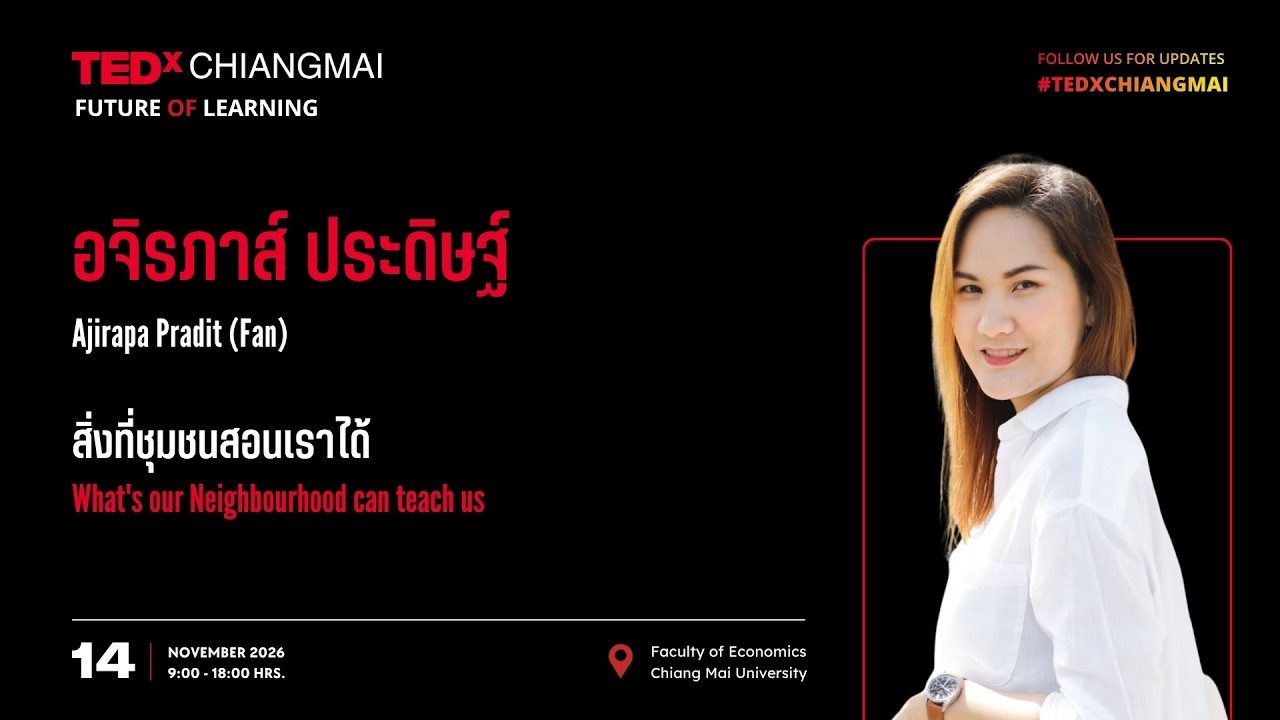
What Can Our Neighbourhood Teach Us? | Ajirapa Pradit | TEDxChiang Mai Play
Keywords
Summary
322 words
Critical Evaluation
Value of the Information & Strength of the Argument
The informational value lies less in data than in a reframing. The talk’s most usable contribution is the four-part taxonomy of learning assets — places, people, objects, memories — which extends the standard tangible/intangible heritage distinction into something a community worker can actually inventory. The Northern Thai vocabulary is a genuinely informative move: it shows that the unit of analysis is not a neutral administrative boundary but a set of social relations of mutual obligation, and it gives the audience a concrete alternative to the flat translation ’neighbourhood’. The single quantitative statement — that among 57 learning cities, participation and solidarity outrank education and skills, with governance and monitoring in between — is the pivot of the whole argument, because it inverts the intuitive assumption that a learning city is a city with better schools. The methodological proposals are practical and low-cost: blank maps as expressive surfaces, sketching and mapping exercises, returning research to the people studied, recruiting residents as storytellers, and the three prompts for attentive walking. The argumentation, however, is associative rather than demonstrative. Several claims are asserted rather than established: the 57-city finding has no stated source, sample or criteria; the graffiti-board anecdote is offered as proof of something general about repressed expression, which is a large inference from two police visits; the notion that neighbourhood work should ‘close a space in order to open it’ is stated metaphorically and never operationalised. The talk also moves quickly between registers — heritage policy, pedagogy, urban design, personal memory — without reconciling them, so the causal claim that neighbourhood learning produces more sustainable cities is asserted at the end rather than argued. It works well as a manifesto for practice and poorly as evidence.
Scientific Rigor, Source Quality, Title Accuracy
Rigour is that of a practitioner’s testimony rather than of a study. The two external anchors — UNESCO’s cultural-asset framework and the comparative review of 57 learning cities — are named but never cited: no report title, no institution behind the survey, no date, no method, no threshold for what counts as a ‘successful’ learning city. UNESCO is invoked by name only to license a four-category extension that is the speaker’s own, and the audience cannot tell where the organisation’s position stops and the speaker’s begins. The empirical material is entirely first-person and undocumented: workshop outputs, a graffiti board, police visits, students’ mapping exercises, conversations with building owners. Nothing is quantified, no outcome is measured, and no failure or counter-example is discussed, which flattens the account into a success narrative. The description offers only the generic TEDx programme link, so no bibliography backs the talk. On the positive side, the speaker is transparent about her institutional position and about the applied, participatory nature of her work; she does not disguise opinion as data and the reflections are internally consistent. Regarding title/content fit: the question posed in the title is the question actually pursued throughout, and the talk returns to it explicitly at start and close, so the framing is honest even if the answers remain programmatic rather than demonstrated.
519 words
Title / Content Match
The title is honoured: the talk repeatedly returns to what a neighbourhood can teach and to the neighbourhood as a unit of lifelong learning. Only the 'TEDxChiang Mai Play' suffix is extraneous, and the content stays slightly more abstract than the promise of concrete lessons.
Quality & Reliability
5/10
The talk is delivered by a genuine specialist — an architecture lecturer and researcher on the Chiang Mai Learning City project — and it anchors its central claim in two identifiable external references: the UNESCO framing of cultural assets (tangible/intangible) and a survey of 57 learning cities worldwide. However, neither reference is given with a citation, author, year or dataset, the '57 cities' finding is reported in a single sentence without method, and the rest of the argument rests on the speaker's own fieldwork anecdotes (a graffiti board, police visits, mapping workshops) presented without documentation. It is a credible and coherent practitioner account, not a verifiable research presentation.
Key Moments
Markers derived by PSI from the transcript: the creator did not define chapters.
- Northern Thai vocabulary of belonging: 'ban' (home), 'long' (a small community whose members know and help each other), 'khong' (the path that connects them).
- UNESCO's tangible/intangible cultural-asset distinction, extended by the speaker into four learning assets: places, people, objects and memories.
- The central question: how much do we actually know about our own city, and about the maps through which we know it?
- The blank-map graffiti board set up for visitors to express their feelings about the city — and the two police visits it provoked.
- Key reported finding: across 57 learning cities worldwide, participation and solidarity rank first, governance and monitoring second, education and skills only third.
- Teaching method: students sketch and map their own neighbourhood, then return that knowledge to building owners, who are invited to become storytellers.
- Three prompts for attentive walking: stop somewhere, sit and talk, look around slowly, look up and look down.
- Closing a space in order to reopen it: bringing in people unfamiliar with the area, using cultural objects, and letting children learn from stories.
- Closing thesis: placemaking means producing places that generate feeling, and lifelong learning with the city as a base aims at sustainable communities.
Cited Sources
- TEDx programme (TED) — The only link provided in the video description; it documents the TEDx format and the independent local organising framework of the event, not any substantive claim made in the talk.
- UNESCO framework on cultural assets and lifelong learning (named in the talk, no reference supplied) — Invoked around 01:15 to ground the tangible/intangible cultural-heritage distinction that the speaker then extends into four learning assets; no document, year or programme is specified.
- Comparative review of 57 learning cities (reported in the talk, no citation supplied) — Cited around 04:55 as evidence that participation and solidarity, then governance and monitoring, outrank education and skills in successful learning cities; no author, institution or methodology is given.
- Chiang Mai Learning City research project (speaker's own work, no output referenced) — The speaker's institutional research context, mentioned in the introduction and description; no publication or dataset is pointed to.
Concurring Sources
- UNESCO Global Network of Learning Cities — Supports the talk's core framing that a learning city is defined by broad participation, governance and monitoring rather than by schooling outputs alone, which is exactly the ranking the speaker reports.
- UNESCO Intangible Cultural Heritage — Confirms the tangible/intangible heritage distinction the speaker uses as her starting point before extending it into four learning assets.
- Project for Public Spaces — placemaking — Corroborates the closing argument that placemaking is about the meaning and social life of a place, not only its physical construction.
Contribution & Novelties
The originality of the talk is not in any discovery but in the transfer of a heritage-conservation vocabulary into the ordinary practice of urban learning. By replacing the administrative idea of a neighbourhood with the Northern Thai triad of home, small mutually-supportive community and connecting path, the speaker proposes that the relevant unit of urban learning is relational rather than spatial. Her four-part inventory — places, people, objects, memories — is a workable operationalisation of UNESCO’s tangible/intangible dichotomy for anyone running a community project, because each category can be observed, mapped and narrated by residents themselves rather than by experts. The reported ranking from 57 learning cities, if accurate, is a pointed corrective to skills-driven urban policy: participation and governance come before education and training, which reverses the usual funding order. The talk also contributes a set of concrete, near-zero-cost protocols: the blank map as expressive surface, the return of student research to the owners of the buildings studied, the recruitment of residents as narrators, the three prompts for slow observation, and the deliberate ‘closure’ of a space so that outsiders can be brought in. The closing notion of placemaking as the production of feeling rather than of built form ties the whole argument to a defensible claim: a neighbourhood teaches because people have invested memory in it, and that investment is what any learning-city policy must first protect.
Further reading:
- UNESCO Global Network of Learning Cities (UNESCO Institute for Lifelong Learning) — The institutional programme that underpins the ’learning city’ framing used throughout the talk and the likely context for the 57-city comparison.
- UNESCO Intangible Cultural Heritage — Reference point for the tangible/intangible cultural-asset distinction the speaker opens with and then extends.
- Project for Public Spaces — placemaking resources — Practitioner literature on placemaking as the production of attachment and use rather than of built form, echoing the speaker’s closing thesis.
- Wikipedia: Placemaking — Overview of the concept and its critiques, useful for testing how far the speaker’s usage aligns with the mainstream definition.
- Wikipedia: Chiang Mai — Background on the city whose neighbourhood culture, Northern Thai vocabulary and urban change frame the case study.
- Learning city / learning neighbourhood indicators — the concept of benchmarking participation, governance and monitoring rather than education outputs; cited by name only, as no precise verifiable source is available for this specific claim.
390 words
Radar Profile
The profile is compact rather than lopsided: moderate quantity and quality of information, low technical demand, and middling reliability reflect a short, concept-driven talk with two named but uncited references. The low technical score is not a weakness here but a consequence of the deliberately accessible, practice-oriented register. Reliability sits just above the midpoint because the speaker is a genuine specialist in the exact field she describes, even though almost nothing is documented.