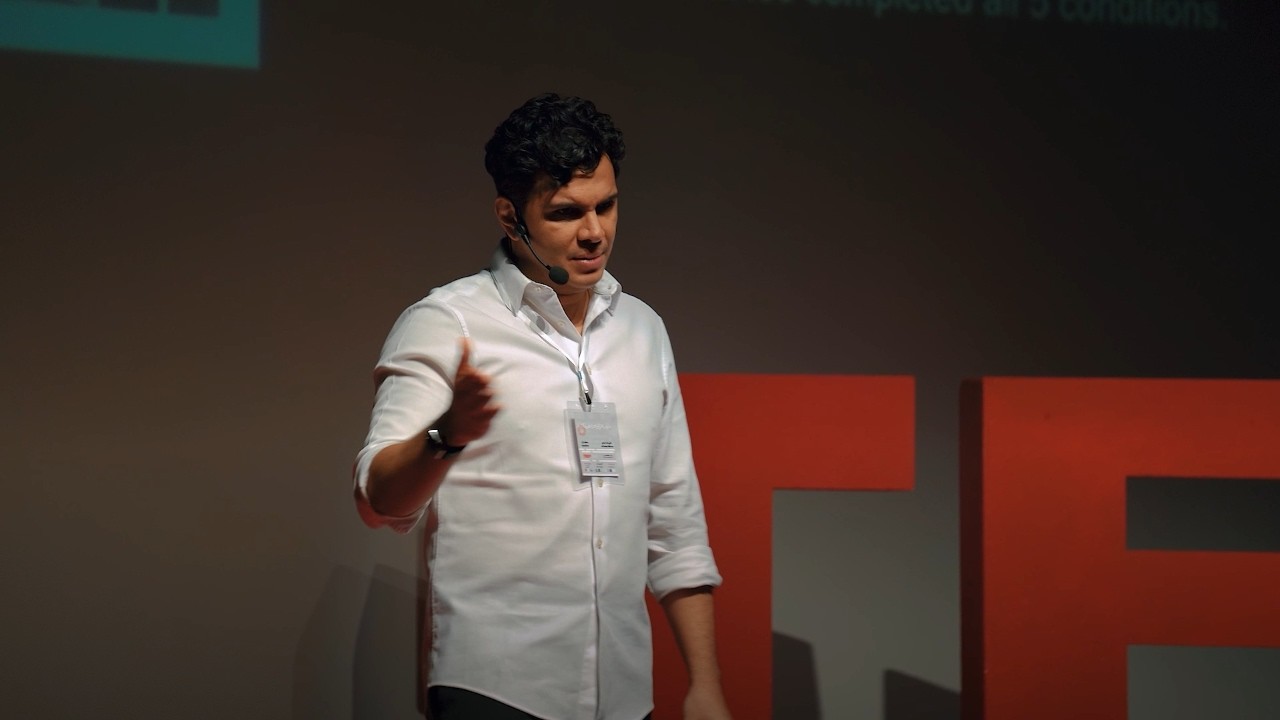
Misconceptions Exist Even in Medicine! | باورهای غلط حتی در پزشکی | Alireza Sadeghinikoo | TEDxKish
Keywords
Summary
260 words
Critical Evaluation
Value of the Information & Strength of the Argument
The informational value lies in the insider view of a clinical trial rather than in the debunking itself. The speaker explains concrete, rarely popularised constraints: ethics committees block designs that would harm volunteers; blinding requires that neither the experimenter administering the substance nor the participant knows what is in the capsule; participants must be matched on sex, age, diet, height and weight; every instrument needs its own validation; and a substance has to be specified by grade, since industrial, food and pharmaceutical sodium bicarbonate are not interchangeable. The distinction between blood lactate sampling and intramuscular lactic acid, and the point that a placebo arm is not decoration but a necessary control, are handled accurately. The pharmacology asides — that over-the-counter cold remedies contain antipyretics and antihistamines rather than anything acting on the virus, and that potassium iodide works by saturating the thyroid so that radioactive iodine-131 cannot bind — are correct and pedagogically useful. The argumentation, however, is built on a deliberate rhetorical paradox: the opening demonstration is an anecdote that the speaker himself declares non-scientific, used to capture attention before pivoting to method. That self-awareness limits the damage but does not eliminate it, since the emotional force of the stunt carries further than the caveat. The central case study is narrated qualitatively: no effect sizes, no confidence intervals, no p-values, no sample-size justification, so the listener must accept ’not significant’ on trust. The inferential leap from one small trial of eight karate athletes to a general maxim that ‘more is not always better’ is presented as a conclusion of the study rather than as a plausible but unproven generalisation. Humour, digressions and a running joke about a radio presenter’s microphone periodically break the thread, and a few statements are stated more briskly than the evidence allows, notably the claim that animal experimentation raises no real ethical difficulty. The closing epistemological message — that medicine is empirical and revisable, unlike arithmetic — is sound and well placed, but it functions as a moral drawn from the narrative rather than as a demonstrated result.
Scientific Rigor, Source Quality, Title Accuracy
Sourcing is thin relative to the claims made. One venue is named explicitly, the journal of the International Society of Sports Nutrition, and the speaker ranks it within a hierarchy of journals using a league analogy; the collaborating institutions are listed by name. But no article, author list, DOI, year of publication or dataset is provided, and the second publication referenced — a COVID-19 paper said to have been published through the World Health Organization — is asserted without any traceable detail. The historical and regulatory examples are the strongest evidential element: ranitidine’s degradation into NDMA and its market withdrawal, and the thalidomide tragedy and its effect on drug-testing duration, are accurate and well documented, as is the mechanism of potassium iodide saturation of the thyroid. The general claim that FDA approval does not equal proof of safety is defensible and correctly illustrated. Counterweights: the assertion that animal testing poses no meaningful ethical problem is contestable and stated without nuance; the sweeping dismissal of the entire over-the-counter cold-medicine category blends an accurate point about symptomatic-only action with an inaccurate implication; and statements about the size and quality of the speaker’s publication record are unverifiable from the talk. On title and content, the fit is good: the announced theme of misconceptions is genuinely the spine of the talk, and the detour through trial methodology, though long, is framed as the reason misconceptions survive.
590 words
Title / Content Match
The title promises a tour of medical misconceptions, and the talk delivers exactly that: folk beliefs about melon and honey, social-media pseudo-cures, radiation-related self-medication and an inflated faith in regulatory approval. The fit is good, though a large part of the runtime is in fact a case study of how a trial is built rather than a catalogue of misconceptions.
Quality & Reliability
6/10
The talk rests on a genuine, methodologically described clinical trial (placebo-controlled, double-blind, matched groups, ethics approval) and on well-established pharmacological facts, but it gives almost no quantitative results, no bibliographic reference beyond a journal name, and mixes rigorous content with anecdote, humour and a few sweeping or loosely worded claims.
Key Moments
Markers derived by PSI from the transcript: the creator did not define chapters.
- Opening audience poll on the belief that eating melon and honey together is harmful or even lethal.
- The speaker eats melon with honey on camera, filmed by relatives expecting the worst, and reports no effect except a high sugar intake.
- He concedes that his own demonstration is not science, and lays out the requirements: a team, reproducible experiments, and population-level evidence rather than individual testimony.
- Presentation of the research question — sodium bicarbonate plus caffeine and fatigue — and of the multinational team across Canada, the United States, Australia and Qatar.
- Ethics approval explained, including what cannot be tested on humans, followed by controversial remarks about animal experimentation.
- Debunking of radiation-related self-medication: potassium iodide, iodine-131, thyroid saturation and the different iodine compounds found in salt and antiseptics.
- Study design walkthrough: five conditions including placebo and control, double blinding, matched participants, incremental tests to exhaustion, lactate and metabolic measurements.
- Results reported qualitatively: bicarbonate alone best, caffeine effective, the combination not statistically significant, no significant lactate difference.
- One paper among thousands feeding a drug dossier; regulatory approval is not absolute proof, illustrated by ranitidine and thalidomide.
- Closing epistemological argument: medicine is an empirical, revisable science, and claims of 100 per cent cures or hidden-knowledge conspiracy should be rejected.
Cited Sources
- TEDx — independently organised TED-format events — Official link given in the video description, documenting the conference format under which the talk was delivered.
- Journal of the International Society of Sports Nutrition — Named by the speaker as the peer-reviewed venue where the sodium bicarbonate and caffeine trial was published; no article reference or DOI is given in the talk.
- World Health Organization (WHO) — Mentioned as having published one of the speaker's co-authored COVID-19-related papers; no specific document is identified.
- U.S. Food and Drug Administration (FDA) — Invoked as the regulatory benchmark whose approval the speaker argues is not an absolute guarantee of safety.
Concurring Sources
- Placebo (Wikipedia) — Supports the speaker's claim that a placebo arm is mandatory when assessing a substance's true effect.
- Blinded experiment (Wikipedia) — Corroborates the double-blind procedure he describes, in which neither the researcher nor the participant knows the content of the capsule.
- Thalidomide (Wikipedia) — Confirms the historical account of congenital malformations that led to longer and stricter drug testing.
- Ranitidine (Wikipedia) — Confirms the NDMA degradation issue and the withdrawal of an FDA-approved medicine.
- Potassium iodide (Wikipedia) — Confirms the thyroid-blocking mechanism against radioactive iodine uptake described in the radiation segment.
Dissenting Sources
- Animal testing (Wikipedia) — The speaker states flatly that animal experimentation raises no real ethical problem; the documented ethical debate, regulatory review frameworks and mandated replacements contradict that simplification.
- Over-the-counter cold medicine — His dismissal of the whole category blends an accurate point (no ingredient acts on the cold virus) with an inaccurate implication that the products are inert or purely nominal; symptomatic efficacy of antipyretics and antihistamines is documented, and no source is offered for the sweeping version.
Contribution & Novelties
The distinctive contribution is not new scientific content but a transparent, first-person account of what a small investigator-initiated trial actually costs and produces. The speaker shows the unglamorous parts that public science communication usually omits: ethics submissions, substance grading, instrument validation, matched cohorts, double blinding, and above all a negative result — a year of work ending in ’not significant’ — which he presents as a legitimate and even valuable outcome rather than a failure. The pairing of a folk belief (melon and honey) with a modern sports-supplement question (bicarbonate plus caffeine) makes the point that misconceptions are not confined to the laity but circulate among clinicians and pharmacists too, as he reports from his own colleagues’ warnings.
Further reading:
- Placebo (Wikipedia) — Background on the placebo arm and expectancy effects that the speaker describes as essential to any drug trial.
- Blinded experiment (Wikipedia) — Explains double blinding and why neither administrator nor participant should know the allocation.
- Thalidomide (Wikipedia) — Documented history behind the claim that this tragedy reshaped drug-testing durations and pregnancy warnings.
- Ranitidine (Wikipedia) — Case of an approved drug withdrawn after NDMA contamination and degradation were identified.
- Potassium iodide (Wikipedia) — Mechanism of thyroid saturation used against radioactive iodine-131 uptake, as described in the talk.
- Sodium bicarbonate as an extracellular buffer in high-intensity exercise — the ergogenic hypothesis the study tested; concept cited by name, no single canonical source given in the talk.
- Preregistration and reporting of negative results in clinical research — the methodological norm underlying the speaker’s insistence that a null result is still a result.
262 words
Radar Profile
The profile is that of a talk with solid informational density and above-average technical content, driven by a real experimental protocol rather than by second-hand reporting. Reliability is held back by the absence of any quantitative result, bibliographic reference or traceable document, and quality by the constant alternation between rigorous explanation and anecdotal or humorous digressions. The gap between technical level and reliability reflects a speaker who knows the method intimately but who, on stage, argues by narrative rather than by data.