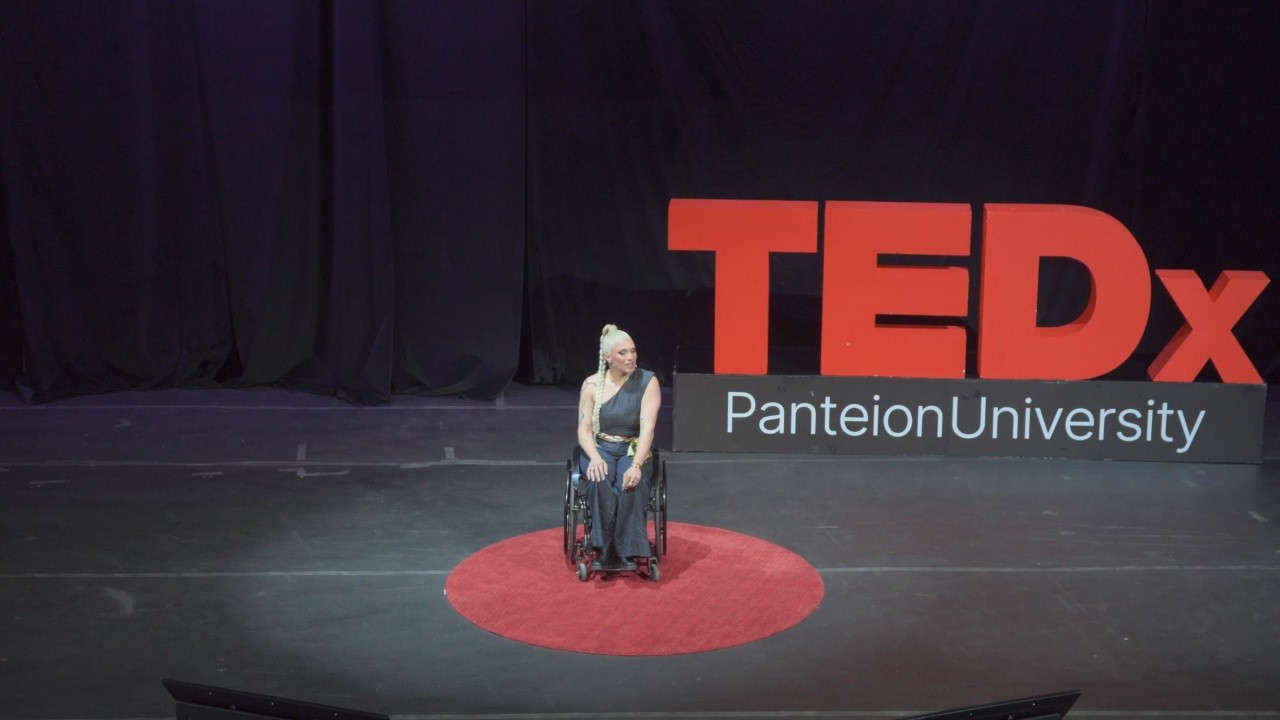
The feeling of being included | Konstantina Alexandridou | TEDxPanteion University
Keywords
Summary
380 words
Critical Evaluation
Value of the Information & Strength of the Argument
The informational value of the talk lies less in facts than in a precise phenomenology of exclusion. Alexandridou gives exclusion a somatic vocabulary — a shiver, a tightness in the stomach, a heaviness of the body, senses that dull in order to make the situation tolerable — and she names the mechanisms through which it is maintained: tokenistic inclusion (‘you exist so that others feel good’), administrative refusals disguised as logistical constraints (‘you’ll hold the group back’, ‘our coaches aren’t for you’, ‘you can come but you’ll pay double’), and, most insidiously, habituation, the fact that after years of it exclusion stops even registering as an injustice. This is the strongest part of the argument: it converts a moral claim into an observable set of institutional practices that the audience can check against their own environments. The pivot to proprioception is a genuinely useful idea, and the empirical anchor she offers — entering a gym and not knowing what to do with one’s body — is concrete and recognisable. Her argumentation, however, is essentially narrative and inductive: one case, richly described, generalised with the assertion that it is a shared experience of disabled people. That assertion is plausible and consistent with disability scholarship, but the talk supplies no evidence for it beyond her own trajectory and the reported ‘dozens’ of athletes at her gym. The mechanism she proposes — that systematic exclusion prevents the development of proprioception — is stated as fact whereas it is at best a hypothesis in need of controlled support; the leap from social exclusion to sensorimotor development is large and is asserted rather than argued. The same applies to the later ‘sensorium’ claim, which shifts from a neurophysiological notion to a metaphor for openness to the world, without signalling the shift. Her handling of the ‘inspiration’ question is more careful than most: she explicitly refuses to be framed as inspiring because she happens to have an impairment, and insists on being recognised for hard training — a distinction that strengthens the argument’s internal consistency. The closing rhetorical move, returning to the opening question about feeling alive and reframing that sensation as a right rather than a privilege, is effective and logically continuous with the rest. Overall: high argumentative coherence and real conceptual usefulness, low evidential density, and a tendency to let a strong metaphor do work that would require data.
Scientific Rigor, Source Quality, Title Accuracy
Scientific rigour is limited by the genre. No study, statistic, dataset or named researcher is invoked; the two quantitative elements in the talk are personal (a 5th place at the Adaptive CrossFit Games, and a fundraising campaign that succeeded in about 52 hours) and are not independently corroborated within the video. The vocabulary borrowed from neuroscience — proprioception, ‘sensorium’ — is used without definitional caution, and the causal claim linking chronic social exclusion to impaired proprioceptive development is presented as established when it is not. The talk is nonetheless intellectually honest about its own status: the speaker explicitly says this is not a private tearful story but a shared experience, and she distinguishes her target (wellbeing and access to an ordinary neighbourhood gym) from elite performance, which prevents an easy overgeneralisation. Source quality is thin by construction: the only external reference in the description points to the generic TEDx programme page, and no academic or institutional documentation is cited. The title-content fit is strong — the talk is literally about the feeling of being included, opens and closes on that feeling, and delivers the promised first-person account without overreach. Presence of a short advertising/sponsorship segment: none identified in the material provided.
611 words
Title / Content Match
The title matches the talk closely: the whole argument is built around the felt experience of inclusion and exclusion, and the closing minutes explicitly return to that 'feeling'. No gap or misleading promise.
Quality & Reliability
5/10
The talk is a first-person narrative delivered by a credentialed speaker (PhD candidate in Disability Studies and Educational Policy, inclusion educator, international adaptive CrossFit athlete), so the testimony is authentic and the lived experience is not in doubt. However, the content is testimonial rather than evidential: no data, no study, no quantified figure other than the speaker's own ranking (5th at the Adaptive CrossFit Games) and an anecdotal crowdfunding detail (funds raised in about 52 hours). Concepts borrowed from neuroscience (proprioception, 'sensorium') are used metaphorically and somewhat loosely, without definitional precision or citation. Reliability is therefore that of a well-informed advocacy testimony, not of a documented scientific demonstration.
Key Moments
Markers derived by PSI from the transcript: the creator did not define chapters.
- Opening self-description (white woman, long blonde ponytail, denim outfit, tattoo, black manual wheelchair) and the audience prompt: remember a moment when your body felt truly alive.
- Childhood exclusion described as a bodily sensation: standing at the edge of the schoolyard, hearing laughter and footsteps without being inside that sound or that space.
- How exclusion became normal: being pulled out of PE, parades and breaks, being told she should be grateful for superficial inclusion, and the body growing heavier each time.
- Proprioception introduced — the sense of where the body is in space — and the claim that systematic exclusion from childhood prevents it from developing, teaching distrust of one's own body.
- Reframing the issue: not elite sport but wellbeing — the right to take care of your body in the gym of your own neighbourhood.
- Ten years back: the first training session, the anticipated refusals ('we can't integrate you', 'you'll hold the group back', 'double price'), and instead a space adapted to her.
- The years of hiding — training only when the gym was nearly empty, not speaking, not claiming space — followed by a change not in her body but in her relationship to it.
- Discovering adaptive athletes abroad training and competing alongside non-disabled athletes, which gives birth to a personal and collective vision.
- First competition: the community raises the funds in about 52 hours, she competes in Barcelona and takes third place, returning with a much larger project.
- Fifth place at the Adaptive CrossFit Games, and the home gym's simple answer ('we'll do it') that has brought dozens of disabled athletes into a mainstream gym as equals.
- Closing argument: real victory is every disabled person who enters a gym and fits, the 'sensorium' belongs to all bodies, and designing for inclusion is a right, not a dream.
Cited Sources
- TEDx programme page — The only external link in the description; it documents the TEDx format and the independent local organising framework under which this talk was given, not any scientific reference.
Concurring Sources
- Social model of disability — Concords with the talk's central claim that exclusion is produced by the design of spaces and by institutional habits ('we can't integrate you', 'double price') rather than by the body itself.
- Universal design — Supports the speaker's prescriptive conclusion that environments should be designed for inclusion from the outset, rather than adapted as an exception.
- World Health Organization — Disability and health — Provides the institutional framing for the participation barriers and reduced access to physical activity that the talk describes from lived experience.
Contribution & Novelties
The originality of the talk is not conceptual novelty — inclusion, the social model of disability and adaptive sport are well-established fields — but the articulation of three things usually kept apart. First, it links social exclusion to a sensorimotor vocabulary: instead of arguing only about rights or representation, it describes exclusion as something that shapes how a body learns (or fails to learn) to locate itself in space, and it makes this tangible through the everyday scene of entering a gym and not knowing what to do with one’s body. Second, it refuses the standard narrative arc of adaptive sport: the speaker explicitly declines the ‘inspiration’ framing, insists she is recognised for training hard rather than for having an impairment, and relocates the victory from the podium to the ordinary neighbourhood gym where dozens of disabled athletes now train as equals — a shift from symbolic representation to infrastructural access. Third, it names the most under-discussed mechanism of exclusion, habituation: the fact that repeated exclusion stops being noticed by the excluded person, which is precisely what makes it durable and what makes ’there was no ill intent’ an insufficient explanation. The talk’s weakness is that it asserts rather than demonstrates the causal link between exclusion and proprioceptive development, and uses ‘sensorium’ as a metaphor while borrowing its scientific authority.
Further reading:
- Social model of disability — The conceptual framework implicitly underlying the whole talk: disability as produced by environmental and attitudinal barriers rather than by impairment itself.
- Proprioception — Background on the sense of body position and movement that the speaker invokes; useful for judging how far her developmental claim goes beyond the established literature.
- Universal design — The design principle behind her call to ‘design for inclusion rather than exclusion’, applied to physical activity spaces.
- CrossFit Games — Context for the adaptive division and the competition pathway in which the speaker competes.
- World Health Organization — Disability and health fact sheet — Institutional overview of participation barriers and physical activity access for disabled people.
- ‘Inspiration porn’ (Stella Young) — The critique of framing disabled people as motivational objects, which the speaker explicitly anticipates and rejects; cited by name because the precise URL was not verifiable here.
368 words
Radar Profile
The profile is characteristic of a testimonial talk: high on nothing, but balanced in the middle — moderate informational content and moderate reliability, supported by an authentic and internally coherent account, with a deliberately low technical level. The relatively weaker scores reflect the absence of data, citations and formal demonstration, not a weakness of conviction or of narrative construction. The dominant strength sits in the qualitative dimension — clarity of concepts such as habituation and tokenistic inclusion — which the numeric axes capture only partially.